
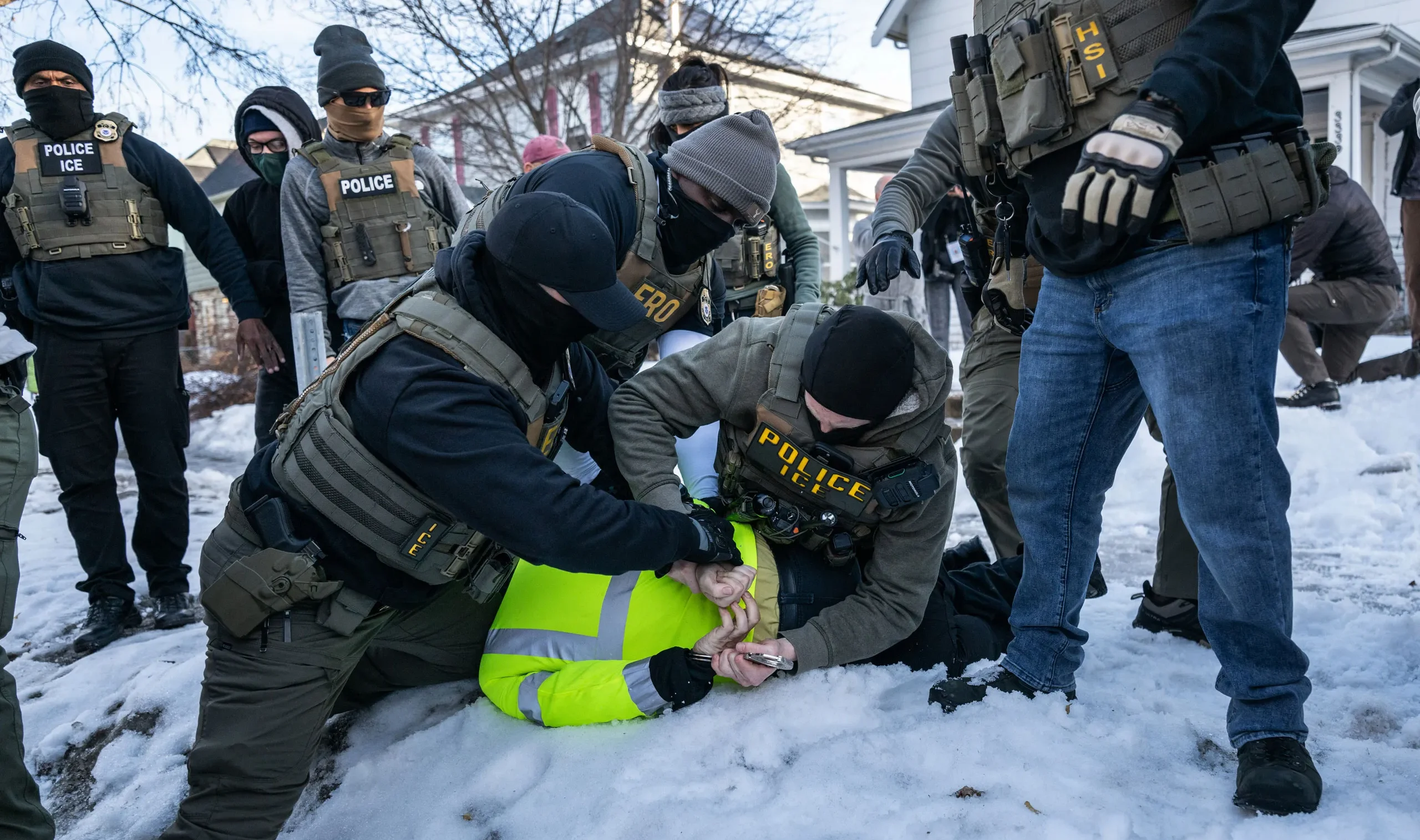
The fear of deportation can reach far beyond the people who are arrested. It can change how families spend their time, whether they feel safe speaking their native language in public, and whether an ordinary trip outside the house feels worth the risk.
U.S. Immigration and Customs Enforcement (ICE) was established in March 2003 as part of the federal government’s reorganization following the Sept. 11, 2001, terrorist attacks. Its responsibilities include enforcing immigration and customs laws, investigating cross-border crimes, and addressing threats to national security and public safety. The agency also carries out immigration arrests and deportations and investigates crimes such as human trafficking, drug smuggling, and financial fraud. It focused primarily on people with criminal convictions.

Since Donald Trump returned to office in January 2025, his administration has expanded immigration enforcement and increased pressure to arrest and deport undocumented immigrants, including people without criminal convictions. According to an analysis by the Migration Policy Institute of deportations during the second Trump administration, 71% of immigrants who had lived in the United States for at least two years before being deported had no criminal convictions.
For Maicol, a Highline College student coming from Colombia who has lived in the United States with his family for four years, the consequences of this enforcement extend into everyday life. “The fear of ICE deportations has limited the way we live our lives,” Maicol said. “We no longer go out much unless it is absolutely necessary, like for work or school.”
Family outings have stopped, he said, after people they knew were deported in recent months. The experience has left his family living with fear and stress. “The most challenging part has been living with fear and uncertainty,” Maicol said. “It feels like we are being watched all the time, and that is an incredibly frightening feeling.”
He also struggles with the feeling that his family’s contributions to the country do not protect them from suspicion. “One of the hardest things is realizing that, even though we work hard and contribute to this country, we are still treated with suspicion and fear,” he said.
The current administration’s immigration enforcement has also received a substantial increase in funding. Before the latest funding expansion, ICE operated on an annual budget of roughly $10 billion. New federal funding enacted in 2025 added approximately $75 billion for the agency over four years, bringing its potential annual funding to about $28 billion if the additional money is spread evenly across that period. The increase has made ICE one of the most heavily funded federal law enforcement agencies.
But the impact of immigration enforcement cannot be measured by budgets or deportation statistics alone. Rather, it could be measured in people who fear being detained and sent to a country where they may face persecution, uncertainty, and anxiety that becomes part of daily life.
I recently visited two people who had traveled more than 7,000 miles to escape Islamic extremism and ethnic persecution from a Middle-Eastern country. Both told me they had received orders of removal but had not been deported because, according to their accounts, their countries of origin had failed to cooperate with or respond to the U.S. government. After being released temporarily from detention, they continued to live with the fear that ICE could return and deport them any moment.
For them, the threat of deportation follows them even into their sleep.
“Deportation and being sent back to the country we fled is a constant nightmare,” they said. They described recurring dreams in which ICE agents arrested them. In those dreams, they sometimes cooperated with the agents and sometimes tried to escape, but the fear remained.
That uncertainty follows them into waking life too. They do not know when ICE might appear, or what they would do: surrender or run away.
Without work permits and with the possibility of being returned to a country they fled, they face not only practical difficulties but also an exhausting emotional burden. They came to the United States seeking safety, yet they continue to live with the fear of being sent back.
A June 2025 survey by the Pew Research Center found that Americans held mixed views of the Trump administration’s immigration policies, with significant divisions along party lines. While 54% disapproved of increasing workplace raids by ICE, 56% supported expanding the U.S.-Mexico border wall. Half of Americans said the administration’s deportation approach was too careless. Additionally, 46% believed the policies would weaken the economy, compared with 34% who expected them to strengthen it.
Maicol has developed his own way of trying to avoid attention: blending in. “I try not to speak Spanish in public and I try not to appear Latino, because that feels safer in many situations,” he said. “Even though that is sad, it is one of the ways I deal with the fear.”
For him, staying safe can mean hiding parts of his identity. The language he speaks and the way others perceive him have become considerations in deciding how to move through public spaces.
“What makes me feel unwelcome is the constant fear of deportation, the anti-immigrant attitude, and the feeling that I have to hide who I am in order to be safe,” he said.
Maicol wants the government to treat asylum cases more fairly and seriously, rather than making the process feel unpredictable.
His experience, alongside the accounts of the two people I visited, shows how immigration enforcement can affect people who have not been convicted of crimes and those who came to the United States seeking protection. The fear does not necessarily end when someone is released from detention, nor does it remain confined to the possibility of arrest.
It can follow people to school, keep families at home, turn a familiar language into a source of anxiety and make sleep another place where fear takes hold. For people living under the threat of deportation, the question is not simply whether ICE will come. It is whether they can live ordinary lives while wondering when it might happen.