
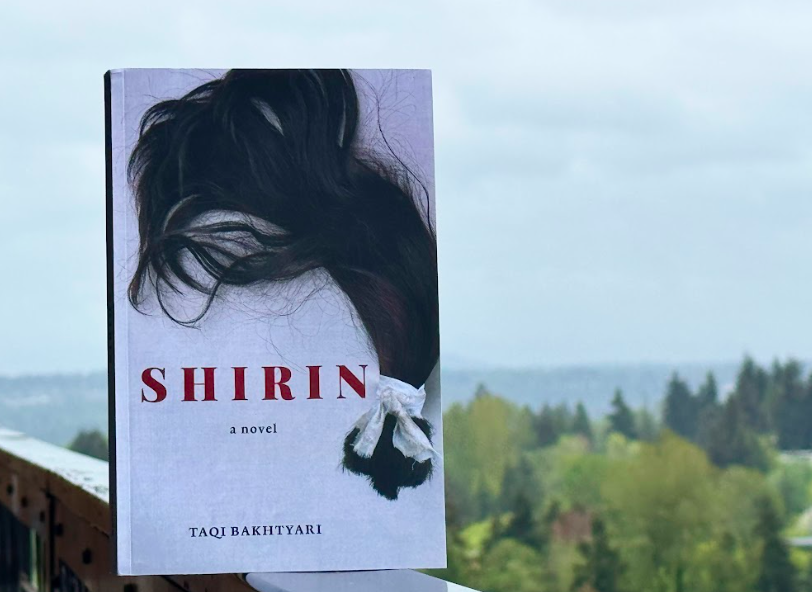
A review of “SHIRIN: A Novel” by Taqi Bakhtyari
I didn’t come to “SHIRIN: A Novel” for literature. I came because someone once said its author should be silenced.
In late 2012, Taqi Bakhtyari’s second novel, “Gomnami (Anonymity)”, sparked outrage in Afghanistan. A radical cleric called it blasphemy—for questioning religious authority, for suggesting that women, not God, are the true creators of life. That was enough to exile him. It was also enough to make me read his work.

What I found then—and again here—is a voice that does not ask for permission.
“SHIRIN: A Novel” is narrated by Aghai, a young Hazara woman living in suburban Sydney after fleeing Afghanistan in August 2021. She is officially a high school senior, though nearly twenty-eight. Her age is falsified by her father so she could enter Australia as a dependent and be married off later.
The novel is written as a diary across a single school year. But the present never holds. It keeps breaking.
It breaks into Parsiana—a fictional stand-in for Afghanistan—where her mother and her closest friend, Shirin, were killed by the Jahladeen, a religious militant group of tribal men. What remains is a single, stubborn mission: To return and carve Shirin’s name onto her gravestone.
In Parsiana, women’s names are not written. Not in public. Not even in death.
This is where the novel begins to press.
One of its greatest strengths is how it builds trauma into the structure itself. The past does not sit quietly behind the narrator. It leaks. A blood-soaked green skirt. Twenty-seven wounds on a mother’s body. Cries swallowed by gunfire.
Then the girls: Khorai, Dadai, Apai, and Aghai. Not called by their names, but by familial titles—each tied to one of the country’s main ethnic groups: Afghan, Tajik, Uzbek, Hazara. Identity reduced to category. Intimacy replaced by designation.
Khorai with her nose and ear severed. Apai given away for her father’s crime. Dadai gone forever after her mother’s stoning. These are not memories recalled—they are moments that refuse to end.
Patriarchy, here, is not local. It does not stay behind in Parsiana. It travels.
It travels in fathers’ hands, in their voices, in the way they say: “You must marry.” Or worse: “Your life—and your afterlife—is saved by this man.”
Aghai’s father is not drawn as a monster. He is more familiar than that. He believes he is protecting her. He arranges her future. He pulls her by the hair and invokes Allah while doing it.
Her life is decided by men. The diary is where she takes it back.
The character of Os, the only Parsiana man in her class, offers another face of the same structure. Publicly, he praises refugees. Privately, he carries the same rigid codes that produce them. He has signed up to be a pilot so that one day he can crash an A380 to Sydney Opera House. Os is not a contradiction. He is consistency in disguise.
Running quietly through the novel is the presence of Omar Khayyam, whose verses Aghai translates from a worn book hidden in her mother’s chest. Khayyam drinks from life—doubt and impermanence. The men around her drink from control.
This tension runs through everything: Between a world that insists on obedience and one that allows uncertainty, beauty, and choice.
And then there is Kylie. The Australian indigenous girl whose past and present parallels Aghai.
With Kylie, nothing is arranged. That alone feels radical.
There is no force, no script, no inherited command. Only attention, care, and the fragile freedom to be seen without being defined. Against everything else in the novel—coercion, silence, inheritance—this relationship stands as a quiet refusal.
“SHIRIN: A Novel” is not interested in comfort. It is interested in what remains after erasure.
Some names are never meant to be written.
This is a novel about one of them. And a girl who writes it anyway.