
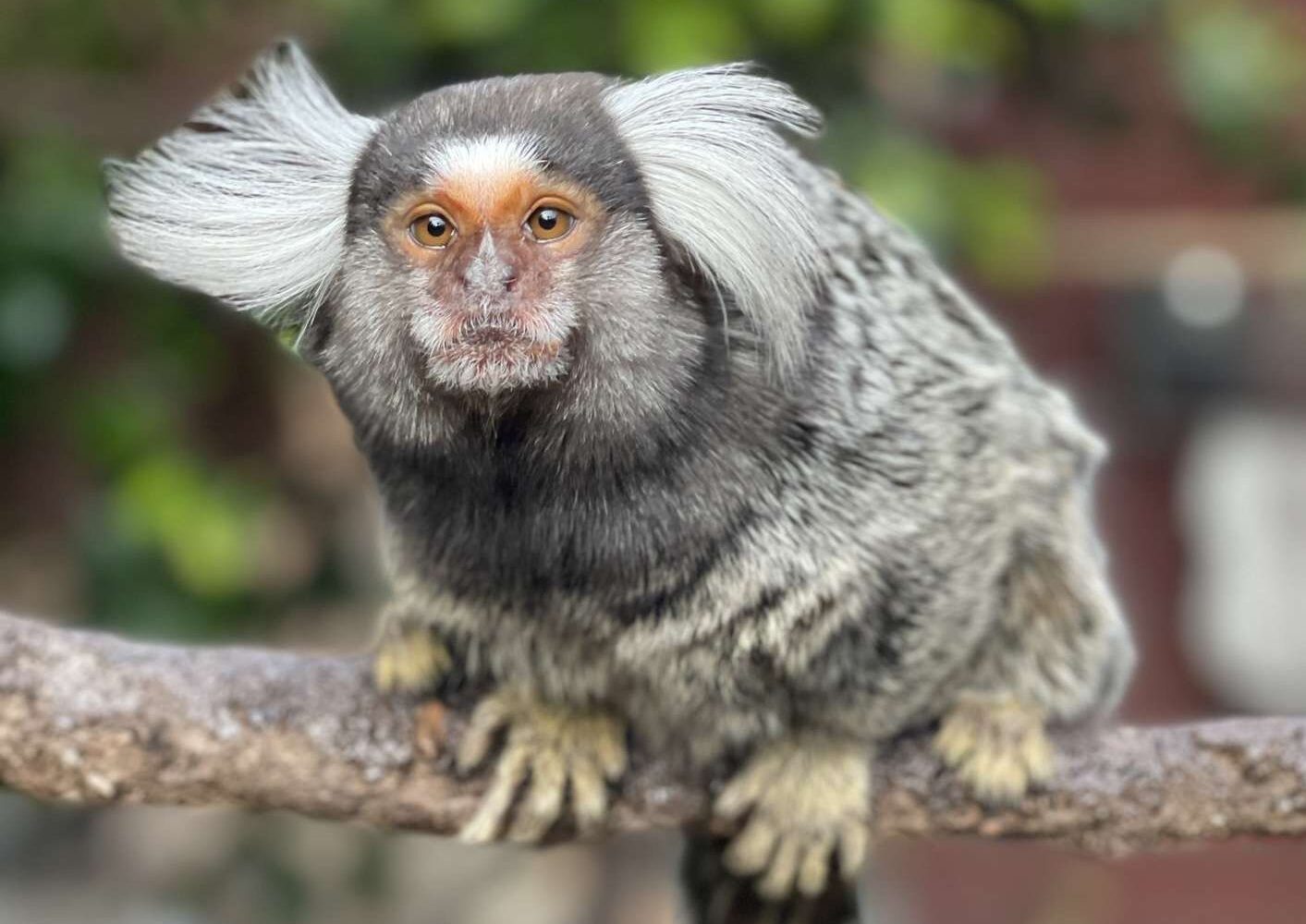
A new study has revealed that marmosets call each other by name. They are the first non-human primate to exhibit this behavior.
Marmosets are a small western monkey that lives in South America. They are very social animals, living in social groups of three to 15 individuals. They are frequently called “finger monkeys” on social media, due to their small size.

Paolo Honrade/THUNDERWORD
Marmosets call each other using what are called “phee-calls,” which are their version of names. These vocalizations are specific to each individual. They use these phee-calls to address and call each other in vocal interactions.
The way researchers discovered this was by putting a visual barrier in between two marmosets. They found that they will quickly start vocalizing, or talking, to each other. They tested the monkeys’ dialogue with other monkeys as well as a computer system.
When they were put with another marmoset, they used a phee-call that was specific to that individual. When they were put with a computer system, they did not use a phee-call to interact with the other.
In an European Research Council study, they found marmosets were able to distinguish between calls directed to them and calls not directed to them. They also found that marmosets used similar sounding calls for individuals in the same family. This discovery gives us insight into how human speech could have evolved.
The only known species, before this study, that vocally labels the other individuals in their species are humans, elephants, and dolphins. This has never been seen in a non-human primate before, marking a higher level of cognitive function than previously thought.
Primates are an order of mammals including monkeys and apes. Monkeys are characterized by tails and their smaller size. They also have more species within the monkey suborder.
Apes do not have tails and are larger with larger brains relative to their size. Apes mainly swing, having more mobility in their shoulders, while monkeys run along branches using their tails for balance.
Common marmosets’ bodies are 15 to 25 centimeters in length and their tails are 25 to 40 centimeters. These monkeys weigh 230 to 260 grams. The sister species to the marmoset, known as the pygmy marmoset, is the smallest monkey in the world. Its body is 12 up to 15 centimeters long with a tail that is 17 to 23 centimeters long.

San Diego Zoo
Marmosets’ subspecies the pygmy marmoset are a smaller variety of the marmoset, but differ in ways more than size. Pygmy marmosets weigh only 85 to 140 grams, which is about the same size as a single serving of tuna. Pygmy marmosets diet mainly consists of tree sap, while marmosets have a varying diet of sap, fruits, insects, and small vertebrates.
Due to their small size, they can be prey to cats and snakes. They have evolved to turn their head backward to try and avoid these predators. Although they are the smallest monkey in the world, they are not the smallest primate. The smallest primate in the world is the mouse lemur.
Marmosets are commonly kept as pets despite their unsuitable nature in private ownership. They are easily found and bought online, with no prior knowledge of care for these animals. Marmosets are very social creatures, seen in their social groups and their development of names for each other.
This cannot be achieved in private captivity, mostly due to the high costs of buying and owning even one marmoset. These animals are often kept singularly as seen widely throughout social media. This not only harms the animal’s mental state, causing severe psychological distress and abnormal behavior. This trend is seen in other species as well like rabbits.
The owning of marmosets, especially in singularity, is inhumane. Marmosets should not be kept or bred in private ownership for the wellbeing and health of the animal.
The discovery into the evolving communication of marmosets is insightful into how human speech evolved. This is monumental into the history of human evolution as well as the ongoing evolution of primates.