
Championing mental health and education for women in Afghanistan
River Ahmad was the only woman on a bus travelling to Kabul, when Taliban stopped them on the road. They didn’t negotiate or demand anything. They just opened fire because the passengers were Hazara.
In the chaos that followed, River Ahmad made a decision that would save her life. She was on her period. She took her own blood, smeared it across her face, and played and pretended to be dead. She listened as the gunmen moved through the bus, checking bodies. She heard one of them look at her and say, “Look, we killed a prostitute.” She did not move. Motionless, silent, breathing as shallowly as she could. By the time people arrived at the scene, twelve passengers were dead. River was one of three survivors.

Sandro Gromen-Hayes
She shared this story in several videos and in an interview with New Lines Magazine and CNN. “I always carry that part of the attack with me. Sometimes in my dreams I see two gunmen coming for me and trying to kill me.”
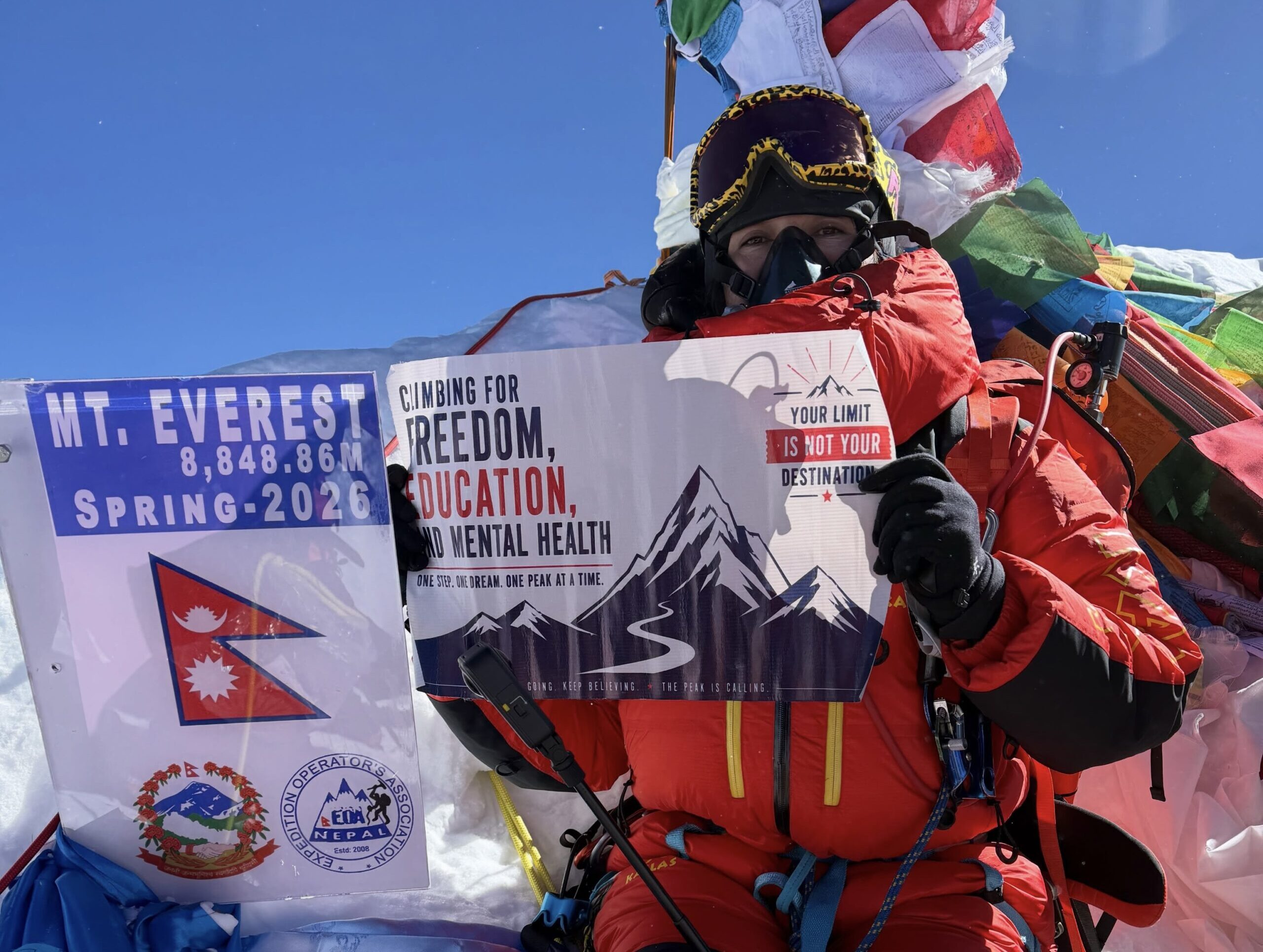
On May 21, 2026, River Ahmad stood on the summit of Mount Everest. At 8,849 meters above sea level, she became the first woman from Afghanistan to reach the highest point on Earth. She was crying, she said. Not just from the altitude or the exhaustion, but from everything the climb had carried with it: a devastated country, a lost brother, millions of silenced women.
She dedicated the journey to mental health awareness and to the education of women and girls in Afghanistan. For her, the mountain was a platform to tell a much bigger story.
River was born in the 1990s in the Jaghori district of Ghazni province — a mountainous, predominantly Hazara region in central Afghanistan. She grew up in the years after the first Taliban regime fell, when girls were briefly allowed to go to school again. She walked four hours a day to attend classes, often returning home to farm, tend livestock, and help raise her younger siblings. As the eldest child, the weight of the family fell disproportionately on her.
She was not supposed to climb trees. She was not supposed to jump from heights. In that context and at that time, it was not something girls did. Her mother would stop her. But the mountains were always there, holding the horizon, and she always looked at them.
After finishing school, River moved to Kabul. She studied journalism, then won a scholarship to India, where she eventually earned a master’s degree in international relations while working night shifts at a call center to support herself and send money home.
In 2022, River and her family arrived in Australia on humanitarian visas. Six months after the family settled in Australia, River’s younger brother, Ahmad Wali, died by suicide.

Sandro Gromen-Hayes
She has spoken carefully about what followed — not because the grief was private, exactly, but because the subject itself is surrounded by so much silence. In Afghanistani society, as in many others, suicide carries shame. Even in her own family, they struggled to say plainly what had happened. That silence is part of what drove her toward the mountain.
“By summiting Mount Everest, I hope to raise awareness about this deeply important issue and encourage people to recognize that mental and emotional struggles should not be hidden. We must create a culture where individuals feel safe seeking help and where conversations about mental health are met with understanding rather than stigma,” she said to Etilaatroz.
According to one of her fundraising organizers, she shared a painful reality: families sometimes struggle even to acknowledge a loved one’s death by suicide because of the shame attached to it. By climbing Everest, she hoped to spark conversations that many people avoid — conversations about grief, depression, trauma, and the importance of seeking help without fear of judgment.
After Ahmad Wali died, River stopped. For a period, she said in a interview in Persian language that she was homeless. The brother she had been closest to was gone, and the shared world they had built around conversations about nature, the future, mountains they would climb together someday — all of it was suddenly only hers to carry
She found her way back through the mountains.
“My grief and hardships had crushed me,” she said in a interview with Etilaatroz. “The mountains were my last refuge. When I returned to them, I felt they accepted me with all my sorrow, and I found my lost self again.”
There had been a moment, she recalled, when she and Ahmad Wali stood together on a hill and looked out over the valley below. He had told her, “Look how beautiful nature is. The Alps and Everest would be even more breathtaking.” She had promised she would climb them with him.
She would keep that promise.
Training for Everest while working part-time at a radio station and studying full-time does not leave much room for anything else. River fundraised, took extra jobs, and put every spare dollar toward expedition costs. The Baba Mazari Foundation was among those who supported her. At base camp on Mount Meru, she held up a small handwritten sign that said, “From Afghanistan to Mt. Everest. Climbing for women’s freedom, education, and mental health worldwide.”

When her lungs burned and her legs trembled and the altitude stripped oxygen from every breath, she said she thought about the women she was climbing for — the women who would never have the chance to try. “When my energy fades,” she wrote to New Lines Magazine, “I think about the women I’m climbing for. And I have a chance to try harder even when they don’t have that.”
In Afghanistan today, girls are barred from education past sixth grade. Women cannot hold most jobs. New Taliban regulations appear to be institutionalizing child marriage. The world, as River sees it, has largely turned away. She has not.
When River looks at a mountain, she says she sees her past. She grew up in a mountainous place. The connection is not metaphorical — it is in her body, in the way she moves through altitude and cold and silence. But she is aware that the journey has become bigger than herself. Being the first woman from Afghanistan to summit Everest means something specific. To stand at the top of the world as a Hazara woman is not just a personal achievement. Because the Hazara people have faced centuries of persecution in Afghanistan, and under the Taliban they face it again.
“I did it,” she said after the summit in a video, “to remind women of Afghanistan that everyone can do the same. That you can summit every kind of mountain — and every kind of obstacle.”
A girl who walked four hours to school. A teenager who played dead to survive. A woman who rebuilt herself after loss, learned to flow like a river, and carried with her, all the way to the roof of the world, the faces of those who could not go. From a village in Jaghori to the world’s highest mountain, standing above the clouds, River’s journey reflects the strength of a woman who transformed grief into purpose and refused to let hardship define her future.
Summiting Everest by itself is not the most remarkable part of this story. Every year, climbers reach the peak. What makes River’s achievement extraordinary is the road that led her there and the story behind it.