
The three different movie adaptations of the Richard Matheson novel I Am Legend are three different beasts with their own victories and failures.
All three films share the same general plot. Each film follows a doctor who is, to his knowledge, the last living human on earth because of a disease that either killed or turned everyone else into a vampire-like creature. The doctor has since made it his mission to hunt down the creatures during the day (since they hibernate at that time due to being sunlight sensitive) and find a cure for the disease.
The first adaptation, The Last Man on Earth (1964), stars Vincent Price as Dr. Robert Morgan.
The film follows Morgan in his day-to-day life as he tries to survive and kill all the creatures in New York. He is also forced to contend with the crippling loneliness of being the only human on earth, and the creatures trying to break into his house every night, taunting him while doing so.

The film is held up by Vincent Price’s excellent acting. In this film Price is a lot more subdued and less over the top and bombastic than in his usual roles. There are greatly acted moments where the audience can tell Morgan is on the verge of tears and on the edge on going insane due to the constant strain he is under.
Something that’s interesting about the film is that it doesn’t go into much detail about some key facts. For example, it’s never stated definitively where the disease originated from, only that it came over from Europe. This is fine, as it allows the film to keep the intrigue on how this all really started throughout the film.
Or why Morgan is immune. Near the end he theorizes that while he was working down in Panama during his youth, a bat bit him while he was asleep, and that this bat had an early strain of the virus that his immune system could fight off, allowing him to build up an immunity to the virus. While a bit underwhelming and contrived, it’s a good enough reason to explain why he’s immune, and also realistic enough to not break the suspension of disbelief.
The creatures in the film are a mixture of zombies and vampires. They have several vampire traits: They must stay out of the sun or they will die, are repelled by garlic, can’t look at themselves in the mirror, can only be killed through a stake through the heart, and they retain their ability to speak. However, they shuffle around and move stiffly like zombies.
The monsters just aren’t very intimidating. At several points in the film Morgan is absolutely surrounded by the monsters but he pushes them away like they’re a mere nuisance and not a real threat.
Another problem that the film has is the overuse of narration in scenes that can speak for themselves. A great example of this is at the beginning of the film, the audience sees a bunch of makeshift calendars drawn on the wall. And, instead of allowing the audience to infer that he’s been like this for a long time, the film’s narration just tells us that he’s been at it for four years.
There are some other minor issues, a big example being, for it being called The Last Man on Earth, you can swear you can see some cars driving in the background.
The Last Man on Earth, while a bit dated and sometimes doesn’t know when it’s a good time to be quiet, has a strong enough performance by Vincent Price to be worth the watch.
A second adaptation was made in 1971 titled The Omega Man, and starring Charlton Heston as Dr. Neville.
The film takes place in California, and follows Neville as the last human on earth after Russia and the U.S. used biological weapons to try to wipe each other out. But things got out of control and the weapons either killed everyone or turned them into vampires.
Neville spends his days simply trying to survive and keep himself sane, while also trying to hunt down a nest of vampires, simply called, The Family, led by a vampire named Matthias (Anthony Zerbe). However, halfway through the film it turns out there is a small group of human survivors being led by a woman named Lisa (Rosalind Cash), who are resistant to the plague, but not immune. So Neville needs to make a cure, try to find a way to destroy The Family once and for all, and stave off his own boredom before it’s too late.
The film takes the most liberties from the source material. The biggest example is that there are other humans running around. In both the book and The Last Man on Earth, the protagonist is truly the only living human on earth. Thankfully the new human characters are at least likable and fun to watch.
Charleston Heston, while not as dramatic or as subdued as Vincent Price’s take on the character, still does a good job portraying the absolute loneliness and boredom he feels every day, just trying to keep himself entertained enough to not go mad.
The movie is very ‘70s. Lisa is rocking an afro, everyone (save The Family) is wearing something not out of place in a disco parlor, and the soundtrack is down to get funky. One wonders what killed them first — boogie fever or the disease? The tone is distracting, but adds its own sort of charm.
The vampires in this film are thankfully much better done in this film compared to the previous film. The Family feels much more like a credible threat, they plan ambushes, use tools, and use manipulation and deception to their advantage. They don’t look or act different enough to really feel like a new species; they seem more like a dangerous cult that’s just into wearing white face paint.
The film probably has the best reason why the main character is immune in all the films. It’s explained in flashback that while the disease was breaking out he made an experimental vaccine and was taking a helicopter to test it in the lab, but during the transport the pilot caught the disease and died mid flight, causing the chopper to crash. Out of desperation, Neville takes the vaccine realising he probably has the virus too. While more over the top, it’s a way more interesting reason than just, “a bat bit me.”
The Omega Man feels more like it’s own thing, which can be a good or a bad thing depending on how a person looks at it.
The third and final adaptation of the novel, I Am Legend (2007), is named after the original novel itself and tries to do a modern retelling of the story.
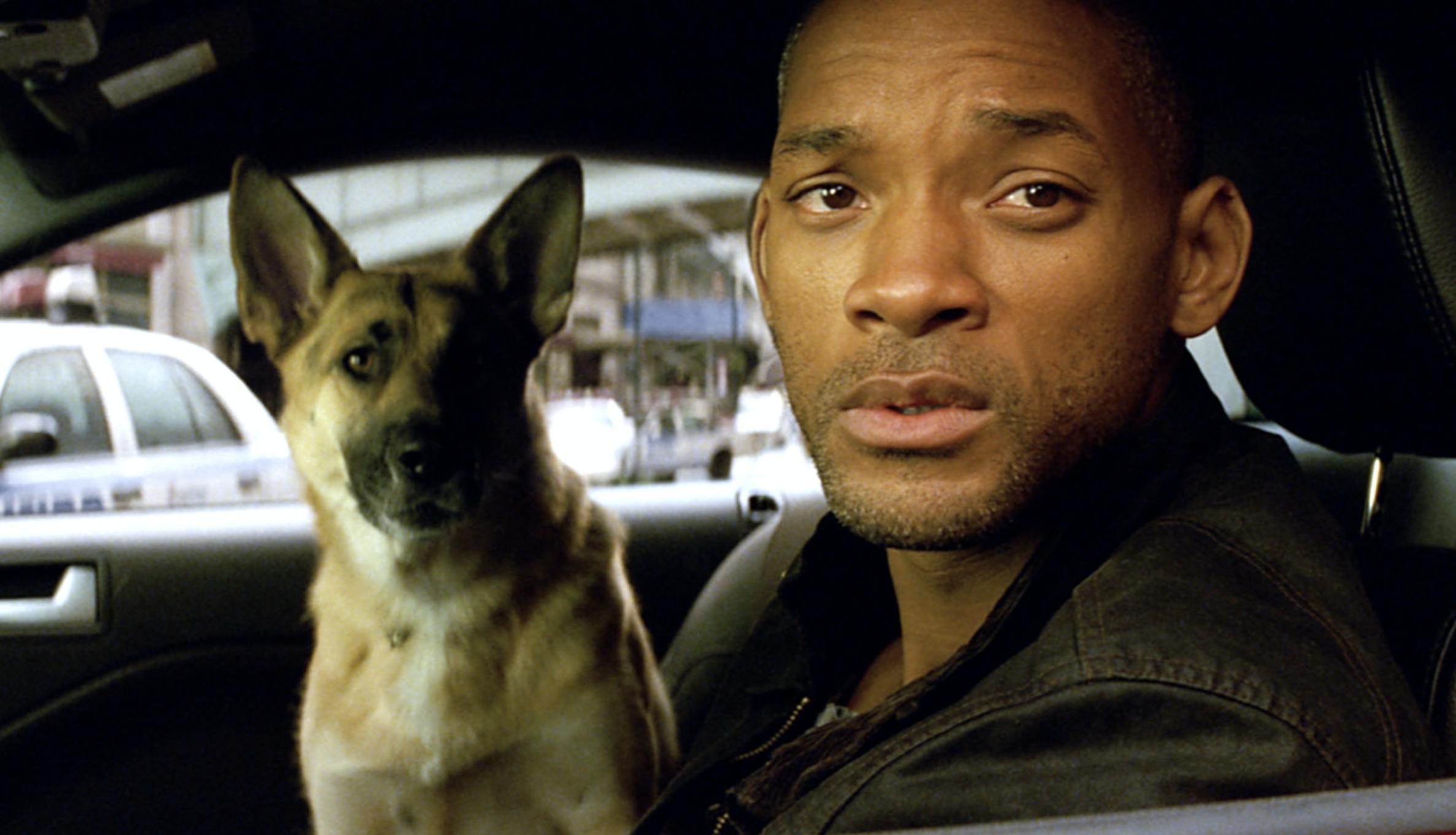
It’s now 2012, Dr. Robert Neville (Will Smith) and his dog Sam (played by a German Shepherd named Abby) are, aside from the wild animals roaming around, the only uninfected creatures in New York. The disease either kills the host or turns into creatures known as Dark Stalkers. Neville and his hound try to survive in this new world by scrounging for supplies and hunting animals, while at the same time Neville is trying to find a cure to the disease.
While the film does take some liberties from the book, most of them are pretty clever updates. For instance, the disease is a mutated type of measles originally genetically engineered to cure cancer, but it got out of control and mutated. Another great change is the inclusion of the dog Sam. It allows Will Smith to use his natural charisma, while avoiding the narration problem from Last Man on Earth.
The creatures in the film are the least interesting out of the films. They’re just zombies that get sunburned really easily.
The film would probably be the best out of all the three, if it wasn’t for the ending. Without spoiling anything, it completely ruins the tone and pathos the story was going for. Instead of the film being this dark and introspective look on humanity and its relationship to the food chain, the movie is now just some generic zombie flick. The original ending was much more in line with the book and the tone the film was going for, but the studio thought it was too depressing.
All three adaptations of I am Legend are good movies in their own right with different strengths and weaknesses.