
Many students incorporate AI usage into their everyday lives, making their skills and thinking more advanced, but less original and genuine. Their usage of AI can benefit their motivation, but can be a pathway to procrastination and thinking that AI is a shortcut through expanding and gaining ideas.
The article “AI Adoption is Nearly Universal Among Students, but Confidence is not” by Digital Education Council, states, “67% of students report using AI daily or weekly, indicating frequent AI use embedded in everyday learning. Amongst students who report frequent use of AI, ChatGPT emerges as the most widely used AI tool, with 88% using it in their studies. In addition, students report using a range of other AI applications, including Google Gemini, NotebookLM, Grok, and Claude.”

Sierra Mukudi / THUNDERWORD
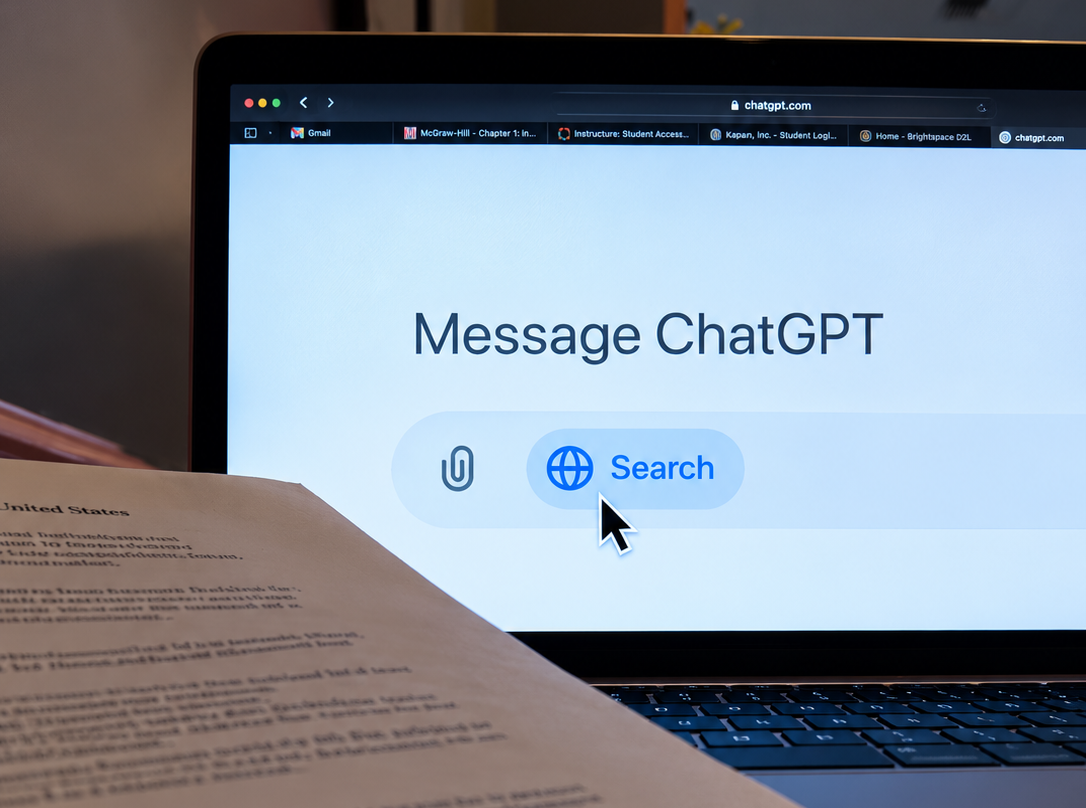
A student contemplates using ChatGPT.
There are positive aspects of students applying AI to their everyday lives. The article, “The benefits of AI in education” by CIS University, highlights that students find AI as a tool they can easily rely on. The article describes the benefits and challenges of using AI in education. AI can personalize learning, automate administrative tasks, and improve accessibility to educational resources.
The article supports this claim by saying, “AI allows adapting study materials to the level of each student. This means that each individual can learn at their own pace, strengthening their weaknesses and advancing in areas where they show greater ability.” However, it also raises concerns about technological dependency, privacy issues, and the potential depersonalization of education.
With the positive aspects of AI also comes limitations and downsides. When students incorporate AI into their learning, the process of utilizing critical thinking, problem solving, and originality, tend to decrease. The ideas taken from AI are not original work but are secondhand ideas.
These aspects can encourage false information amongst these algorithms. And these factors can reflect unreliability and inconsistency. The article, “Limitations and Risks – Generative Artificial Intelligence” by the University of Reading, interprets the potential effects of the issues AI has on society. The article posits, “They can produce false information – for example, pieces of fictional news or, in academic texts, made-up citations – and they also present this false information in a very factual tone.”
“AI has affected my education by integrating itself into our systems. For example grading, detecting academic dishonesty, and background activity,” said Carmella Guerrero, a full-time Running Start student who answered questions regarding her personal usage of AI. “I do not personally use AI within my work, however, I do use grammar systems as well as run my writings into AI systems for spelling checks and suggestions, without it considerably altering my own writing. I do not personally use AI to come up with ideas, use informational sources or to generate answers to my assignments.”
“AI can limit a person’s originality in writing through gradual dependence on AI over time. Slowly lowering a person’s ability to think critically and make self-made decisions, as well as a person’s trust within their own judgement and problem solving skills,” said Guerrero.
Societies’ take on AI usage varies based on individual perspectives. Many include concerns regarding unemployment rises, the environmental effects of using AI, impacting decision making, and many more concerns about AI taking over many components of people’s lives. While using AI can be a rather positive aspect of a student’s school life, there are limitations that can be crucial to a person’s ability to not be dependent on AI for guidance and support.