
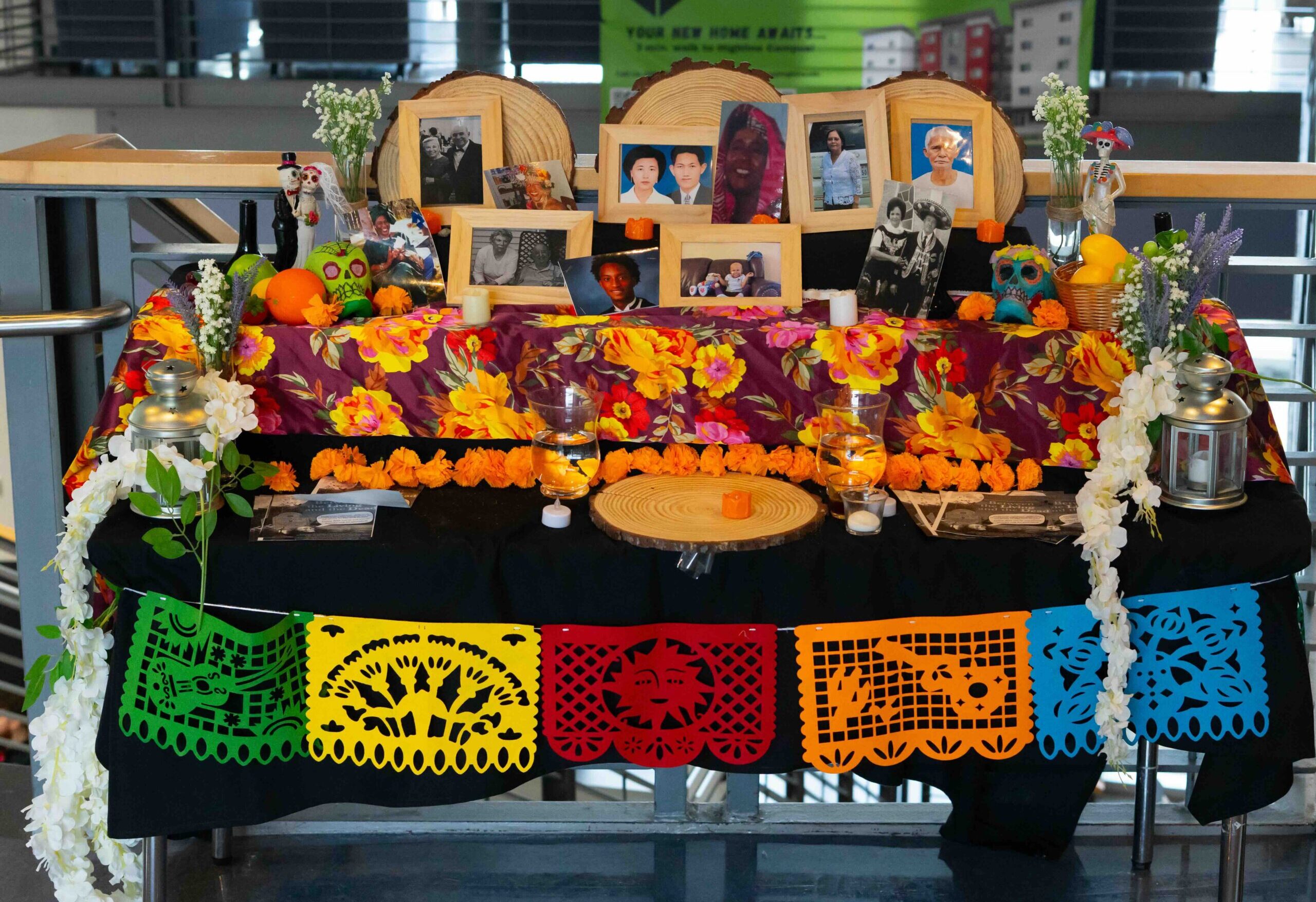
All of humanity across the world’s various cultures have different attitudes, traditions, and folklore surrounding what comes after death. Who draws the line between the living and the dead?
Between the Living & the Dead was part storytelling, part crafting, and fully community building. The event was held from 2:30 p.m. to 4 p.m. in Building 8’s Intercultural Center (ICC). There, attendees had the opportunity to learn about other cultures’ perceptions of death as well as sharing their own.
After a brief ice breaker, both Global Student Ambassadors and student leaders with the ICC took turns telling ghost stories from their respective cultures. Stories included Pishtaco, the mountainside serial killer of Peru; Mami Wata, a West African water spirit; Maria Labo, a woman from the Philippines who murdered (and possibly ate) her family; and La Llorona, a ghost of Latin American origin who drowns children as a form of revenge.

Melany Velasco / THUNDERWORD
For brevity’s sake, not all the stories could be included in their entirety, but here’s a taste. This is the story of La Llorona, as told by Mauricio Tamayo Gallegos:
“Maria was a beautiful woman who knew not to marry a man from her village, she wanted to marry someone richer. Eventually, she found a wealthy and handsome man who she was attracted to. They got married and had two sons. They had been very in love, but over the next few months, things started to change.
The husband started disappearing month after month, and when he came back to the village, he would only acknowledge their sons. On a random day, the husband came to the village in a carriage with a different woman.
Maria was furious.
She was furious and filled with jealousy, so that night, she lured her two sons to a nearby river and drowned them in rage. After realizing what she had done, she drowned herself out of regret. Later that night, the villagers found her body and dressed her in all white.
Now, legend has it that she roams around in Latin America, looking for her kids. ‘Mis hijos…mis hijos…dónde están mis hijos?’ translating to ‘my sons…my sons…where are my sons?’ Her grieving ghost searches for her kids, and people say she kidnaps kids, thinking they’re hers. When she finds out they’re not her sons, she drowns them as well.
That’s just one version of the story, there’s another version where she finds drunk or lonely men and drowns them as well as revenge on her husband, so, if you ever see her, you may suffer the same fate.”
The ghost stories were bone chilling, but they aren’t the only way one could view death. Many cultures see death as a continued state of being for those who have passed away and create rituals to honor their deceased.
A few of these rituals are lighting lanterns, creating special masks, and giving significance to the marigold flower. In Japan and China, lanterns represent hope and peace and their light can guide spirits to where they need to be. In much of Africa, masks can be used to provide safe passage of the soul from the body, or as a status symbol. In Mexico, marigolds are used to decorate ofrendas and guide spirits back home so that they can visit their families on Dia de los Muertos.

Melany Velasco / THUNDERWORD
To close out the event, participants could choose whether they would like to make a lantern, crepe marigold flowers, or a mask.
Stevyn Lang, a Global Student Ambassador, reflected on collaborating with the ICC, Cambodian folklore, and how her expectations were exceeded.
“This was our first time working together. It’s also our first time working as a GSA team, so obviously it started out on a rocky road,” said Lang. “Because we aren’t familiar with each other yet, communication was one of our problems, but we did work things out later on. Once we understood each other’s techniques and work ethics, we were able to get it done.
I’m really glad that it actually worked out, because on my way from class, I didn’t have high expectations. I was thinking ‘what if three people show up?’ I’m glad at least 10-20 people showed up.”
Lang was unable to present her folklore to the attendees because of a schedule conflict, and, while she swears her scary story is best experienced face-to-face, she agreed to divulge a bit about Cambodian traditions around death.
“In Cambodia, we think that death isn’t the end. The people who passed away will always, spiritually, be there for us,” she said. “During [October], in Cambodia, it’s Pchum Ben, and that’s a tradition we do every year where we go to a pagoda [a temple] for fifteen days straight. Some people wake up really early in the morning, around two or three in the morning, to go to the pagoda. They throw rice around the pagoda to give out food to the people who’ve passed away.
We also have this belief where, when you’re alive, you have to do good things, because if you do bad things, [when one passes away they] turn into this thing called Pret. That’s why people wake up early, because if any of our ancestors don’t make it to heaven, they become Pret and this is the only time they get to eat food.”
Lang believes that, despite the growing pains of two departments converging for the first time, things went well. “I’m glad [the speakers] pulled it off, because I’ve seen them practicing a lot, and I’m really pleased there are a lot of people coming in still. Like I told you, I didn’t expect anyone to come. Maybe it was just the first-event nerves,” she said.
Indeed, Between the Living & the Dead enjoyed growing attendance until its closing at 4 p.m. Whether it was the promise of crafts, spooky stories, or just a community space, many find themselves longing to hear theories about the question no living creature can actually answer.
Death is the only inevitable part of the human experience. It comes for everyone and there is nothing anyone can do to avoid eventually meeting theirs. In a time of such division, there’s something comforting about the fact that, in the very end, humanity has at least this in common.
There’s also great beauty in the way that, depending on who they have known or where they have grown up, the culture and time they were raised in, one person can view death in a completely different way than how someone else may. Death rituals function as a mirror of the origin story – every culture has one, and all of them are irreplaceable.