
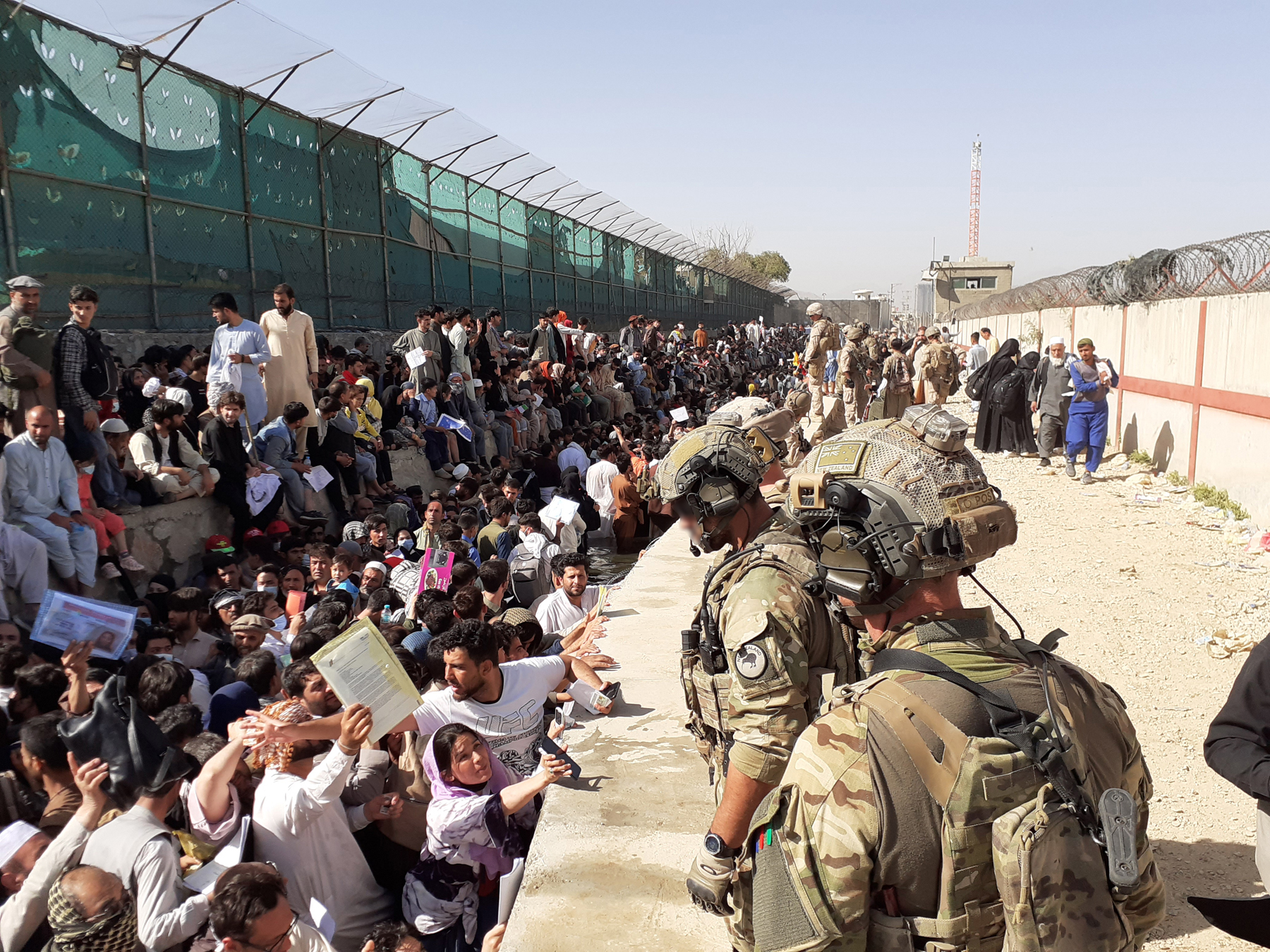
On Aug. 15, 2021, when the U.S.-backed government collapsed and the Taliban took control of Afghanistan, one of the first places where the consequences became visible was Kabul’s international airport.
Tens of thousands of people rushed to the airport, desperate to leave. Some were fleeing fear of the Taliban. Others were searching for a way to reach what they believed would be a safer and better future in the Western world. The chaos at the airport produced some of the most enduring images of that moment in history — images of desperation, foreign intervention, government corruption, and the resilience of a terrorist group that had fought its way back to power.

Screenshot from a video/Facebook
After the collapse, following the Trump administration’s 2020 deal with the Taliban, the Biden administration helped evacuate Afghanistanis who were considered vulnerable due to partnering with the U.S. in Afghanistan. Through an initiative known as Operation Allies Welcome, more than 100,000 people from Afghanistan were brought to the United States over roughly a year. Thousands of them have resettled in major cities, and many of them are now studying at Highline College.
I was one of them.
I arrived in the United States at the end of November 2021. Personally, my journey went relatively smoothly. But for many others, the story did not end with their arrival in America.
For three years, I lived with two roommates whose wives remained in Kabul. Their wives were in the process of coming to the United States when changes to immigration policy under the Trump administration interrupted their journey in 2025.
The women had traveled to Islamabad, Pakistan, hoping to continue the process of joining their husbands in Seattle. Then they were forced to leave Pakistan and return to Kabul. Their lives were suddenly placed in a state of uncertainty. They had already left one country behind, but they had no clear path to the country where their husbands were living.
A woman who entered the United States through the southern border in 2023 described her life to me in a simple phrase: being in limbo.
She asked not to use her name because she was worried about speaking publicly about her situation. “I have nothing going forward and no bridge to go back,” she said. “I am now in limbo.” That uncertainty is perhaps one of the most painful parts of many immigrants.
Another family I know (a mother and her five children, including two adult children and three younger ones) recently experienced a tragedy of their own. Their father had been unable to leave Afghanistan with them in 2021. His process of coming to the United States was later suspended by changes in immigration policy under the Trump administration.
According to one of his children, their father recently died of a heart attack after years of anxiety, depression, waiting, and uncertainty related to being separated from his wife and children.
I saw the family here and felt their sorrow. For them, immigration was not simply about paperwork, visas, or government decisions. It was about a father who was not there when the family needed him the most.
For more than two years, I have worked as a community and system navigator, helping immigrants from Afghanistan understand public systems and adjust to life in the United States. Through this work, I have seen many other difficult cases connected to changes in immigration policy. One of the biggest problems is not necessarily the policy change itself. It is the uncertainty that follows.
People whose immigration cases were already in process but have now been stopped or delayed often do not know what will happen next. They wait for years without knowing whether they should continue building their lives in the United States or prepare to leave.

Boris Roessler/DPA via AFP
I once helped a family apply for public benefits and translate medical documents and letters. One of the family members told me, “We just want to understand what the final decision will be so we can decide whether to stay here or leave. They brought us here and now put us on hold.”
“There should be a policy that is not changing every year or in every administration and impacting millions of lives,” the mother of the family said. “We are not just numbers. We are humans with real feelings, backgrounds, connections, and humanity.” Her words stayed with me.
As I have followed immigration trends for many years, one of the most troubling aspects has been the politicization of immigration. This became especially visible during Donald Trump’s presidential campaigns, when immigrants were often discussed as a political category rather than as individuals with families, histories, and hopes. Political rhetoric can turn complicated human realities into simple slogans, and fear can become a powerful tool for gaining public support.
Every country has the right to decide who can enter its borders and under what conditions. A country may choose to restrict immigration, accept fewer immigrants, or make long-term changes to its immigration system according to its interests. But immigration policy is ultimately about people.
Behind every application is a family waiting for an answer. Behind every visa is a person hoping to reunite with someone they love. Behind every policy change are people who may have to change their plans, their homes and sometimes the course of their lives.
The United States has the right to decide its immigration policies. But it also has a responsibility to consider the human dignity of the people affected by those decisions — the diversity of its communities, the families caught between borders, and the country’s ethical responsibility and image in the world.