
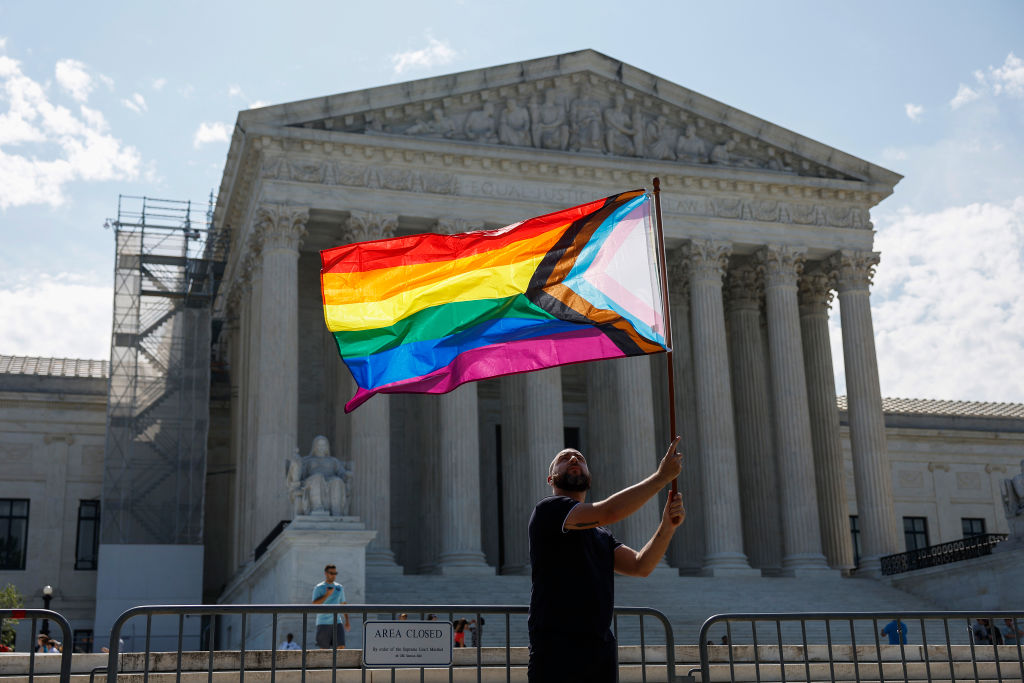
The Supreme Court ruled in an 8-1 majority against a law that banned conversion therapy in Colorado, siding with Kaley Chiles, a Christian teen counselor who “argues the law banning talk therapy violates the First Amendment. The justices agreed that the law raises free speech concerns and sent it back to a lower court to decide if it meets a legal standard that few laws pass,” according to AP news.
Conversion therapy is a type of “talk therapy” that is used with the intent to change or alter someone’s sexual orientation or gender identity so that the person is then cisgender and straight.
Colorado is known as a ‘safe state,’ and this ruling is another attempt of a stacked court to harm LGBTQ+ youth. Colorado is one of 23 states with bans on conversion therapy. The Supreme Court ruling sets a scary precedent for all of them to be struck down.
Justice Ketanji Brown Jackson being the sole vote against it. Jackson’s reasoning against the ban reversal was that because Chiles is a talk therapist, she is technically a healthcare professional.
This means that when she conveys ideas to her patients, her speech “is instead ‘incidentally’ restricted due to a State’s otherwise legitimate regulation of the medical treatments being offered to patients,” and that Chiles, “is simply being held to the same standard of care that all other licensed medical professionals in that State must follow.”
In her 35-page dissent, Jackson wrote, “Not only is conversion therapy ineffective, former participants report that it causes lasting psychological harm. Gay and transgender children who underwent nonaversive conversion therapy say they were taught to feel shame and self-hatred. Survivors continue to suffer from PTSD, anxiety, and suicidal ideation. As one survivor put it, conversion therapy ‘came close to killing me.’”
In a 2007 review of the research surrounding conversion therapy, the American Psychological Association found that “there was very little methodologically valid research” on sexual orientation change efforts.
In the Opinion of the Court, Justice Neil Gorsuch stated, “While the First Amendment protects many and varied forms of expression, the spoken word is perhaps the quintessential form of protected speech. … As a talk therapist, all Ms. Chiles does is speak with clients; she does not prescribe medication, use medical devices, or employ any physical methods.”
The court believes that because she is only talking with her patients, then the First Amendment protects her speech, meaning she freely suggest and employ conversion therapy strategies in her practice.
Colorado House immediately responded, pushing legislation to allow people to file civil claims against licensed mental health professionals.
The internet became predictably outraged at the ruling across social media.
One instagram user, @aleshalynn2, commented, “How did only 1 justice vote no on this? Conversion therapy is not effective and just harmful.”
On reddit, @cannotberushed on r/therapists, stated that, “Studies show kids who go through conversion therapy are more than twice as likely to attempt suicide. Every major medical association opposes it. Science is clear.”
Another comment on r/therapists by @kdash6 wrote about how upset they were by this decision, and “it almost makes me want to set up a conversion therapy to turn people gay just to show the courts how stupid this is … according to the Court, it’s okay to gaslight and abuse a child to make them straight because that’s free speech, [but it’s] not okay to tell a child about the existence of gay people because that’s not protected speech,” potentially referencing ‘Don’t Say Gay’ laws and book bans on LGBTQ+ stories.
Another instagram user, @zachxparks, said “Of all the things wrong with our country this is the bullshit they waste their time on. Something that effects less than 1% of the national population.”
The negative effects of conversion therapy is well documented. Sami Tacher, a Seattelite who went through conversion therapy as a teen under religious pressure, wrote in Uncloseted Media, “The program turned my mind into a hostile environment. I was taught that my body would betray me and that a crush was a spiritual emergency. I monitored my eyes, my thoughts, my friendships, my fantasies, my posture, my tone and my body. And because I had never been with a boy, I told myself it must be working. I was miserable and shrinking inside—but I was holding on.”
Tacher writes about how, at 12 years old, his dad told him that God would never love him again for being gay. Intimidated and scared of persecution, Tacher went looking for a way to comply. “When I found conversion therapy at 15, it felt like the answer.”
Tacher said about the experience, “Anxiety became a permanent condition.” Not only was the anxiety lingering, but Tacher was also having suicidal thoughts consistently by age 17.
A few years later after an interaction with the grocery bagger at the supermarket, Tacher came to the realization that he was never going to be attracted to women, and “at the same time, cracks were forming in my family’s faith … I remember the relief when [Dad and I] were sitting in our old house, reading scripture and arriving at the same conclusion: The condemnation we had built our lives around was not as clear, or as holy, as we had been taught. The Bible didn’t condemn homosexuality like the church said it did.”
A few years later, the family had stepped down from leadership in the church after seeing the toxicity in that community, and was eventually excommunicated.
About the Supreme Court ruling, Tacher said, “The court’s conservative supermajority decided a therapist’s ‘free speech’ matters more than a child’s [well-being]. This isn’t just about Colorado. More than 20 states had bans. Most of them are now in jeopardy.”
With this happening in Colorado, there’s a probability that other states’ bans are already in process of being overturned as well.