
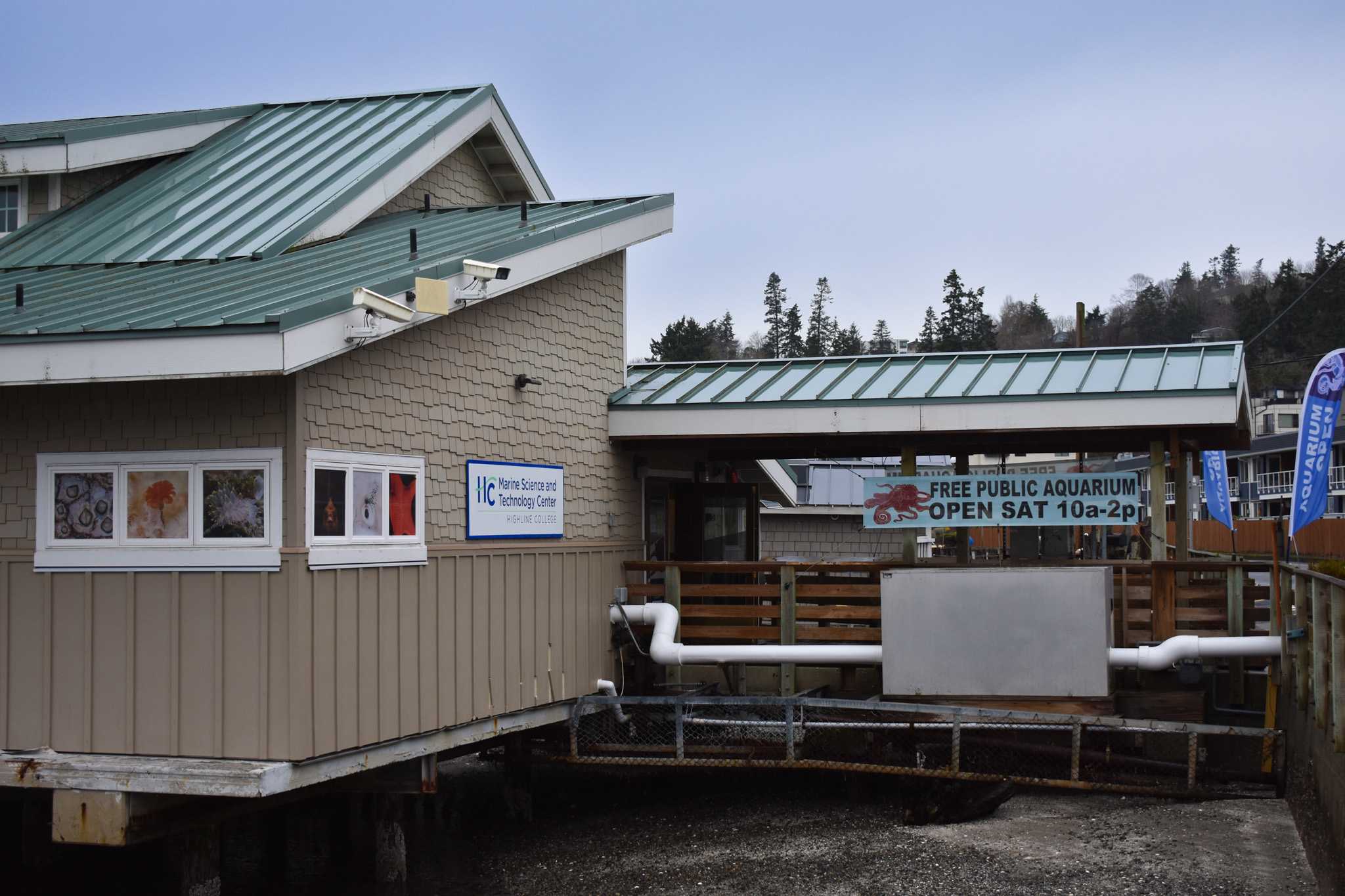
Highline’s MaST Center Aquarium is hosting plankton and photo exhibits, but they have more to see than just that.

Jamie Dueck/THUNDERWORD
The entries for the Underwater Photography Contest are displayed proudly within the entryway of the aquarium.
Highline’s Marine, Science and Technology Center Aquarium, better known as the MaST Center Aquarium, is a place where people can learn all about the different kinds of marine life from the local ecosystems here in the Puget Sound.
“Marine science education is the bottom line,” said Randy Williams, vice president of the Washington Scuba Alliance and long time volunteer of at the MaST Center.
“How many people live near Redondo Beach and never come out here,” said Williams.
Currently, the MaST Center has two exhibits going on, “Plankton: Wanderers of the Salish Sea,” and the “Underwater Photography Challenge.”
The MaST Center has partnered up with the University of Washington and the Community Marine Centers of the Salish to help educate the community about plankton through their exhibit, “Plankton: Wanderers of the Salish Sea.”

Jamie Dueck/THUNDERWORD
A 38-foot gray whale skeleton looms over the main entrance of the MaST Center.
The exhibit allows for visitors to learn about different kinds of plankton through an interactive guessing game.
There are also signs explaining different facts about different plankton, like how phytoplankton are plants and zooplankton are animals, or how some plankton are just baby forms of other animals like crabs and jellyfish.
There’s even a station that allows for visitors to observe the plankton under a microscope, where you can see that some plankton are even bioluminescent.
The “Underwater Photography Challenge” is an exhibit that shows off photos from local divers in the Redondo Beach area.
There were several different categories that the photographs could fall under, like the “Splash of Color Category”, which shows off all of the different colors that can be seen from the wildlife underwater, or the “Human Impact Category,” which takes photos that show how humanity has changed the natural ecosystem that marine life lives in.
The “Underwater Photography Challenge” will be at the MaST Center Aquarium until the end of February, while “Plankton: Wanderers of the Salish Sea” will be available until the end of March.
The aquarium is open on Saturdays from 10 a.m. until 2 p.m, but not just for the exhibits.
Visitors have the opportunity to see more than just the two exhibits, since the aquarium hosts several tanks filled with various forms of local marine life, many of which allow for close up interactions.
“We collect everything here in the Puget Sound, they’re all local animals,” said Williams. “We’ve also worked jointly with other labs, exchanging animals,” he added.
A couple of the tanks allow you to touch some of the starfish and urchins. One urchin reacts to your touch, and the spines covering its body begin to try and reject you.
Changes in the microenvironments can even be observed. Due to recent lighting renovations kelp has even begun to grow in the tanks.
The intimacy of the MaST Center Aquarium allows for visitors to really get close up with the animals.
“I think it’s awesome,” said Carla Smith, an aquarium goer looking for something fun to do with her kid. “I’ve never been able to stare at the red octopus in the regular aquarium, it’s nice to be able to get so close.”
The MaST center Aquarium is also a great place to bring your kids. They offer special programs for students from 6th to 12th grades throughout the week.
“I think it’s great that kids have something local to learn about our local animals, not just exotic animals from, like, Hawaii,” said Smith.
For more information on the MaST Center Aquarium, check out their website here: https://mast.highline.edu/visit/