
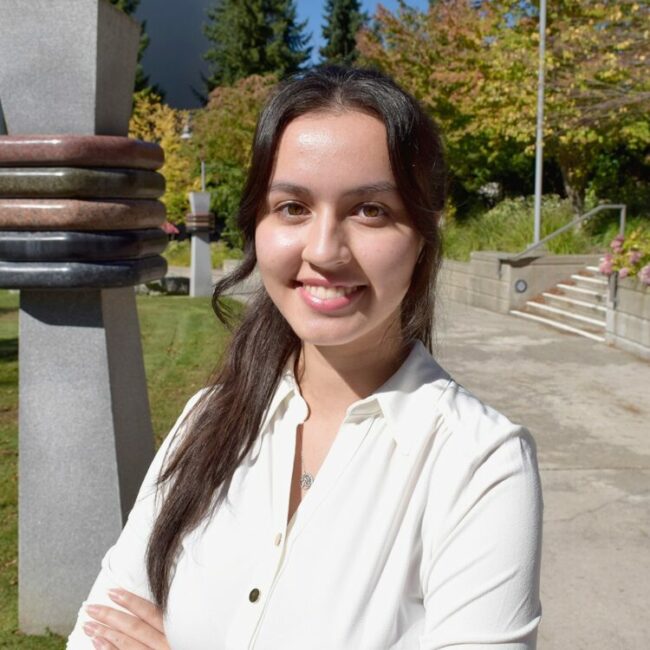
New Student Government President Mya Leonhard has taken on many leadership roles while at Highline, many of which advocate for equity and change in education.
She joined the Center for Cultural and Inclusive Excellence/Center for Leadership and Service, as the Inter-Cultural Center Peer Facilitator, which led her to expand her experience into the Associated Students of Highline College as the Speaker of the Caucus, and now as the Student Government president. Leonhard was appointed to the position earlier this quarter.
While at Highline she has been on the college president’s honor roll, and awarded the Martin Achievement Scholarship which provides support for students in their second year of community college, and additional funds for three years at the University of Washington-Seattle.
“Mya is a caring community builder who goes above and beyond to advocate for others and a more equitable culture of learning,” said Thomas Bui, the adviser of the Associated Students of Highline College, and director of the Center for Leadership and Service.
“In my time working with Mya, I have seen her passion for supporting those around her and her drive for creating change in education, especially at Highline College,” Bui said.
Leonhard joined the Associated Students of Highline College after wanting to further her experience as a student leader in the Inter-Cultural Center.
“It was a rather seamless transition since I had amazing support from all of the leadership advisers from the different teams that I built a relationship with in the past school year,” Leonhard said.
Working from home as the Student Government president, “has [made it] a bit more difficult to assess student issues on campus as we aren’t exactly ‘on campus’ for the most part,” Leonhard said.
However, that does not stop her from doing her work as president.
A project she is currently working on is creating a stakeholder committee that will focus on implementing the Senate Bill 5194, a bill that was supported by a number of advocacy groups, such as the Communities for Our College Coalition.
The Communities for Our College Coalition is a non-profit organization that advocates for Washington state’s community and technical colleges.
“[The bill] provides a $33M investment in our state’s community college system,” Leonhard said.
The Senate Bill 5194 addresses a number of student needs, such as “improving mental health counseling services,” Leonhard said. As well as “keeping the college accountable on creating and carrying out a Diversity, Equity, and Inclusion Strategic Plan, to fully implement guided pathways, and converting part-time faculty positions into full time.”
Leonhard worked as a volunteer advocating for change with the College Coalition, which collaborated with the Inter-Cultural Center in July 2020.
After the collaboration, Leonhard applied to work in the Inter-Cultural Center.
There, Leonhard met Edwina Fui, the Inter-Cultural Center leadership adviser in the Center for Cultural and Inclusive Excellence, and Leonhard’s supervisor.
“Mya is mindful, brilliant, and inclusive,” Fui said. “She is intentional in the way she interacts with people. She is a natural leader and creates a safe environment for her peers and teammates.”
Through her work at Highline and the College Coalition group, she has found her community, Leonhard said.
“I’ve learned how much good there is out in the world and finding the right people really helps make you feel uplifted, and helps you uplift others as well,” Leonhard said in reflection of her experience in her work and volunteering.
“Seeing how such a diverse group of people can all come together to work for the same ultimate goals and vision is something that feels very uniting and special to me,” Leonhard said.
From working as the peer facilitator at the Inter-Cultural Center, Leonhard also met Iesha Valencia, the associate dean for Student Life in Student Services.
“[Mya] role models the importance of learning about identity, privilege, and oppression as an important part of the process in becoming an effective social change agent in our diverse society that we live in,” said Valencia.
“I feel like it’s really important to show other students that anyone can be a leader and it’s crucial to tap into that part of themselves,” Leonhard said.
Leonhard said she often reflects on a statement by Alice Walker, an American novelist, writer, and social activist, who said, “The most common way people give up their power is by thinking they don’t have any.”
“[Once] I started putting myself out there as if I were some person with power, no matter how much I felt like I lacked it, I actually soon found myself being a leader in many ways; at home, with my friends, with my community, with other fellow students, and with the various organizations I’ve been a part of, including Highline,” Leonhard said.
Leonhard plans to transfer with her AA degree with an emphasis in psychology to the University of Washington-Seattle for a bachelor’s degree in psychology.
“I decided on psychology as my major because I would like to become a psychiatrist,” Leonhard said.
Leonhard decided to pursue this career because she has seen how stigmatized mental health is in her Vietnamese community, and the need for a culturally aware aspect in mental health treatment.
Another reason Leonhard decided to become a psychiatrist is because she has seen her mother, who continues to battle stage 4 lung cancer since 2018, struggle with discussing her mental health.
“That’s why I really want to focus on an equity lens when it comes to mental health,” Leonhard said.
“[I have] learned so much through both my psychology classes and leadership opportunities and hope to learn more as my education and career journey progresses after Highline,” Leonhard said.