
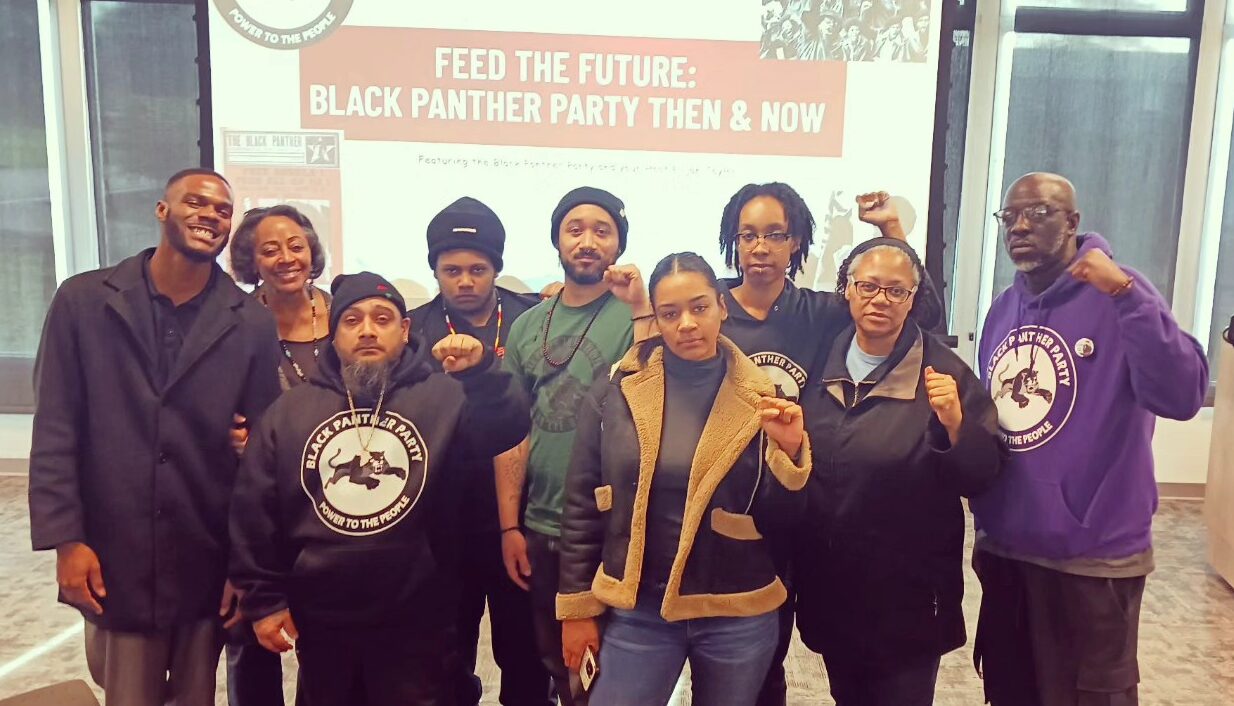
The Tacoma Black Panther for Self Defense made an appearance on Highline’s campus last week, paneling to a diverse mass of students, and accepting donations of food, clothing, and hygiene products. The discussion ranged from the history of the party, to the fracturing of different chapters, the integral role of women in the party, and life living as a target for the federal government.
The panel was a part of Center for Cultural Inclusion and Excellence’s MLK series, celebrating Black History Month. This event was especially poignant, gathering a diverse mass of students to learn about a historically militant political group discussing our current day and age.
“The original point behind the creation of the [Black Panther Party (BPP)] was particularly to address police brutality in the Black communities of Oakland [Calif.] The first chapter outside the state of California was formed in Seattle,” Comrade Bunchy C, one of the panelists, shared. “Over time, the Party evolved beyond this police brutality issue, and began to build political platforms to address the oppression that all oppressed people around the world face.”
The early history of the BPP were headlines of members wearing black beret hats and carrying firearms, intimidating cops into behaving properly during traffic stops. While this practice was what gave the Party their reputation, it’s community outreach that has made immeasurable differences.
Outreach and support have been at the heart of BPP operations, tied into the original founding tenet of intercommunalism, an ideology coined by BPP founder Huey P. Newton.
Panelist and Comrade Amirah said, “The original Panthers, they saw the need in the community because they were boots on the ground with the community, and they chose to meet the people where they were at. They saw a need in the community and chose to fulfill that need. We choose to do that today.”
The BPP’s efforts of providing for their community is traced deep into the history of the Party, much like how the modern policing system is rooted in the slave patrols of the 1800s.
“The [BPP] was absolutely created in its initial inception for the protection of the Black community because they were the most likely to be affected by police brutality,” Comrade Buchy said. “As understanding grew, they started to understand that oppression doesn’t have color.”
During the live Q&A at the end, a Highline student from South Africa, shared that they were told “[The BPP] was for Black Americans, not Africans.” While this may have been the original sentiment of the BPP, many chapters have expanded to fight against all oppression. There are still different parties within the Party, traced back to an east/west coast divide from the early days, resulting in different ideologies.
Comrade Amirah summed up how the Tacoma BPP chapter feels: “The only difference between Africans, Caribbeans, or Black Americans is a boat stop.”
The lived-paranoia and fear persists. Early members faced threats, assassinations, and raids. “The federal government made a determination that anywhere Black Panthers exist, they needed to be eliminated, and that is continuing today, unfortunately,” said Comrade Buchy.
Comrade Ovunayo shared the story of Fred Hampton, an early Panther in Chicago who founded the Rainbow Coalition, a multicultural political activist organization. Hampton was drugged, then shot and killed by the state.
“I got comrades that I see as brothers and sisters … I wanna make sure they get home,” shared Comrade Ovunayo.
The discussion turned with each question. The BPP was formed during a time of deep gender-inequality as well as race oppression. While BPP leadership fractured in the ’70s, Black women like Elaine Brown and Erica Huggins kept the Party alive, beginning an era of unprecedented progress for the Party.
The BPP expanded into their communities, opening Liberation Schools, creating free breakfast programs, and campaigning for local offices. Most of these programs were instituted by Brown, and carried on today. Whether referred to as Feed the People or Feed the Future, this local BPP chapter holds regular events around Tacoma, giving out hot breakfasts, packed lunches, and household goods. Information is available through official social media and link trees.
“Providing resources to other people, providing health, life, opportunity, to other people, is a threat to capitalism in itself,” Comrade Amirah continued. “I also want to acknowledge that our federal government – they deemed that a threat to our society,”
Capitalism, in its basic definition, is an economic and political system controlled by private, for-profit corporations that dictate the flow of trade. Allocating resources to take care of people, whether that be food, healthcare, or education, without charging those people, is the opposite of capitalism.
The Seattle Civil Rights & Labor History Project, through the University of Washington, has a database named “Seattle Black Panther Party History and Memory Project,” compiling all known documents from the 10 years the original Seattle BPP chapter operated.
**Mavrie has been serving as editor for the ThunderWord since 2024. She is also the founding president of Highline’s Non-fiction Writers Circle.**