
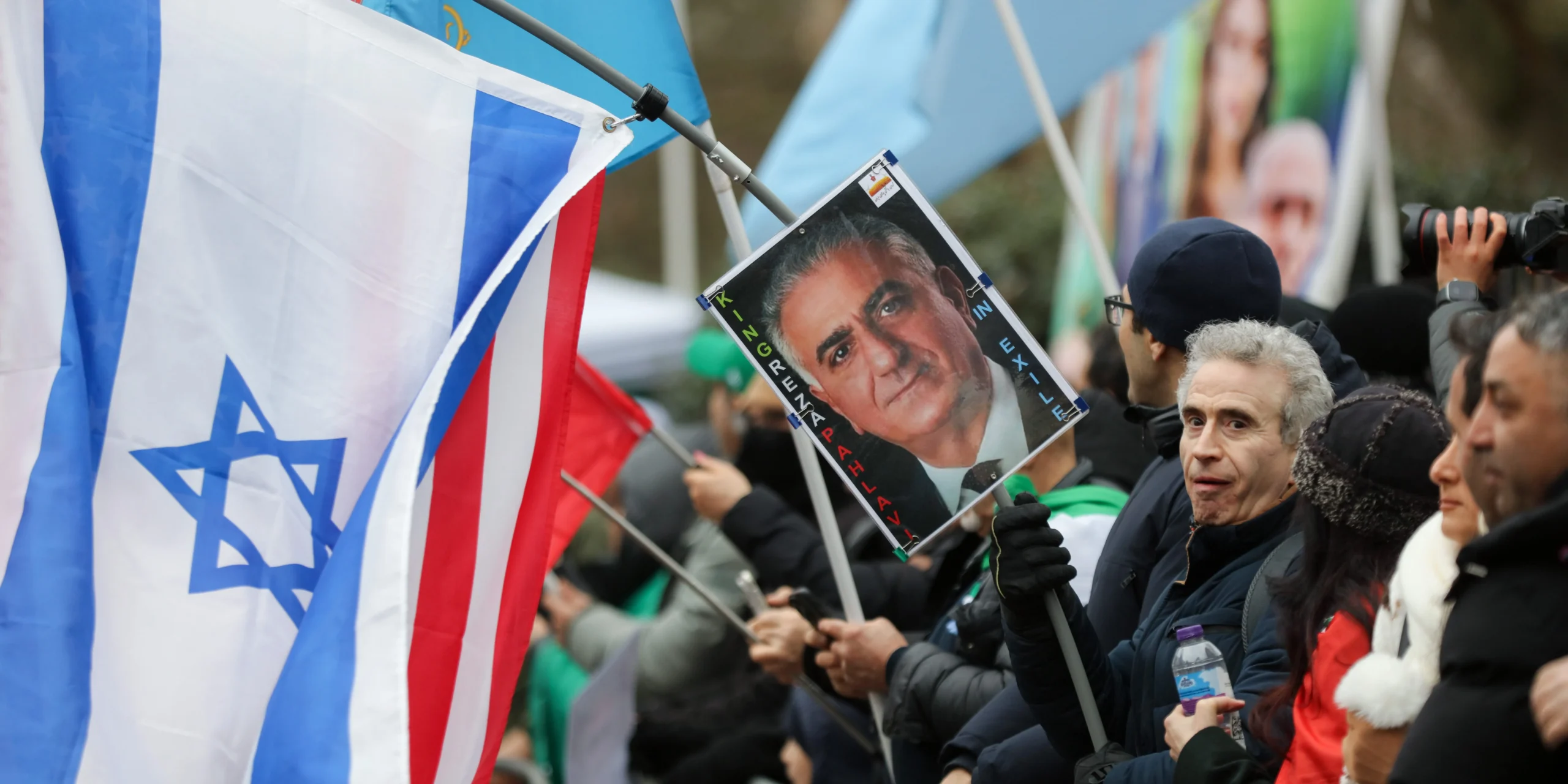
As tensions between Iran, the United States, and Israel have intensified, one political movement has become increasingly visible both inside and outside Iran: the royalists. While many Iranians fear the prospect of another war, a significant number of royalists have welcomed outside pressure on the Islamic Republic, including military action, seeing it as a possible path to political change.
You may have seen footage of Iranians carrying Israeli flags at protests in Europe or North America, calling for stronger action and more bombs against Iran. For many observers, the scene raises questions: Who are these people, and why do they support policies that could lead to conflict with their own country? What do they want? And how realistic are their chances of shaping the country’s future?
As a journalist from the Middle East who speaks Persian and has followed Iranian politics for years, I will try to answer these questions in a clear, short, and simple way.
In recent months during periods of political unrest and U.S. and Israel invasion on Iran, supporters of Iran’s former royal family have organized large demonstrations across Europe and North America.
Most Iranians view the Islamic Republic as a failed system that has brought economic hardship, political repression, social restrictions, and international isolation. For them, removing the current regime is only the first step; but royalists envision a different future for Iran – one that they often associate with the country’s pre-1979 era.

WWHF
Iranian royalists are generally considered part of the political right within the broader Iranian opposition. Their leader, Reza Pahlavi, the son of Mohammad Reza Shah Pahlavi, the last King of Iran. Living in exile since the 1979 Islamic Revolution, Reza Pahlavi has become one of the most recognizable opposition figures outside the country.
While some supporters openly advocate restoring the monarchy, Pahlavi himself has often presented his role as that of a transitional leader who would help Iranians decide their future through a democratic process.
One of the most striking features of today’s royalist movement is its strong nationalism.
Many supporters take pride in Iran’s ancient, pre-Islamic history and emphasize Persian civilization as a core part of their identity. This outlook has helped explain why many royalists have adopted positions that differ sharply from those traditionally associated with the Islamic Republic. Most are openly supportive of closer relations with the West, especially the United States and Israel.
At the same time, Iran has experienced significant cultural and religious changes over the past decade. Public frustration with the Islamic Republic has led some Iranians to distance themselves from religion, particularly from the state’s official interpretation of Islam.
Among certain monarchist circles, slogans emphasizing Persian identity over religious identity have become increasingly common. A recent campaign featured the slogan, “I am Persian, I am not Muslim.”
To understand this movement, it is important to remember the shadow of 1979. The Islamic Revolution overthrew the shah and transformed Iran from a close ally of the United States into one of its fiercest adversaries. Relations with Israel were severed, and a new political order emerged based on revolutionary Islam.
Today, some Iranians look back at the final years of the monarchy with nostalgia. They point to periods of economic growth, modernization, and stronger ties with the outside world. Others, however, remember the shah’s authoritarian rule, censorship, and political repression. The debate over Iran’s past remains deeply contested.
What is clear is that Reza Pahlavi has gained visibility among parts of the opposition. During waves of protest, many Iranians have viewed him as a potential symbol around which anti-government forces could unite. Yet his popularity is difficult to measure, and it remains unclear how much support royalists truly command inside Iran.
The movement also faces major obstacles.
First, the Islamic Republic retains powerful military and security institutions. Even with severe internal unrest and external pressure, a political transition would be extraordinarily difficult. The idea that foreign intervention alone could bring royalists to power remains highly uncertain.
Second, Iran’s opposition is deeply fragmented. Royalists, republicans, leftist groups, ethnic minority movements, reformists, and other factions often disagree not only about strategy but also about what kind of state should replace the current system. These divisions have repeatedly weakened efforts to build a united and organized opposition front.
Finally, royalists themselves remain controversial. According to an article in The Atlantic, royalists treat dissenting opposition figures with hostility, subject them to online harassment, and promote an exclusionary form of politics.

MICHAELA STACHE/AFP
Critics of the Iranian royalist movement often express concern that the movement’s aggressive online discourse and its perceived alignment with hardline figures in the U.S. and Israel (such as Trump and Netanyahu) may undermine its democratic credibility.
For many within the broader Iranian opposition, these factors fuel the fear that a post-revolutionary transition led by royalists might mirror the authoritarian patterns of the past, effectively swapping one centralized, undemocratic power structure for another. They oppose and critique a hereditary political system that is lifelong, unaccountable, non-transparent, and unconstrained, viewing it as obsolete, reactionary, and archaic.
The future of Iran remains uncertain. The Islamic Republic faces serious economic, political, and social challenges, yet no opposition movement has emerged as a clear alternative. Iranian royalists have become one of the loudest and most organized voices in exile, but turning visibility into political power is another matter entirely.
For now, the movement reflects a broader reality: millions of Iranians are searching for a different future, but they remain deeply divided over what that future should look like. Whether Iran’s next chapter is written by royalists, republicans, reformers, or an entirely new generation of leaders, the struggle is no longer only about removing a regime. It is about deciding what comes after.
I like to end this commentary with two questions:
First, if the Iranian regime reaches an agreement with Trump and succeeds in easing external pressure, will the royalist movement once again retreat into political hibernation?
Second, if the former crown prince, Reza Pahlavi, were to die unexpectedly for any reason, what would become of this political camp? Is it strong enough to survive without the figure around whom it has largely been built, or would it gradually fragment and fade?