
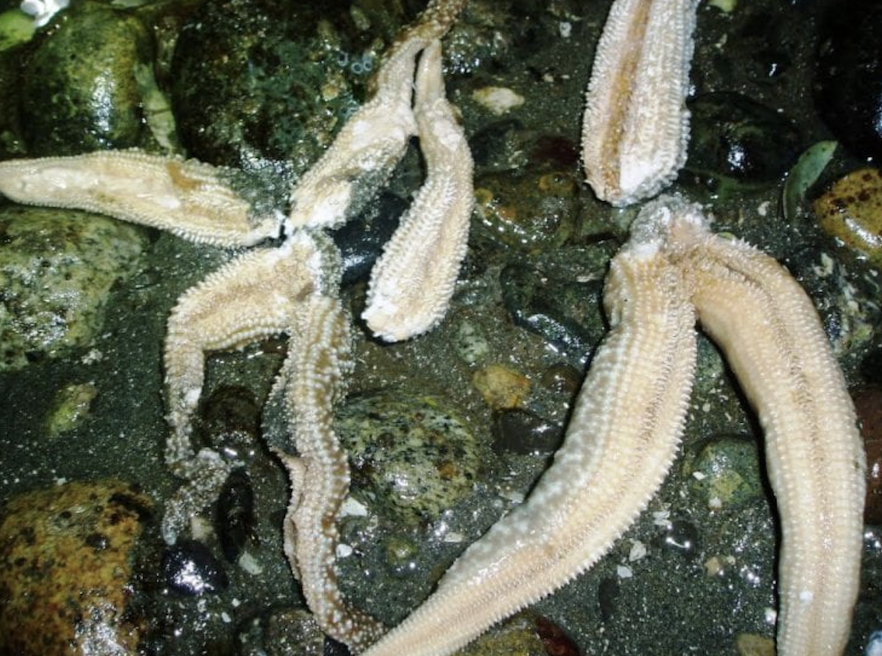
Star fish are disappearing all over the north west, dying in large numbers due to a disease called Sea Star Wasting Disease.
As you walk along the Pacific West Coast beaches, you may notice something concerning: sea stars with twisted arms, lesions, or bodies that seem to be melting away. This distressing sight is a trademark of Sea Star Wasting Disease (SSWD). The disease has affected over 20 species of sea stars.
As of 2025, more than 5 billion sea stars have been lost from the initial 2013 plague until now, resulting in a population decline of over 90% in some species according to the Western Fisheries Research Center.
SSWD starts with small white lesions which appear on a star’s body. As the disease continues, it starts body fragmentation and death. There have been recent discoveries connecting this disease to a bacteria or increased water temperatures in some locales, but these have not been conclusive.
Rus Higley, director of Highline’s Marine Science and Technology Center (MaST), said, “Starfish are a keystone species.” Higley explained that removing sea stars from the ecosystem can dramatically change the environment. “When sea stars are removed from an environment, the ecosystem’s balance struggles.”
“We are currently about seven to eight years into the disease. The effects have been disastrous and the ecosystem may never be normal again, although knowing exactly what normal was to begin with is difficult,” continued Higley. “With vastly fewer sea stars we have seen an increase in purple sea urchins which eat kelp, this can lead to the rise of some species and fall of others.
The sea is a zero sum game, there will always be some winners and other losers. In Robert Paine’s famous experiment, removing the Pisaster sea star caused mussel populations to increase, which eventually reduced the number of species in the area from 15 to eight. Ultimately there has been and will be a significant impact of the wasting disease, however we won’t truly know the extent of the damage until it plays out.”
As of May 2026 there are many people working to solve this disease, while the proposed cures have not had the intended effect, many aquariums and organizations, like the MaST Center, are working hard to find the cure. There are also a few star fish species which appear to have a resistance to the disease which may shed some light on developing a cure. At the very least there will still be star fish around.