
When stepping into the high-tech, bright-light world of galactic sci-fi media, it can feel overwhelming to know where to start. Ryan Gosling’s one-man show “Project Hail Mary”, might be the way to go.
Space sci-fi is infamous for its convoluted, intricate scientific systems, its beautiful visuals, and its big, philosophical questions it tries to answer. However, that can be a lot to a new viewer of sci-fi. One of film’s most engaging components is how easy the concepts – ‘sciencey’ or simple – can be understood by the non-seasoned space film vet.
Phil Lord and Christopher Miller, the directors of “Project Hail Mary”, have a really solid line-up before this movie: “Cloudy with a Chance of Meatballs”, “The LEGO Movie”, the Spider-Verse saga, and “21 Jump Street”. Audiences recall these films as wonderfully comedic. And while they also directed “Clone High”, their forte is in what makes a viewer laugh – and Lord and Miller tell you that themselves.
In an interview with Rolling Stone, Lord noted “You don’t get the same satisfaction as a laugh, but you can feel it when audiences are enraptured – you hear them be quiet. And that’s a big deal. But we do come from comedy, so we do spend the time going ‘Did it land?’ That’s important.”
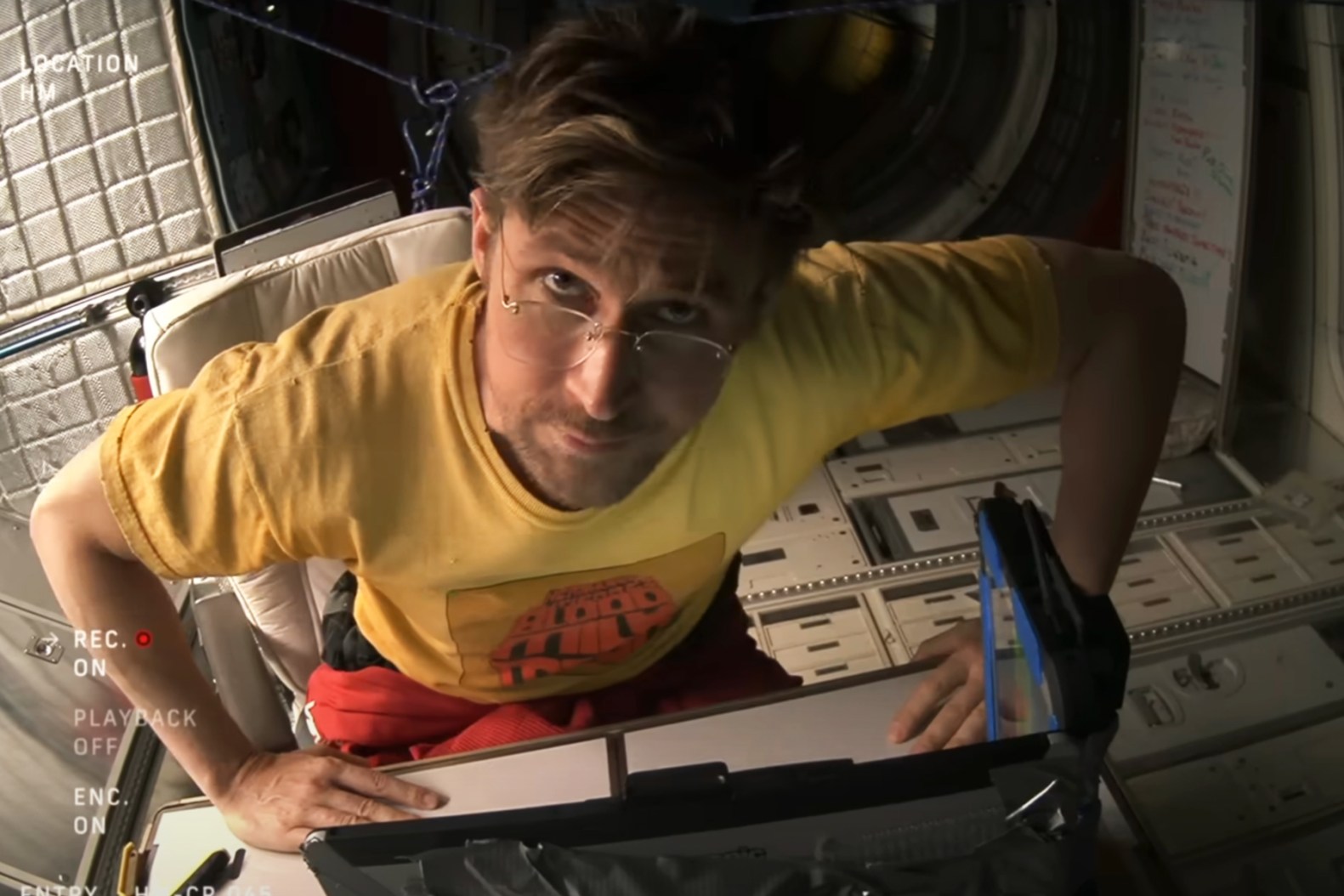
Those comedic roots definitely shine through in this film. Gosling, starring as Ryland Grace, is notably isolated when his two astronaut counterparts do not survive the journey to the galaxy they needed to travel to. But when he realizes, the movie transitions through a few montages of him coming to terms with this information – it’s not strategizing to get home or working out complex equations or philosophizing. It’s just shot after shot of him panicking, letting it set in.
There are some laughable scenes and some heartwarming ones – at the end of this scene, he finds all the photos they brought with them in the ship and gives them a moment of remembrance before their bodies are sent out of the spacecraft and into space. And that’s where the movie is most engaging. It’s warm, it’s human, it feels understandable and familiar to any type of viewer.
Halfway through the movie, Rocky is introduced. He is the alien that joins Grace’s quest to save their respective planets. A puppet, controlled by puppeteer James Ortiz’s team, wasn’t a long, spindly martian or a weird parasitic creature.
Built like a spider out of stone, Rocky was never frightening, and, in personality, quickly became comforting – to Grace, and to the audience. Rocky’s personality, as noted by Ortiz in a NoFilmSchool BTS article is “a miserly old man, a peppy labrador, and an anxious 14 year-old boy.”

Amazon MGM Studios
Where the movie really gets its acclaims, however, is that they managed to pull off this film without CGI or green screens – a staple of modern television, especially with anything in space. And the film-making team went out of their way to make it look and feel as enrapturing as it did.
Building manual rigs to make Ryland float in space as opposed to mechanical ones, using a mash-up of puppeteering and robotics to work Rocky and polishing him afterwards with visual effects, and building the entire interior (and pieces of the exterior) of the space-craft; these film-makers went out of their way to make the movie feel grounded, reachable, and cinematically inviting. And in watching it, all of that meticulous crafting is impossible to miss. It’s obvious how much care and attention was paid to every detail in the film.
It was the first movie I had been back to the theaters to see in a long time, and I was certainly in for a treat. If you want a film that makes you laugh, gasp, cry, and laugh all over again, “Project Hail Mary” is a must-watch.