
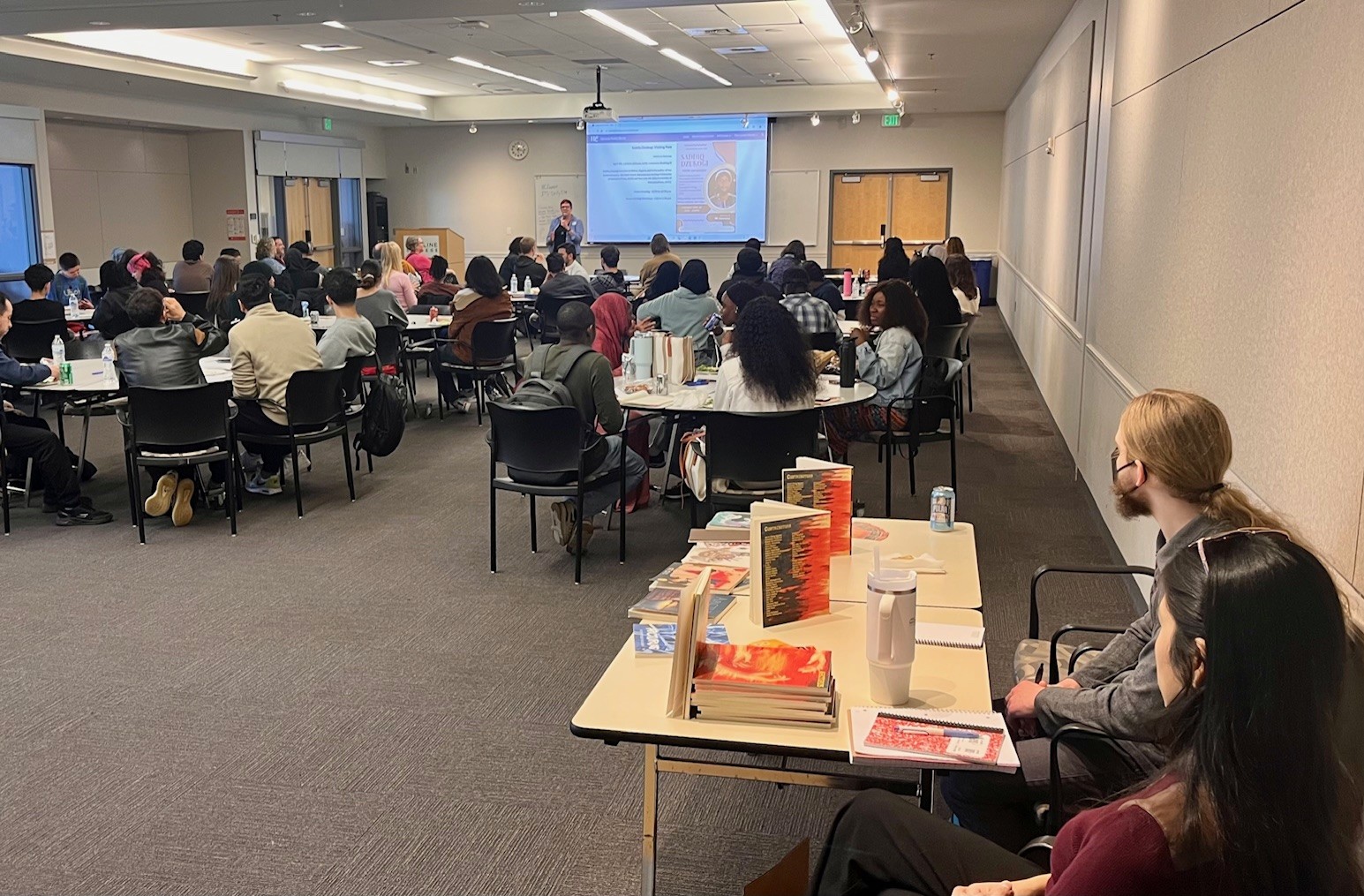
Good things can happen unexpectedly. Nine years ago, Highline professor Susan Rich read a poem by Saddiq Dzukogi in the Taoist Journal of Poetry, sending her on a near-decade correspondence with the Nigerian author. Dzukogi celebrated his recent book release, “Bakandamiya: An Elegy” at last week’s “Poetry and Samosas” event as the keynote speaker.
Once Professor Rich read that 2017 edition, she wrote a letter to the editor, exclaiming about how much she loved it. She then received Dzukogi’s email, which became a professional relationship between the two. Dzukogi’s second book came out last year, and he shared a range of new and older works.

Max Juedeman/THUNDERWORD
“Bakandamiya: An Elegy” is an epic poem that recounts 500 years of cultural transformation in northern Nigeria. The event kicked off with Dzukogi sharing four excerpts which explored grief, immigration to America, religion, and family.
“[My editor and I] arrived at this book because I read somebody – I don’t remember who, thank goodness – but they were speaking about my people, in [north Nigeria], and they said this thing precisely: ‘These are people without myth,’” Dzukogi said.
“I was angered by it because I saw it as the greatest form of dehumanization because if you say that people are without myth, you’re saying that they have no story, and if they have no story, that means you don’t even see them, they don’t exist, they aren’t a human being. But I’m here, in the flesh. I’m a human being,” continued Dzukogi. “We have stories, the ones my grandma was telling me as a kid. We have origin stories.”
Dzukogi is used to his creative vision not being understood. Prefacing one of his poems, he said, “My editor asked me ‘Why are Africans so afraid of writing epics? There is no African epic.’ and I thought to myself ‘I’m going to do it. I am going to write an African epic.’”
He talked about conversations with peers centering on grief, and how that is incorporated in his poetry. “Grief is the only constant in our life, more constant than light, more constant than love, so why not [write about it]?”
He then spoke of how his editor tried to get him to change the name of the book, because Bakandamiya, a Hausa word, is hard to pronounce. Dzukogi defended the choice, saying, “[Using a Hausa word as the title of his book] is my own way to introduce the world to all of me. I think I’d write in Hausa in the future because it’s the only way to preserve the language, to keep it from dying.”
“Bakandamiya: An Elegy” is now available for students to purchase at the Highline Bookstore and can be checked out from the library.
Following the reading was a Q&A section where the audience was able to ask questions.
When asked what inspired him to become a poet, Dzukogi said, “I didn’t know how to read when I was ten, so all the kids in the neighborhood in Nigeria would laugh at me because everyone could read. It was painful. I went to an older friend, I was crying, and I said ‘I want to know how to read’ and pretty quickly, in about a month, he’d taught me how to read.”
Dzukogi continued: “Nigeria suffers from power cuts. It’s worse now, but one day there was a power cut, and the dude who taught me how to read left for Suleja … so I wrote in the notebook that my mom gifted me:
‘[My friend] left for Suleja on Thursday.
NEPA (the power holding company in Nigeria) took light on Thursday.
Whereas [my friend] returned on Friday.
NEPA didn’t return on Friday.’
My dad saw it and said that it was a poem. That night I wrote four poems.”
Dzukogi is multilingual, and when asked about when he wrote his first poem in English, he said, “I only write in English, but I did write a few poems in Hausa. … It’s complicated, yesterday I was telling my students that I have to do the work of translating [my work] into English or even Arabic. … English is the language of intellect, for me, and so I can’t speak about my poetry in Hausa even though it’s my mother tongue. I can’t pray in Hausa, I can’t pray in English, I can only pray in Arabic – which is wildly different from the language of my dreams, which is Nupe. Right now, what I’m doing is ensuring that all those influences, all those languages have a relationship within the context of my poems.”
In 2011, Dzukogi decided that he wanted to do something different with his life, and so he began to study poetry for thirty minutes a day, which eventually led to a career as a poet.

Max Juedeman/THUNDERWORD
Micah Colindres, a second year student at Highline College, understood the vision. “My favorite poem was the one about grief,” they said. “I can’t explain why, exactly, it just said something within me. I came to this reading for a class … but mostly I came to this one because I went to Ebo Barton’s [poetry reading] last quarter. I loved it, it was fun, active, and I wanted to engage with literature in community. … I was amazed. I loved the imagery, I do this thing where I try to picture what’s being said in a poem, and the poem about grief had a powerful image of being pushed into a void. That picture told me what the poem is.”
True to its name, “Poetry & Samosas” provided food. Aster Gilbert, a first year student at Highline College, said, “I did really like them. I thought they had good filling and they weren’t underdone. I didn’t try the tzatziki sauce, but I usually like it. I had no issue with there only being vegetarian options, but it would’ve been nice to have an option for people who wanted samosas with meat [as a filling].”