
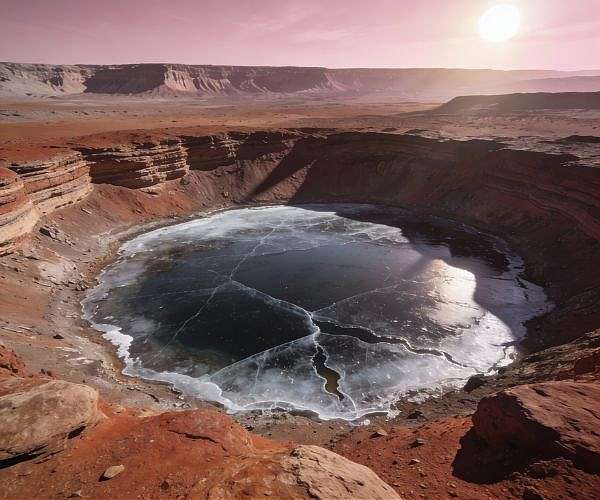
Recently scientists have pondered if lakes on ancient Mars could have stayed liquid for years. As new research suggests, there is a chance only the top layer of the lakes could have frozen over, acting as insulation to prevent the rest of the water from freezing.
‘Ancient Mars’ refers to the early, geological history of the red planet, in which it was once teeming with water, and covered with ocean billions of years ago. Now, the planet is pockmarked with lake basins and structures resembling ancient river systems.
If water on ancient Mars existed for lengthy amounts of time, it could have been a key ingredient for early life there.
Eleanor Moreland, the lead author of the groundbreaking Mars ice study, mentioned, “Seeing ancient lake basins on Mars without clear evidence of thick, long-lasting ice made me question whether those lakes could have held water for more than a single season in a cold climate.”
To answer that question, the research team turned to climate modeling – a helpful way of simulating climates, especially ones that can’t be observed firsthand.
Looking at Gale Crater, an ancient lake basin that has been observed by NASA’s famous Curiosity rover, they redesigned a climate model for Mars’ conditions there from approximately 3.6 billion years ago. They ran 64 different simulations, each for around 30 Martian years (56 Earth years) testing whether a hypothetical lake could exist under those conditions.
“It was fun to work through the thought experiment of how a lake model designed for Earth could be adapted for another planet, [and] this process came with a hefty amount of debugging when we had to change, say, gravity,” said Sylvia Dee, a co-author of the study.
Fortunately for them, its findings were remarkable. In some of their simulations, the lakes did freeze solid, but in others, the ice acted like an insulator, preventing the rest of the lake from freezing completely.
“[The] seasonal ice cover behaves like a natural blanket for the lake,” remarked Kirsten Siebach, another co-author of the Mars ice study. “It insulates the water in winter while allowing it to melt in summer. … Because the ice is thin and temporary, it would leave little evidence behind, which could explain why rovers have not found clear signs of perennial ice or glaciers on Mars.”
Because of how well the climate model (which they nicknamed, funnily enough, LakeM2ARS) worked, they now plan to turn to other locations where similar conditions could exist. The question is: If similar patterns arise, what could that mean for early life on Mars? Might we eventually find evidence of life that started to develop before Mars’ oceans froze away?