
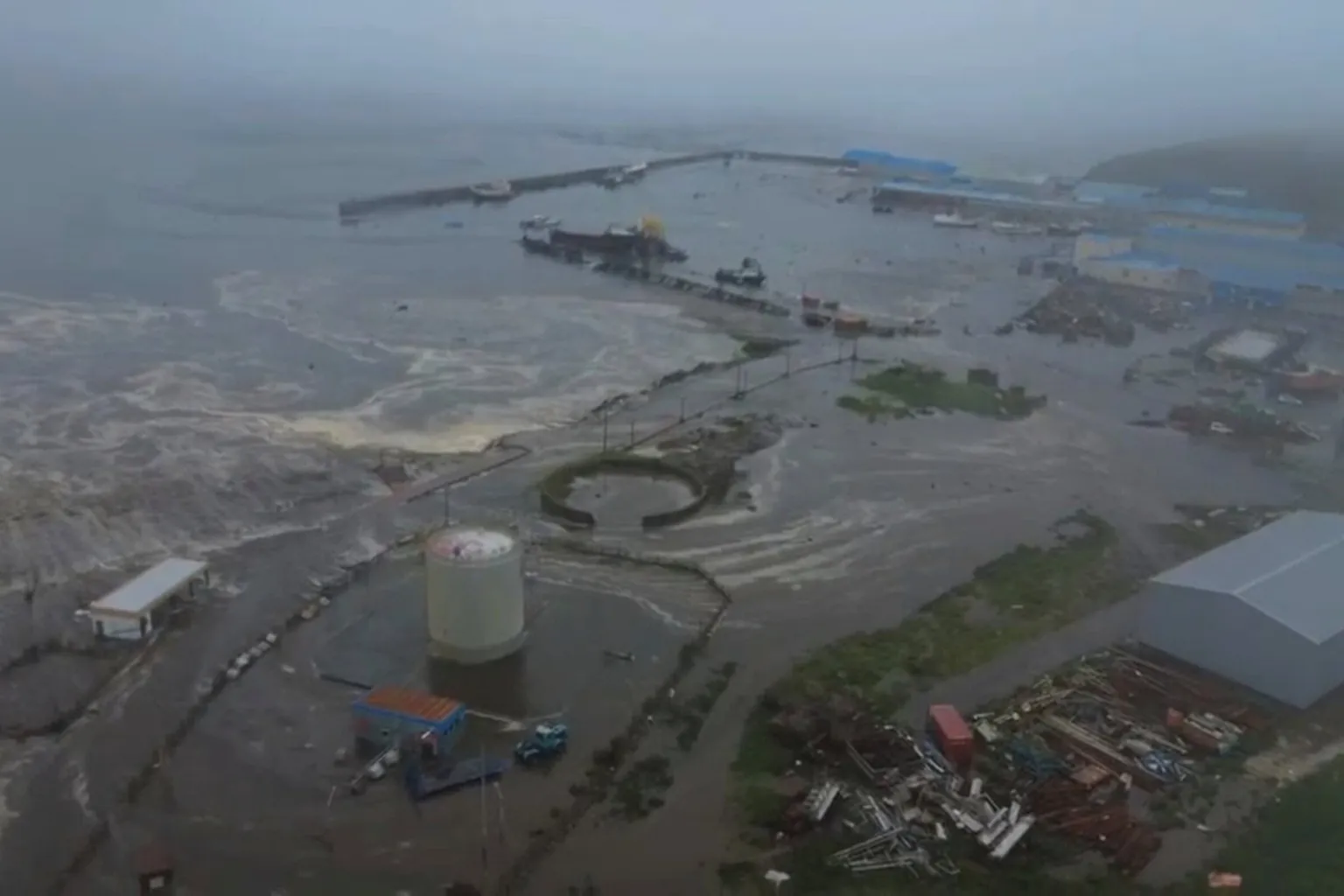
An 8.8 magnitude earthquake, one of the strongest earthquakes in recorded history, struck off Russia’s Kamchatka Peninsula Tuesday evening (local time), prompting a tsunami advisory for the entire North American west coast. Washington’s outer coast was under tsunami advisory until Wednesday morning, with the tallest tsunami waves measuring about a foot and a half at La Push around 1 a.m.
The advisory initially stretched from the Olympic Peninsula coast, through the straight of Juan de Fuca, and into the Puget Sound, reaching the Port of Tacoma. Around 9:30 p.m. on Tuesday, the advisory was pulled back from the Puget Sound. All Washington beaches closed in response to the advisory, though no coastal damage has been reported.

KIRO7 News
Rus Higley, Director of Highline’s MaST Center, said there was no cause for concern in the Redondo/Des Moines area.
La Push and Westport saw the first tsunami waves early Wednesday morning, hours following the initial earthquake. The water pushed further into the straight of Juan de Fuca, bringing waves to Port Angeles, Take Point, and Neah Bay. Tsunamis bring stronger ocean currents, so people are still advised to stay out of the water.
The Washington Emergency Management Division said in a Facebook post, “[A]ll waves must be less than one foot for three hours for the advisory to be cancelled by the National Tsunami Warning Center.”
The earthquake was followed by more than 100 aftershocks, with the strongest being a 6.9 shortly after the initial quake. The aftershocks ranged from 4.4 and greater, and occurred in the surrounding regions. A 6.4 magnitude aftershock struck 200 miles southwest of the epicenter. Aftershocks are most numerous in the hours to days after the main earthquake.
Advisories were issued for nearly all coastal regions in the Pacific. Evacuations were ordered in Hawaii, where tsunami waves were measured at four feet off Maui and Oahu.

Russian Ministry for Emergencies/Handout via REUTERS
Damage was reported in Russia’s Far East, with tsunami waves around 10-13 feet. Several people remain injured, but no fatalities. Following the earthquake, Russia’s Klyuchevskoy Volcano on the peninsula erupted as Japan and Hawaii pulled back their tsunami warnings.
Two million remain displaced in Japan as officials warn waters might remain elevated for the next day.
In 2011, the Great East Japan Earthquake and Tsunami struck. The earthquake measured at 9.0-9.1 magnitude with tsunami waves as high as 130 feet. More than 20,000 people died, a further 40,000 were displaced, and over $20 billion in damages occurred.
Detecting an earthquake before it occurs is a near impossible task. Most earthquake tracking occurs after a disaster has struck, when seismologists return to review seismic activity leading up to the quake in an attempt to identify patterns.
As waves subside and people return to their homes, more information will become available concerning the damage caused in Russia and Japan.
**Mavrie has been serving as editor for the ThunderWord since 2024. She is also the founding president of Highline’s Non-fiction Writers Circle.**