
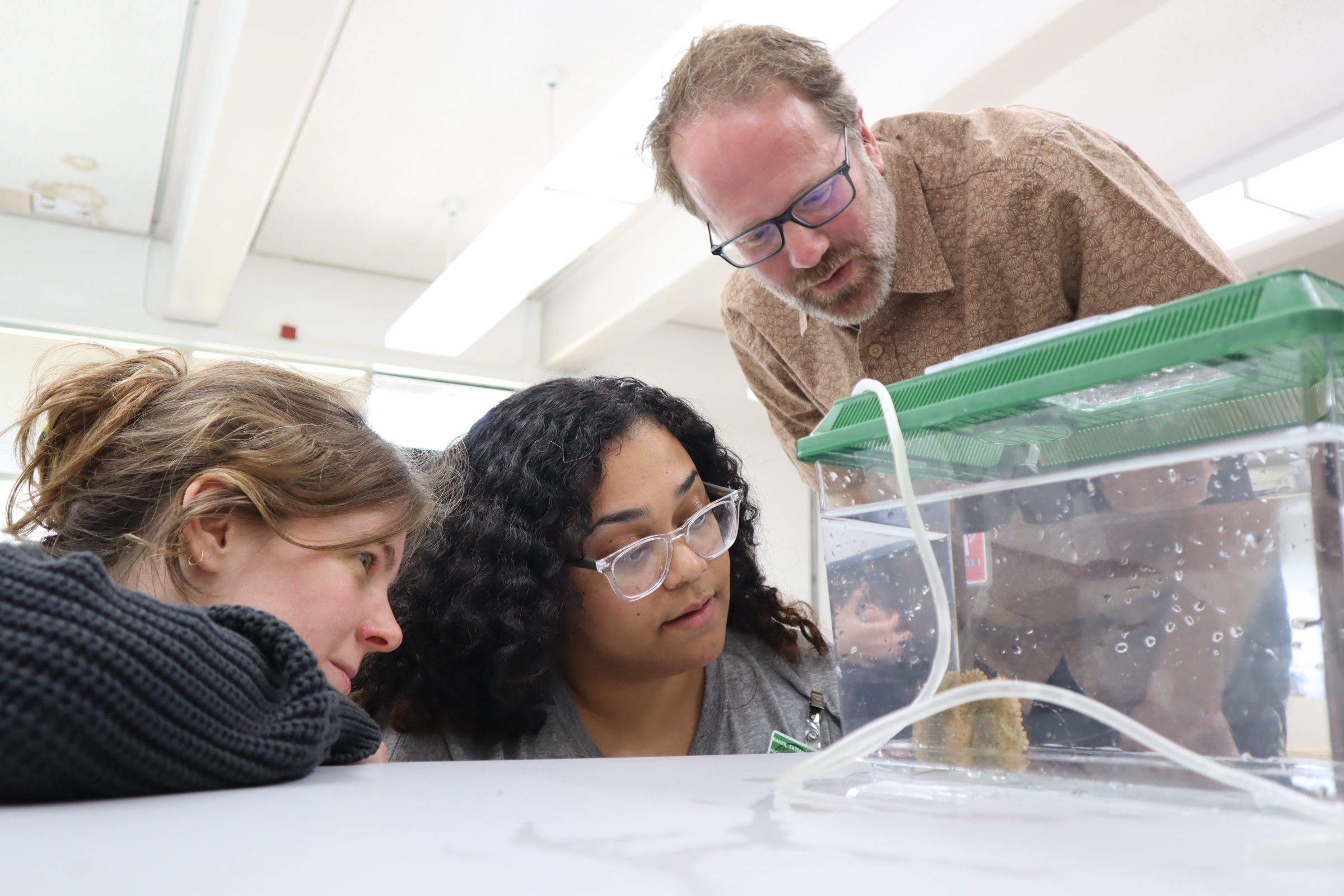
Highline’s Marine Science Technology Center (MaST) in partnership with the Sustainability in Prisons Project (SPP), a group dedicated to bringing educational experiences to incarcerated individuals, brought a growing red octopus to the Washington Corrections Center for Women (WCCW) in Gig Harbor.
Their goal: give the students imprisoned there an opportunity to study, ponder and come to an individual conclusion on the connection between this oceanic species and our own.
When you think of an intelligent being, do you picture an octopus? Through vast oceans, is it possible that humans can form a meaningful connection to these cephalopods? These are questions that the incarcerated students poked small, curling tendrils at.

Emily Passarelli/Sustainability in Prison Project
“Do any of you know someone who is smart?” Rus Higley, MaST director, poses to the room. Whether it’s a small shake of the head or a more exuberant shout out, collectively the attendees as a whole agreed, they know what “smart” looks like.
Higley pressed further, “Do you know anyone that is an idiot in one way, but so smart in another?” La’Darion, an avid student of the day’s lecture, and currently incarcerated person at WCCW shared “my brother!” to which many endorsed with “mine too” or a laugh in agreement. The point was made, intelligence in one area does not guarantee another.
With this established, Higley pivots. He starts by exploring the differences between humans and octopus. Biologically, it’s made clear, we couldn’t be more distinct.
What one might assume is the octopus brain holds all of their internal organs such as their stomach, two hearts, and other vital systems. The lenses in their eyes are comparable to a birds. Most shocking to those in attendance, is the hidden beak an octopus has, resting at the core of their soft underbelly.
As the students consider these clear variations, the air sits unsure with how these revelations affect their greater thesis. It’s heavy on their minds. Collectively with their new found knowledge, they start to dig in, and wonder “Can something so different from us really be intelligent?”
Next, students are presented with a video of an octopus adapting to its environment. It’s shown, gliding between different corals in a coral reef. Each one is drastically different and unique from the last. Concerned by a danger unseen, the octopus settles. Within a matter of .09 seconds, it camouflages itself completely. Even the viewer, who has observed this process from start to finish, struggles to pin down its precise location.

SFU CA
“Is it just instinct? Is instinct intelligence?” Higley will not let their minds settle on the idea. Onward he presents more evidence for consideration.
Octopus have food preferences. Typically choosing human favorites, such as shrimp, clams, and small crabs when it comes to cuisine, depending on the ocean they live in. Octopus use tools. They have the ability to recognize behavior. They can solve puzzles, such as mazes. They have a proclivity to escape from containers.
This last characteristic sticks with the class. They question what this looks like, and how it is possible for such a small animal to accomplish such a big feat as bucking an enclosure.
Higley expands by reflecting on his career in housing and caring for several octopus. To the room, Higley recalls a young Giant Pacific Octopus he had collected some years ago.
Over the course of Giant Pacific Octopus’s lives they gain strength in each suction cup on each tentacle. Within the first nights in the MaST center, many attempts were made to ensure the animal had no means of escape in its tank. Including, placing a 75-pound weight over the top of the enclosure.
However, the animal’s will to shake its captivity persisted through Higley’s attempts. One morning, Higley was met with an alarmed call from a center volunteer. Somehow, the creature was splayed out on the floor. It was found outside of water, and barely clinging to life. After rushedly placing the octopus in a nearby touch tank, Higley attempted a modified form of CPR to no avail. In its quest for freedom, the animal died.
To the roughly 30 incarcerated students at WCCW, this resonated. With it, a new question emerged: Is an inescapable distaste of captivity, a form of intelligence?
As they are viewing the presentation, and engaging in conversation, students reference the octopus directly. The animal sits in a corner of the room, never quite sitting still. Its color gradually changes shades, sometimes its natural red, at other moments green. As they observe the octopus, students begin to visualize the information Rus presents.

Emily Passarelli/Sustainability in Prison Project
.
As for the overarching question of the day’s lecture, no definitive answer was given to the students. Knowledge was simply presented and discussed.
After the lecture, questions were taken. Many wanted to know about the animals’ quality of life. Asking “Is she bored in there all day?” or more to the point “Is she ok?” However, most inspiring of all was a question toward the end.
Patiently waiting for the right moment, La’Darion raised her hand and directed at Higley “How many years of education does it take to be you?”
Before the lecture began, students trickled in, many stopping to look in on the octopus present. When La’Darion made her introduction to the animal, she shared her personal history. She felt that the octopus was her spirit animal, it reminded her of her childhood and herself. She formed a deep connection to them.
Years ago, when she was fishing with her boyfriend they had unintentionally hooked an octopus. As she carefully worked to set the creature free, there was an impactful moment. A brief second where they locked eyes, and studied each other. In the same instant it quickly slipped through a crack in the boat.
In response to her question, Higley shared the MaST has volunteers as young as 10 years old. Then he discerned if she would like to work with marine animals as a vocation.
“I aspire to be a Marine Biologist. It’s the most ideal career path to working with these animals,” replied La’Darion. The day’s lecture, in tandem with the invertebrate present, had made an impact on all. For at least one student present, it had re-ignited a long forgotten passion.

Emily Passarelli/Sustainability in Prison Project