
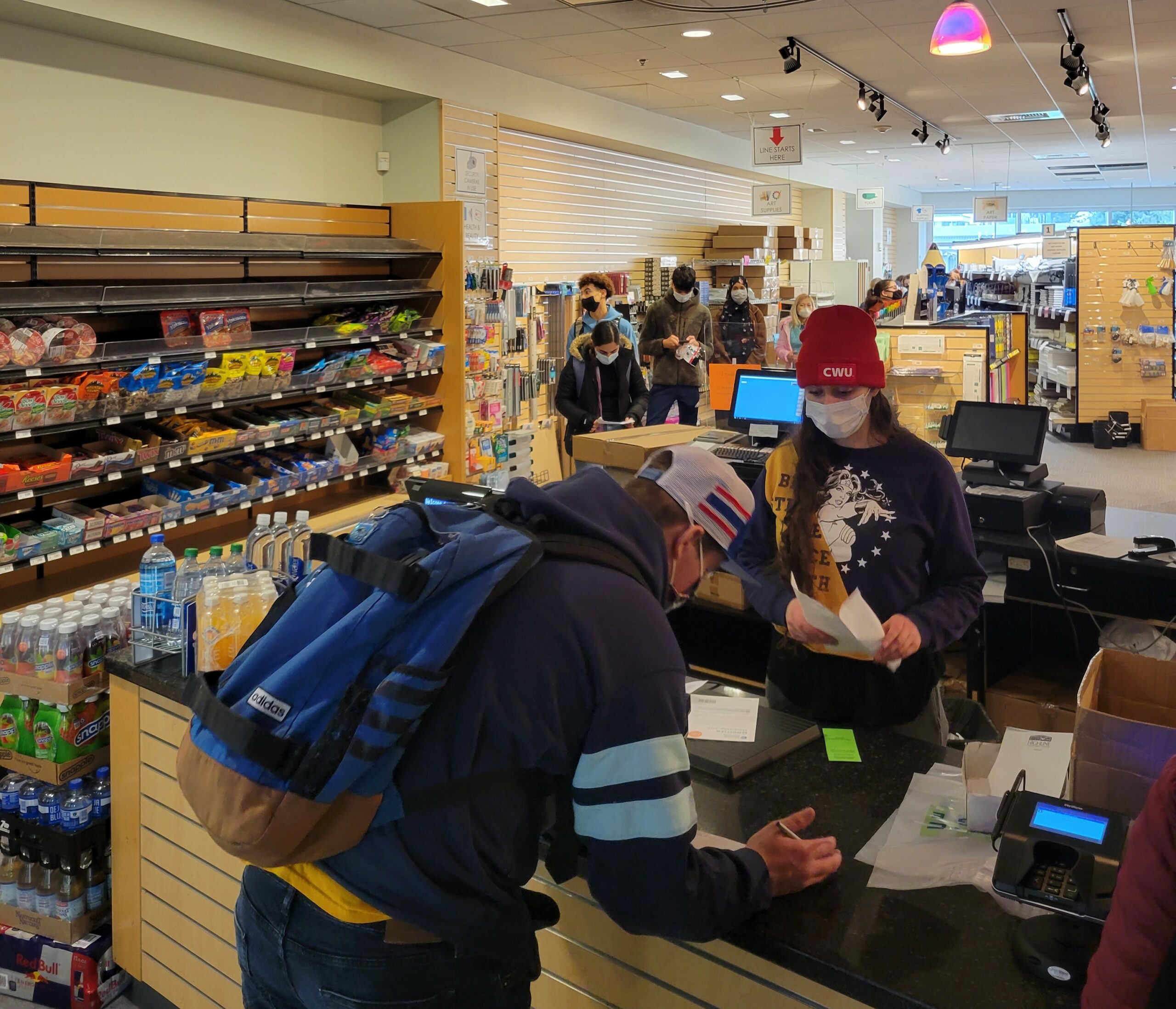
Enrollment at Highline continues to fall, and college officials are trying to find ways to deal with it.
College enrollment is down nearly 16 percent from winter of 2021. It’s down in nearly every category, including regular students, Running Start, and international students. Enrollment matters because state funding depends in part on how many students show up each quarter.
Moreover, only 70 percent of students returned from Fall Quarter. Normally, that number is about 75 percent, said Dr. Emily Lardner, vice president of Academic Affairs.

College officials aren’t sure why, but they have a number of theories.
“These are challenging times for everyone,” Dr. Lardner said. “The pandemic is exhausting and devastating, and it feels like it will never end.
“But it will,” she said. “We know some people will always want to learn remotely, and as a college, we’ve gotten better at supporting that. At the same time, we know our beautiful campus has a lot to offer in-person, and we want to celebrate that, and celebrate the opportunity to be together safely.”
In recent meetings, faculty and administrators have identified a number of factors that may be affecting enrollment.
For example, students say it’s too difficult to register at Highline; that they don’t hear back quickly when they ask for information; that the financial aid process can be challenging. Another observation has been that Highline doesn’t do enough to market itself.
While students who enter college early via Running Start report that they generally get adequate assistance with enrollment and registration, regular students say the process can be challenging.
On a different note, while interviewing a regular college student she had a completely different experience.
“I enrolled a couple of months ago, November of 2021 to be exact,” said Yadira Meraz Soto. “This is my first quarter at Highline. My experience was a bit difficult since I had finished high school two years ago and had no idea how to even start.”
Soto said she could have used more help.
“It was a long process,” she said. “I felt frustrated because I felt as if I couldn’t do it all by myself and didn’t know what the next steps were.”
Soto said she did get help from the TRiO program.
“I think everything is OK regarding the process, but I did get lost throughout the process from time to time.”
Academic division chairs recently met to discuss enrollment numbers, and identified a similar set of concerns.
“Enrollment is definitely down; it’s down for Highline and it’s down nationwide, so we’re not alone in this,” said Dr. Teri Balkenende, chair of the Social Sciences Division.
“I think many students have probably decided to take advantage of the employment opportunities that are emerging again at this point,” she said, speaking on behalf of the other chairs. “Others may just be tired of dealing with online classes or, alternatively, they’re afraid of being on campus with the Omicron variant still raging. It could be that they’ve just decided to take a little break for a bit.”
The chairs also said COVID probably hasn’t helped.
“I think Covid is weighing heavily on students’ decisions about whether to come back,” Dr. Balkenende said. “It’s also having all kinds of impacts on the economy, and that influences students’ decisions as well.”
Highline faculty, staff and administrators also are trying to find the right mix of offerings to attract students – in-person, virtual or online.
“Every division’s numbers are a little different on this question,” Dr. Balkenende said. “We started enrollments in the fall with the goal of providing about 50 percent of our total offerings on campus. As Winter Quarter came closer, however, it was pretty clear that the on-campus offerings were not filling as well in many departments. It wasn’t true across the board; some student groups seem to prefer face-to-face classes. But the general trend was to shift to more online and Zoom classes, since that seemed to be the preference.”
Asking students what they prefer hasn’t produced a clear answer, however.
“The college has attempted to poll students about their preferences, but my understanding is that we’ve been getting very mixed messages,” Dr. Balkenende said. “At least in our division, there were some departments where students really seemed to want those in-person classes and other departments where they preferred to be online.”
Professors are equally mixed about which way to teach, she said.
“I think the faculty have a lot of mixed feelings about online classes as well,” Dr. Balkenende said. “Generally, I’ve heard many colleagues say that they can’t wait to get back to a fully in-person campus.
“But the reality is that we’ve been dealing with lots of faculty and students getting sick. Even folks who aren’t sick themselves might find their schedules upended by a family member or someone else close to them getting sick, or because of a lack of child care.”
Classes have been changed mid-quarter to meet changing circumstances, Dr. Balkenende said.
“If you’ve designed your class for the quarter to be in-person, but you suddenly have to shift online because of an illness, or you find that only a small percentage of the students are able to be there each day, it makes it really challenging to find work-arounds,” she said. “In some cases, it can feel like one class morphs into two – one for the students who are still coming to class and another for those who are unable to come – and you end up working twice as hard.
“I guess just that the faculty are genuinely doing their best to keep students safe and provide quality education at the same time,” she said.