
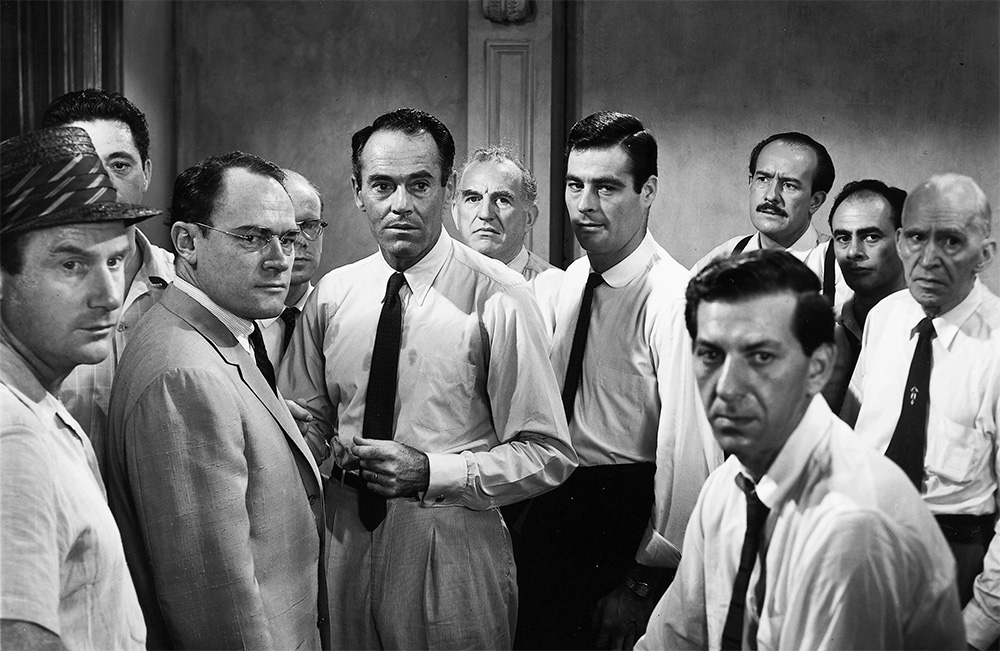
The classic film 12 Angry Men, despite being almost 70 years old, still holds up remarkably well, and offers a message that remains relevant today.
The film, directed by Sidney Lumet and released in 1957, stars Henry Fonda as juror eight, in a 12-man jury that is supposed to determine whether a 17-year-old boy murdered his own father in cold blood. If the boy is found is guilty he will be executed, with no chance in a change of punishment.
Everyone else is sure that the boy murdered his father, however Fonda’s character isn’t quite convinced. And for the next 90 minutes he has to try to persuade the rest of the jury that this boy might be innocent.

This film is a master class of giving exposition and character backstory. Every character gets across their professions in ways that would be natural in this situation. As everyone is locked in the room until they reach a verdict, at times they talk about their personal lives a bit trying to get across a point.
Within the first few minutes in the jury room the audience learns the main characteristic of each juror. With them being:
Juror No. 1 (Martin Balsam) the person who’s given the unenviable responsibility of trying to keep the situation under control.
Juror No. 2 (John Fielder) is the youngest and most inexperienced when it comes to jury duty.
Juror No. 3 (played masterfully by Lee J. Cobb) believes the kid is guilty more than any of the others and has an estranged relationship with his son.
Juror No. 4 (E.G. Marshall) is a stock broker and uses logic to dictate his actions.
Juror No. 5 (Jack Klugman) grew up in a slum and knows what it’s really like.
Juror No. 6 (Edward Binns) is a salt to the earth construction worker and is very respectful towards his elders.
Juror No. 7 (Jack Warden) has some bets on a baseball game and just wants to get this over with.
Juror No. 8 (Fonda), while not 100 percent sure that the kid is innocent, believes they should at least discuss it.
Juror No. 9 (played by Joseph Sweeny), a kind old man who respects bravery.
Juror No. 10 (Ed Begley), a rude and bigoted man who holds several prejudices against people in slums.
Juror No. 11 (George Voskovec), is a foreigner and a watchmaker.
And Juror No. 12 (Robert Webber), is a kind-hearted, if sometimes empty-headed advertising executive.
The film also does a great job of going over the evidence of the case and showing how some people might legitimately think that the boy is guilty, with the holes in the arguments not being head-bangingly obvious.
This film also knows how to build tension.
Early on in the movie it is explained that it is the hottest day of the year, they’re stuck in a small room, and the fan doesn’t work. Aside from the very beginning and the very end, the film takes place in this room, letting the claustrophobia and tension build naturally as the arguments given by the characters get more and more heated.
The camera work in the film is done beautifully. An easy example is when the jury first walks into the juror room and the camera goes around and introduces the characters in one long take.
Or how early on the camera looks down on Henry Fonda, symbolizing how small and seemingly insignificant he is. However as the film progresses and he manages to convince more and more people that the kid may be innocent, the camera looks up at him symbolizes the superiority he’s gaining over the people who are die hard set that the defendant is guilty.
The film, despite being released in the ‘50s, is timeless. No one talks in the stereotypical ‘50s style with them going “see” and smoking a cigar in between every other word.
The film itself isn’t just timeless, but so is the message, that being “don’t judge people based on superficial factors, like where they grew up in, but on what kind of person they are.”
This message is best shown with jurors No. 5 and No. 10. Throughout the film juror 10 makes several prejudicial remarks about people who live in slums and constantly calls the accused “one of them.” This comes to a head when juror 5 finally yells at him and tells him he used to live in a slum, saying that not all people who live in a slum are criminals.
One of the best parts of the film is how Henry Fonda’s character gets some of the more excitable characters to say things they really shouldn’t say in order to prove a point.
As an example, early in the film they argue about how a neighbor heard the kid say how he was going to kill his father, they argue whether he really meant it or if it was just heat-of-the-moment arguing. Henry Fonda eventually proves his point by egging on Lee J. Cobb to the point where he needs to be held back and says he’s going to kill him, with Fonda simply responding with “You don’t really mean that do you?”
Speaking of Lee J. Cobb, he’s the best part of the film hands down. He masterfully acts both intimidating but at the same time does a great job giving off the vibe that he has his own baggage that he needs to sort out.
There are few films one might consider a masterpiece, but this film is certainly one of them.
If a person doesn’t want to watch black and white films fearing that they’re boring this film is a great way to change their mind and possibly convince them to watch other black and white films.