
ICE (U.S. Immigration and Customs Enforcement) agents are detaining more people than ever before in the United States – and I can’t stop wondering how many families must be broken before we decide it has gone too far.
I am used to seeing immigration enforcement reduced to headlines and statistics: Thousands detained, facilities overcrowded, rules tightened. Those figures dominate headlines and briefings. But they flatten a reality that is deeply human.
Behind every headline and statistic is a parent who packed lunches in the morning and never came home at night, families who came to this country believing safety and stability were possible.

Alex Brandon/AP Photo
I find it impossible to separate those stories from the reality of ICE detention today. Overcrowded facilities, reports of inadequate medical care, and aggressive enforcement tactics point to a system that values punishment over humanity. When detainment becomes routine and brutality becomes normalized, enforcement stops being about law and order and starts becoming something far more dangerous.
Many individuals in ICE custody have no violent criminal history. Some have lived in this country for years. Some are raising U.S. citizen children. Yet they can be taken from their homes in minutes, separated from their families without warning, and sent to detention centers far away.
Being treated as if they do not matter.
An office staff member within the Highline Public Schools district, has seen that reality directly when families are forced to withdraw their children from school.
“It is very sad to see it firsthand, where people are coming into the office crying because they have to leave their life behind,” they said. “Some of these kids didn’t even grow up in the country they’re being sent back to. The parents just want the best for their kids, and being here was giving them that.”
For children, the damage can last a lifetime. Young kids have been detained, transferred across states and placed in unfamiliar environments. Immigration enforcement doesn’t stop at detention centers – it reaches into classrooms. Young kids grow up with constant fear. Education is disrupted, and anxiety becomes part of daily life.
“Kids are scared every day,” the office staff member stated. “We’ve had parents call saying they saw ICE pass by, and that they’re keeping their child home from school to be safe.”
What hurts most is how normal this has become.
We scroll past these stories. We shake our heads. Then we move on. But this issue is not something to ignore. It affects our classrooms, our neighborhoods and our futures. Immigrant families are part of our communities. When they live in fear, we all lose something – trust, stability and compassion.
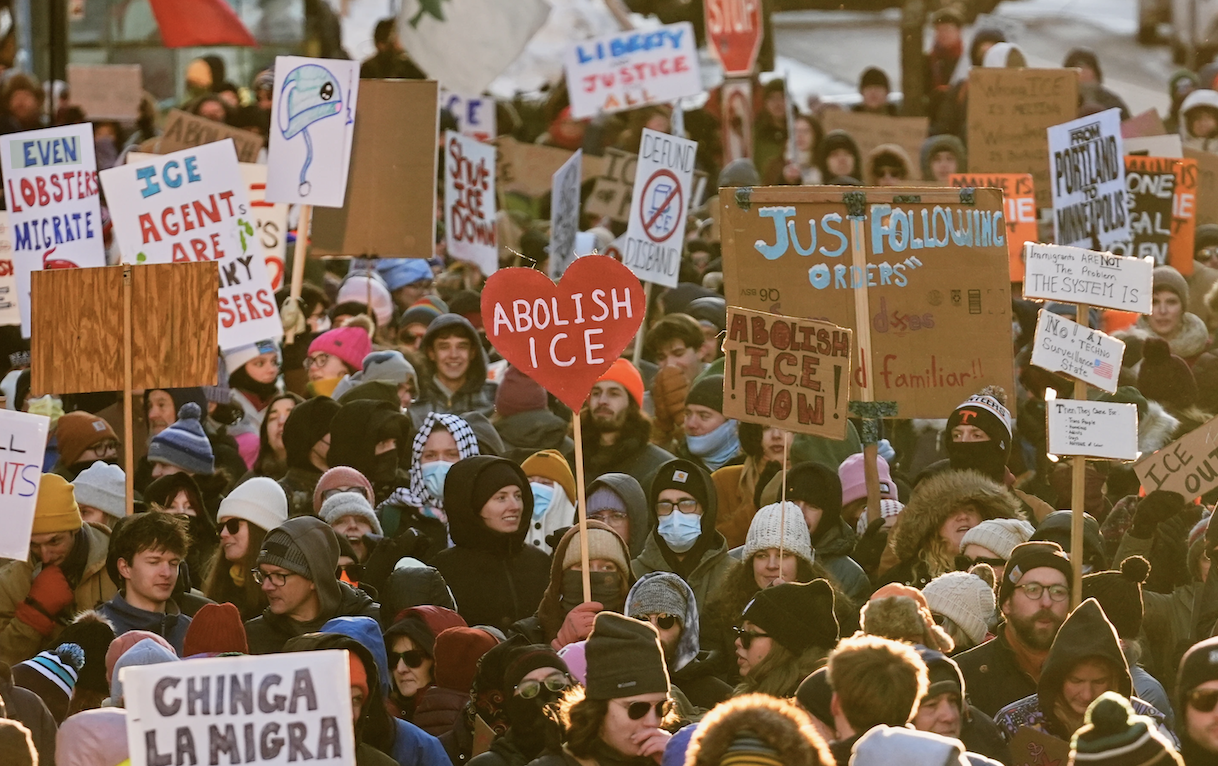
Across the country, people are refusing to stay silent. In places like Minneapolis, Maine, and Los Angeles, communities have gathered in the streets to protest the rise in ICE detentions and demand change. These demonstrations show that many Americans are no longer willing to accept policies that tear families apart.

Jae C. Hong/AP Photo
I come from an immigrant family. My family came to the United States from Honduras searching for opportunity and stability, believing this country could offer a safer future.
Watching ICE detentions rise feels deeply personal, and the reports of brutality feel impossible to separate from my own life. It breaks my heart to imagine families like mine are being torn apart, children coming home to empty houses, parents treated as disposable.
Witnessing this over and over, the staff member has changed the way they view ICE detainment and raids as a whole. “We hear about it on the news, but for them, this is their reality,” they said. “They’re going back, and they don’t have options.”
These are real human beings with dreams, fears, and love for their families – not criminals, not statistics, and not something to be labeled or erased. When people are reduced to their immigration status, their humanity is stripped away, and that is something that should not be taken lightly.
If the office staff member could speak directly to lawmakers and immigration officials, they said their message would be simple. “Remember humanity,” they said. “These are people. They have lives here. They are not doing any harm. Treat them how you would treat your own family. Have a heart, don’t be heartless.”
We should not accept a system that traumatizes children and tears parents from their homes. We should not measure success by how many people we can detain. We should measure it by how many people we protect.
As students, we are taught to stand up for justice, fairness, and human rights. This is one of those moments. Silence is easy. Caring is harder.
The next time we hear about another raid, another detention, another family separated, we should ask ourselves one question:
If this were my family, my future, my life – would I still be ok with it?