
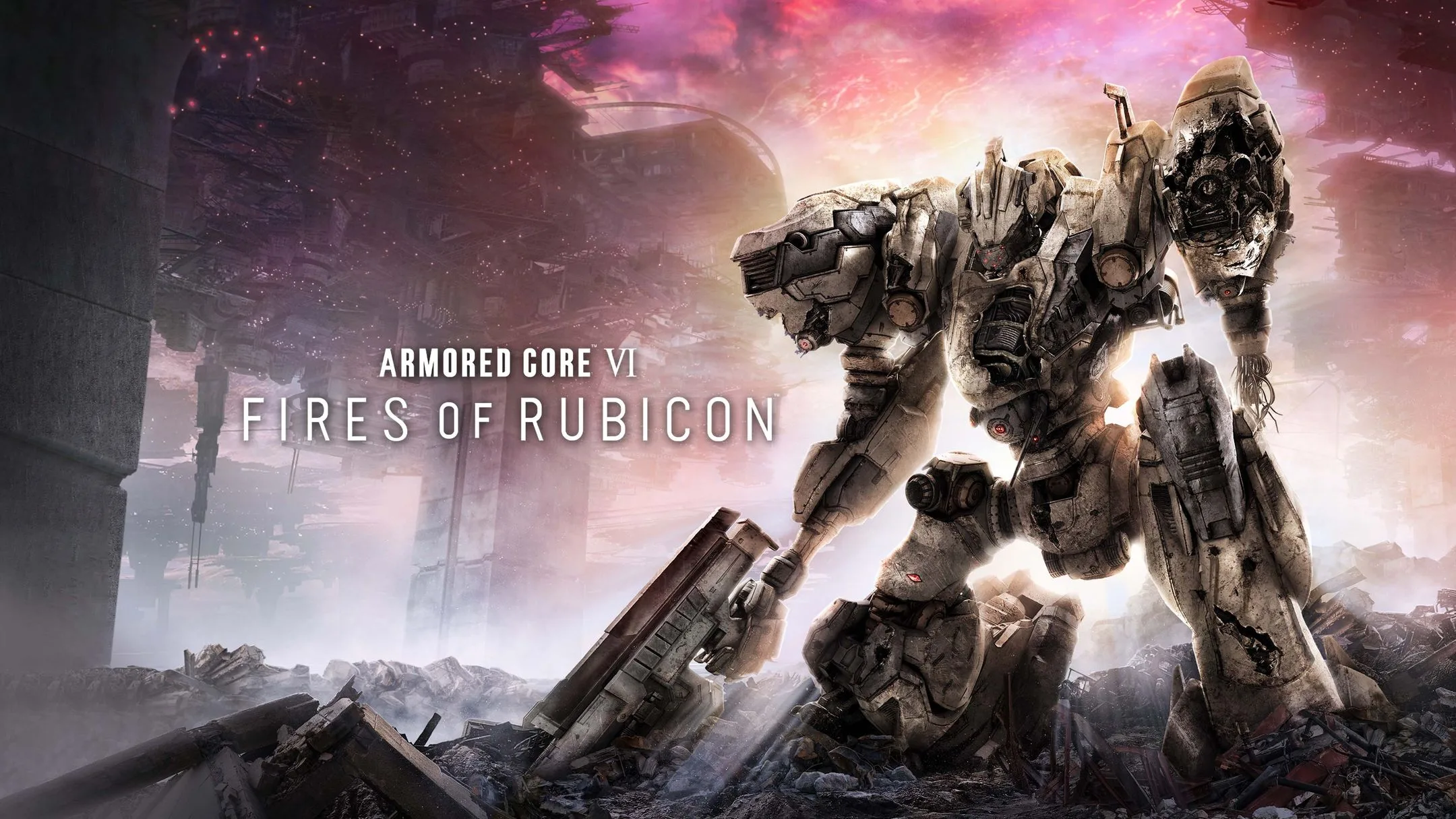
I’ve always been a fan of giant robot action. From “Transformers” and “Mobile Suit Gundam”, to “Pacific Rim” and “Titanfall”, mecha combat has had its grip on my heart. Earlier this year, “Mecha Break” joined the ranks, and now “Armored Core VI: Fires of Rubicon” has as well.
**Be warned, spoilers for “Armored Core VI” await.**
The game starts off with a sullen and tense mission to acquire a pilot’s license for you, 621, an augmented human piloting a mecha known as an AC, or Armored Core. Coming from offworld, you and your boss, Handler Walter, sneak onto the planet of Rubicon and loot the license from an AC wreck.
However, trouble soon comes as a group known as the PCA (Planetary Closure Administration) shows up and attacks you for trespassing. As the game reveals, Rubicon is a barren wasteland after an apocalyptic event involving an energy source known as Coral was lit ablaze, causing a planetwide explosive burst of flame that left the planet lifeless.
Of course, Coral itself is not to blame and some of it still remains deep underground. Using your new alias, Raven, the player takes on missions from two corporations and a rebel faction known as the RLF (Rubicon Liberation Front) to make ends meet while Walter tracks down the last reservoir of Coral.
This turns complicated as secret plots from each faction (persons of interest) rise to the surface, leading to a clash over the usage of Coral and Rubicon’s fate. In the end, the player must choose how the Coral is handled.

Bandai Namco
Despite it being a FromSoftware game, “Armored Core VI” is more linear and isn’t open world. While the areas that you go through in missions are open with explorable areas, they are small and have a set path and events in them. “Armored Core VI” also has a set storyline that’s told to you, not sprinkled in secret notes across the world.
While there are story details that you find in data logs left around certain missions, the main story is perfectly understandable without them. I appreciated that as I’ve never been a big fan of games where you have to seek out every single detail of the main story yourself.
What I really loved about “Armored Core VI” though, is the freedom in gameplay. Wanna pilot a heavy AC with big explosive weapons and powerful armor? Go ahead, tank treads are your friend. Prefer being a quick dasher with a lethal blade? Go ham, there are so many good melee weapons, you could drown in choices. If you have an idea, it’s most likely possible.
I dedicated hours just to bringing life to AC ideas I wanted to try out. It’s a fun experience and I hadn’t felt that free with customization since “Baldur’s Gate 3”. This customization is important to gameplay of course though, so choose wisely.
While the FromSoftware difficulty is prevalent in the game, I did have fun getting used to bosses and timing my attacks to punish them without getting hit myself. While some made me grit my teeth and walk away from the game for a moment to cool off, most of the bosses are easy to understand and beat down.
The game has many intricate values and techniques that you have to keep in mind, but those add a lot of freedom to how you attack a mission or an enemy. The slow but hard hitting bosses are easy to get around, but one mistake will lead to you getting melted. Meanwhile, the fast moving enemies don’t hit very hard, but they are difficult to track.
Getting back to the story, there are three endings to “Armored Core VI”. The first two are the base endings, Liberator of Rubicon and Fires of Raven. The first is the “good” ending where you unite with the RLF and kick out the corporations whilst stopping Handler Walter from destroying the Coral and killing everyone on Rubicon.
Meanwhile, the “bad” ending is where you side with Handler Walter and destroy the Coral, burning Rubicon again. While both endings have their pros and cons, it’s clear that one is better than the other…Fires of Raven.
Jokes aside, there is no definitive good ending because the game isn’t about a defined good path. However, the third ending, Alea Iacta Est, is the most complicated and takes good and bad from both.
While the first two endings have you make a serious gamble based on your own personal experience with Rubicon, the third ending has you follow the commands of AllMind, an independent mercenary networking AI and do strange missions involving the Coral.

Bandai Namco
Unlike Liberator and Fires, Alea is vague and somewhat uncomfortable as it involves backstabbing nearly every character of interest in the game. This all culminates in the somewhat obvious twist that AllMind was using you and now plans to remove you as you’re a “threat to Coral release.” Oops, the creepy AI that had you betray people, has betrayed you! Shocking.
No hate to the plot twist of course, it’s just hilariously obvious even before the twist. The real twist is that one of the many characters that you defeated throughout your run through of the game, G5 (read Gun Five) Iguazu, is going to be the one that tries to kill you.
What makes this particularly interesting, is that G5 Iguazu is your self-proclaimed rival that’s obsessed with taking you down to prove his strength (which is made worse by the fact that you kick his tail every single time). Even though he died in your previous fight with him one mission before, Iguazu returns to kill you, but with a super powerful AC that’s been given to him by AllMind.
This bossfight is the culmination of the entire game, and as such, it tests all your skills. It’s the ultimate final battle and takes bits and pieces from every major boss in the game, and I didn’t care for it. While I get what the goal was for this fight, the perfect enemy that is a mix of every foe you’ve ever faced, the execution is bloated and downright infuriating.
Though every boss and miniboss have their grating moments, the Iguazu-AllMind bossfight is infuriating the entire way through. Between hard to read melee thrust attacks, annoying grunts jumping in and getting in the way, and the beyond annoying stun attack Iguazu unleashes in the third phase of the fight, I simply didn’t enjoy the fight.
Despite this gripe, I did love playing “Armored Core VI” and exploring the world it laid out. To me, there’s nothing funner than moving around in a giant robot suit and wreaking some major havoc. There’s something exhilarating about piloting a massive super-powered robot and showing the world what for.
While “Titanfall” took on a more grounded and tactical approach to this idea, “Armored Core VI” went with a more dramatic and industrial vibe which tends to be unexplored thanks to it being less “cool” to look at. I really enjoyed the aesthetic and overall atmosphere of “Armored Core VI”. The story was incredible, and while I didn’t like every story beat, I had a good time overall.