
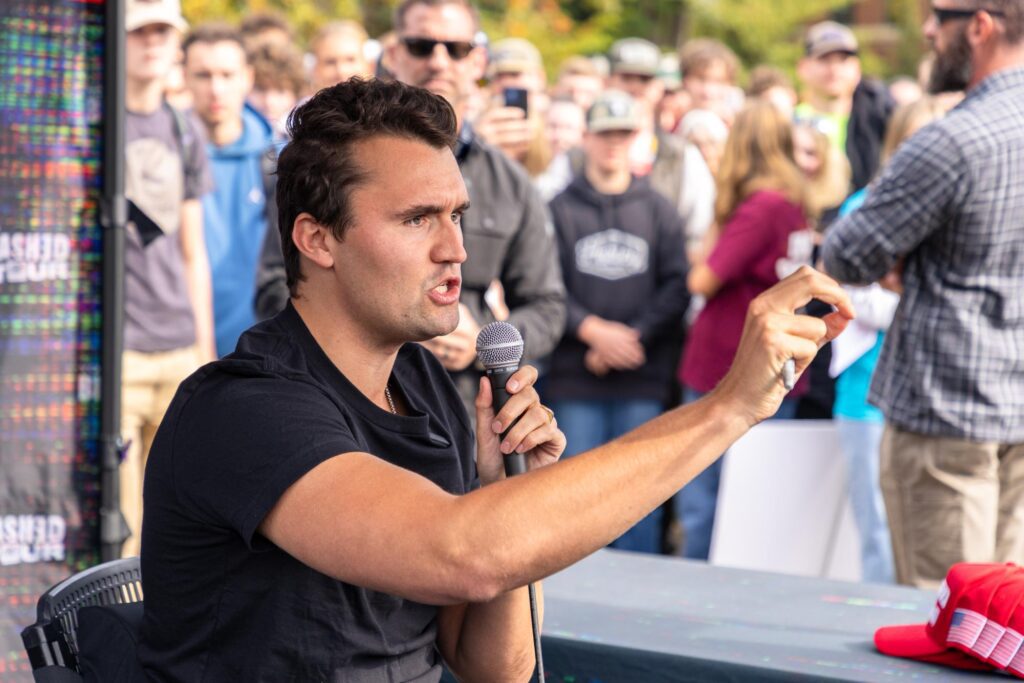
On September 10, 2025, conservative activist Charlie Kirk, founder of Turning Point USA, was fatally shot while speaking at an outdoor event at Utah Valley University in Orem, Utah.
Kirk, 31, was one of the most visible figures on the American right, known for his sharp critiques of progressive politics, outspoken support of President Donald Trump, and his pro-Israel positions.
Authorities quickly identified Tyler James Robinson, 22, as the prime suspect. Robinson has been charged with aggravated murder, and prosecutors have announced plans to seek the death penalty.
Investigators say Robinson’s DNA was found on the rifle used in the shooting and on a towel wrapped around it. Shoe and palm prints recovered from the rooftop where the shot was fired also match the suspect. Surveillance footage released by the FBI shows a man on the roof moments before the fatal shot and then fleeing the scene.

The Daily Beast/Handout
In the hours after the attack, an older man named George Zinn falsely claimed responsibility. Investigators later dismissed his confession and arrested him for obstruction, calling his statement a distraction from the actual case.
Prosecutors allege Robinson was motivated by his belief that Kirk’s rhetoric spread hate. According to court filings, he exchanged text messages with his roommate and romantic partner, Lance Twigs, discussing Kirk in the days leading up to the attack. Critics of the prosecution, including some of Kirk’s allies, argue the text messages appear inconsistent, with missing timestamps and unusual phrasing. They claim the messages could have been altered — an issue expected to be examined closely in court.
Still, major questions remain.
Surveillance shows Robinson entering campus around 8:07 a.m., yet the shooting occurred shortly before noon. What happened during those four hours has not been fully explained. Questions also linger about security: why officers shifted position moments before the shot, and whether multiple people were involved.
Meanwhile, conspiracy theories have flourished. Some claim Kirk’s death was linked to his shifting stance on Israel, pressures from major donors, or even files connected to Jeffrey Epstein. Others point to gaps in video footage or inconsistencies in the indictment.
Prominent conservative commentator Candace Owens, a close ally of Kirk, has suggested the public is not being told the full story. She criticized Utah’s Governor Spencer Cox, accused donors of pressuring Kirk, and linked the controversy to what she called “a post-Epstein world.”
So far, investigators have not substantiated claims of foreign involvement, donor disputes, or connections to Epstein. Instead, the case against Robinson centers on forensic evidence, surveillance footage, and his alleged statements to friends and his roommate.
As the case moves toward trial, the tension between official findings and public speculation is only deepening. To Kirk’s supporters, the assassination represents a devastating loss for the conservative movement. To critics, the violent act underscores the volatility of America’s political climate. And for investigators, the task remains to cut through rumors and prove what really happened on that rooftop in Utah.
Divided Reactions in Congress
The murder of Charlie Kirk drew near-universal condemnation across the political spectrum, but not all lawmakers agreed on how to memorialize his legacy.
When the House introduced a resolution to honor Kirk’s life, Rep. Alexandria Ocasio-Cortez (D-N.Y.) voted against it, delivering a floor speech that highlighted both the tragedy of his death and the deep partisan divides surrounding his legacy.
Ocasio-Cortez condemned the assassination as “a horrific, vile attack of political violence,” stressing that such violence must be rejected outright. But she argued that the resolution to honor Kirk’s life was drafted recklessly, “on a purely partisan basis,” rather than through a bipartisan measure focused on condemning political violence itself.
She noted that Congress had come together in the past after similar tragedies, pointing to the resolution honoring the late Minnesota House Speaker Melissa Hortman, and suggested that Republicans were exploiting Kirk’s death for partisan gain.
Ocasio-Cortez also criticized Kirk’s record, citing his rejection of the Civil Rights Act, inflammatory comments about Jewish influence in media and education, and dismissive statements on systemic racism. She argued that celebrating Kirk’s “life and legacy” whitewashed the harm of his rhetoric.
“It is not a license for the abuse of power and whitewashing of American history,” she said. “This resolution brings great pain to the millions of Americans who endured segregation, Jim Crow, and the legacy of bigotry today.”
Her remarks underscored the irony she saw in honoring a figure whose positions, in her view, sought to disenfranchise vulnerable groups, while simultaneously warning against censorship and the politicization of tragedy.
Ocasio-Cortez closed her speech by offering condolences: “We continue to pray for Mr. Kirk’s family in the wake of this terrible act. I am thinking especially of his children and his wife, whose grief cannot be measured.”
The Larger Debate on Kirk’s Ideas
Kirk’s death has also revived scrutiny of the ideas he promoted. He was often criticized for rejecting the concept of systemic racism, a position challenged by scholars such as Professor Tim Wise of Stetson University, who has lectured widely on the enduring realities of racial inequality.
In debates with progressive figures, including journalist Briahna Joy Gray, Kirk defended conservative positions on race, economics, and free speech. These debates often showcased both his rhetorical strengths and the sharp criticisms leveled at him by opponents.
For supporters, Kirk was a fearless defender of conservative values; for critics, he embodied the dangers of right-wing populism. His assassination has amplified both perspectives, leaving Congress, commentators, and the public bitterly divided not only over his death but over his contested legacy.