
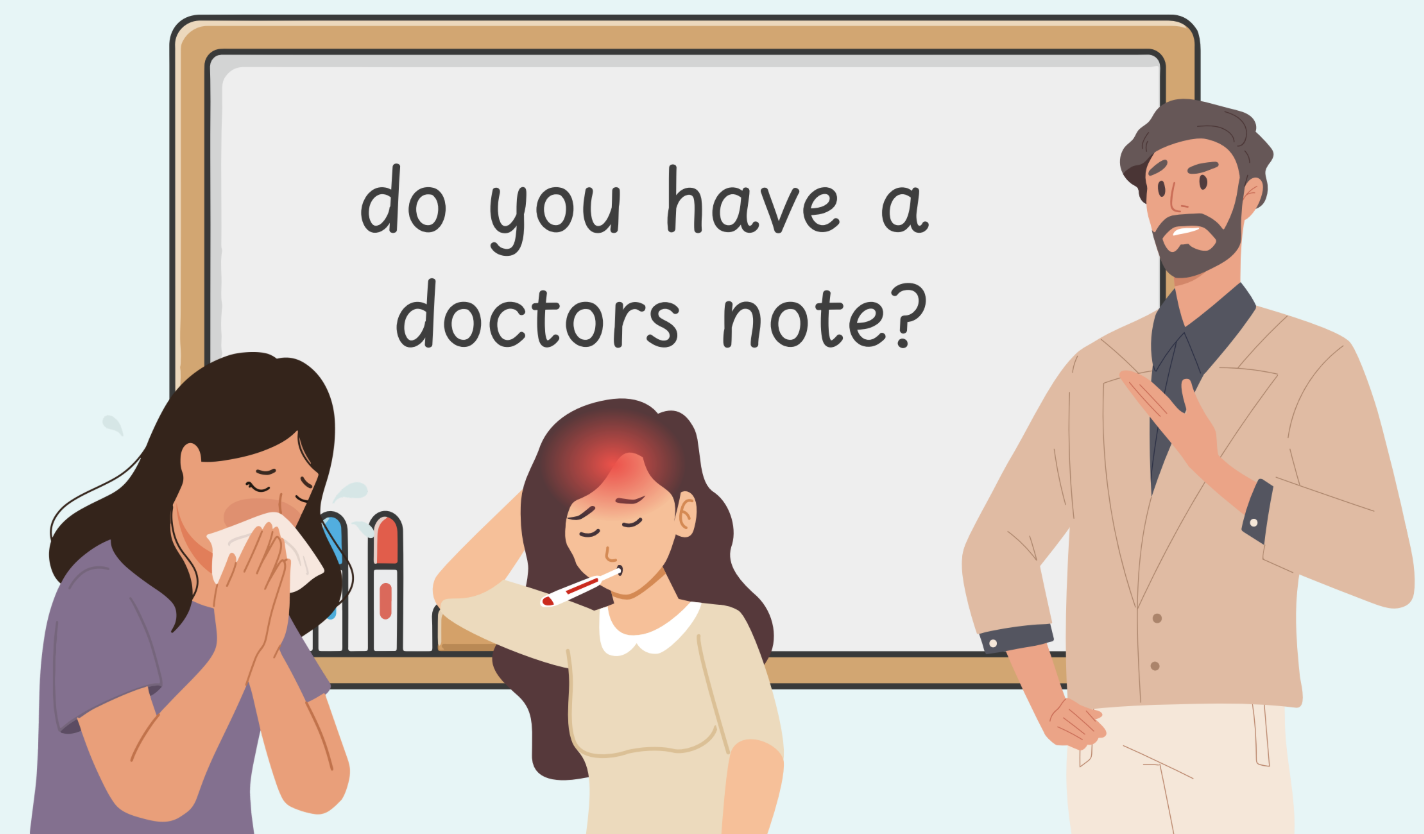
As healthcare access rises in costs and lowers in accessibility, college syllabus policies have fallen behind in accounting for the challenges students are facing in accessing doctor’s notes – a common requirement for excused absences or assignments.
While Highline does not have a standard attendance or makeup policy for students, faculty are left with creating their own policies in their syllabus. The Highline inclusive syllabus policy encourages faculty to remain flexible and understanding, and insist a “make up” policy about late work and missing assignments or exams be included.
When professors are writing their syllabus, nowhere does it say on the syllabus policy provided to professors that students must provide a doctor’s note to make up course work they may have missed due to illness. But some faculty have taken it a step further, requiring students to provide official doctor’s notes as the “make up” policy.
Helen Burn, a Highline professor tells the ThunderWord “No one reviews our syllabus for this policy.”
On the other side, Highline does not ask the same requirement from its faculty when they are absent or cancelling class. Burn shared, “We just fill out an absence report and the type (e.g., sick leave, personal leave).”
In a survey conducted by the ThunderWord, 50% of respondents said they were required to provide a doctor’s note by a professor to be allowed make up work or tests. And 69% of respondents admitted to having to pay for a doctor’s note – ranging anywhere between $10 to $200. Of these, 50% of respondents had to pay out of pocket, with 18.8% admitting to not having medical insurance.
One response read, “I ended up forfeiting a retake on a quiz because I couldn’t get a doctor’s note.”
Another wrote, “I got laid off at the time and had no medical insurance so I had to pay for it out of pocket.”
Another Highline student stated, “It was frustrating and stressful. I couldn’t get the support I needed, and it made things harder for me. It was worse because it was an online class, so there’s no need for an online class professor to be that strict with deadlines.”
A Highline student tells us in the survey, “I think it’s bullshit honestly, we’re all adults here and we should be trusted to tell the truth of if we’re sick or not. Most of us are paying to be here so why would we lie in the first place?”
“Why don’t professors trust their college-aged students?” one student responded.
The distrust students feel from the professor comes from this doctor’s note requirement, which is compounded by being sick or ill and needing to worry about classes and assignments. The practice was described as “unnecessary” and “really stupid.”
“It adds an additional cost that not everyone can afford. College is expensive enough, why erect another barrier to education?” another respondent commented.
Although the college also has running start students, many are in agreement that they should be treated as trusted adults, and not children. After all, many are paying out of pocket for their education.
College students here at Highline want their voices heard, and to be believed when saying they are sick, they shouldn’t need to have doctor’s note that could affect their financial and emotional state even further.