
Asian American and Pacific Islander Heritage month honors the history, culture, and contributions of Asian Americans, Native Hawaiians, and Pacific Islanders (AANHPI) in the United States. It’s celebrated annually in May, so as May comes to a close, I find it only fitting that we review some of the contributions the AANHPI communities have made to American culture.
Starting with Asian Americans, one of the first documented contributions was in the 1860s with the Central Pacific Railroad – a major part of the Transcontinental Railroad. The work was very high risk and very little reward, and this sparked the 1867 Chinese Labor Strike.
By this time, 80-90% of the Central Pacific Railroad workforce was Chinese, and the strike threatened the company’s efforts. It was an organized and nonviolent strike, and although it quieted down after a week, it forced the company to raise the workers’ pay.
Throughout the years Asian Americans have been foundational in the science, technology, and the medicine worlds, contributing wonderful and groundbreaking innovations. From Physicist Chien-Shiung Wu, who vastly improved radiation detection and uranium enrichment during WWII in the Manhattan Project.
To space tech trailblazers like Kalpana Chawla, the first Indian American woman in space, and astronaut Ellison Onizuka. Both of which pushed the boundaries of aerospace engineering. Dr. An Wang’s early magnetic core memory inventions, to Eric Yuan’s development of Zoom. All of this shows that modern communications are built on AANHPI innovations, and more continue to be created throughout the years.
These, however, are only the tip of the iceberg. Native Hawaiians, or Kānaka Maoli, or Kānaka ʻŌiwi are the indigenous people of Hawai‘i and have influenced major parts of American society. From holistic healing and wellness practices, environmental and land stewardship, to military and strategic geography.
Lā’au Lapa’au are traditional Hawaiian herbal medicine and holistic healing practices that have heavily influenced alternative American medicine and wellness industries. Pacific Islander military personnel also heavily contribute to the U.S. Indo-Pacific operations and large-scale humanitarian relief missions. Native Hawaiian sailors and navigators were instrumental in the 19th-century maritime fur trade and whaling, which built massive wealth for New England merchants.

Aiden Sonsteng/THUNDERWORD
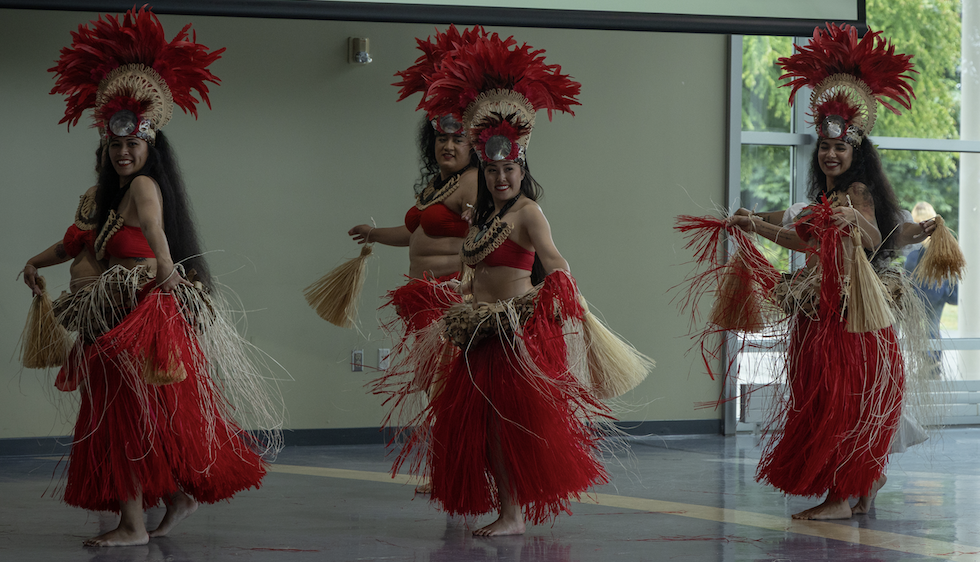
A Pacific Islander cultural dance was performed at Highline’s Global Fest last Tuesday.

Aiden Sonsteng/THUNDERWORD
A Pacific Islander cultural dance was performed at Highline’s Global Fest last Tuesday.

Aiden Sonsteng/THUNDERWORD
A Pacific Islander cultural dance was performed at Highline’s Global Fest last Tuesday.
The AANHPI communities have contributed heavily to American society throughout the decades, and continue to do so. But let’s clarify some things. There is a long history of injustices driven by white American-led policies, xenophobia, and white supremacy. And what is listed below, isn’t even half of it.
The California Constitution of 1879, deterred Chinese immigration into California by prohibiting corporations from employing them. This specific part of the constitution restricted and decreased the number of Chinese people in California. Why? Because they feared that they would take over the state.
Then there was the Chinese Exclusion Act of 1882. This law banned the immigration of Chinese laborers. It wasn’t repealed until 1943.
Something local was the Seattle Riot on Feb. 7, 1886. White workers rounded up virtually every Chinese person in Seattle and violently expelled them, forcing them to board a waiting boat for passage out of town. As with similar expulsions throughout the West, the victims were never compensated.
Indigenous languages, including ʻŌlelo Hawaiʻi, were legally banned in schools and public venues to force assimilation into American culture, white Americans and Europeans suppressed traditional religious and healing practices in Hawai’i in the name of Christianity, stripping Native Hawaiians’ of their beliefs, values, culture, and traditional practices.
By 1893 when white Americans and Europeans overthrew the Hawaiian monarchy, fewer than 40,000 Native Hawaiians remained.
During the ‘40s and ‘50s, the U.S. conducted dozens of nuclear tests in the Marshall Islands in the South Pacific. This action devastated the local ecosystem. It displaced Indigenous populations and caused severe, multi-generational health crises from radiation exposure.
There has been extensive land use for military bases in places like Guam, Hawaii, and American Samoa which has continually disrupted traditional ways of life and restricted Indigenous access to sacred sites.

Jib Kiattinant of Stanford University
The AANHPI populations are frequently aggregated with other groups or completely omitted from research altogether. This “data genocide” or erasure hides the stark disparities in health, poverty, and wage gaps, making it difficult to advocate for community resources.
White Americans need to do better. America is said to be the “melting pot” of cultures and identities – but how can we live up to that name if we continue to hate and erase the cultures that make up our society?
Whether you like it or not, the U.S. is full of immigrants – white Americans ARE IMMIGRANTS. America is built from: Hispanic & Latino American, African American, Middle Eastern & North African (MENA), Indigenous Americans, and AANHPI communities, and the list goes on.
They are the foundation of our lives and our society and these communities are what gives vibrancy to the U.S. and white Americans should treat them as such.