
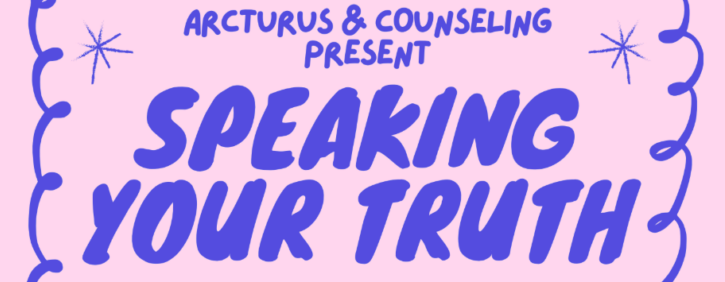
How can poetry be used as a way to empower ourselves? That question informed the activities taking place during “Speaking Your Truth”, the third event put on by Highline College for Week of Wellness, which took place from May 5 to May 7. Hosted collaboratively by the Counseling Center and the Arcturus editing team, “Speaking Your Truth” was held in Building 2 from 1 p.m. to 2 p.m.
Mavrie Durham of the Arcturus editing team and Darlyn Harris of the Counseling Center began by leading the audience through a guided meditation. Alongside doing guided meditation as a group, attendees were able to partake in light refreshments such as cookies, bagels, and soda. To stay on theme, free notebooks and copies of last year’s Arcturus were handed out.
When asked about the appeal of this event, Alex Lawrence, the program manager of the Counseling Center, said, “We ran this event last year, and I’m glad it’s back because it’s great hearing student poetry and [using] poetry as a tool to check in with yourself is a great outlet. We have great, expressive students on campus.”
Last year’s writing and wellbeing-related event was called “Ink and Insight” which was, “a very similar event that followed the same formula,” said Durham. “It was a big hit, so we were trying to recreate that under a different name.”

Max Juedeman/THUNDERWORD
“Speaking Your Truth” can be a loaded phrase, as everyone has their own experiences and truths to share. This may have contributed to the majority of the attendees being faculty and less of them being students. The tone of the audience was somber due to the subject matter of some poems being performed. “We had a few engaged students once the poetry readings took place. There was a lot of engagement, it was conversational, which was fun, but it was sparse,” said Durham.
“I think people were nervous due to it not being fun storytelling stuff. The point of ‘Speaking Your Truth’ was for [attendees and poets] to speak their truth, so there was some heavy stuff,” continued Durham. “That was the goal of it, to create a space where people could engage and feel empowered by that. The turnout wasn’t quite what I wanted, that goes into the minimal promotion we did leading up to the event and understanding what we need to do leading up to the event to improve turnout.
[The preparation for the event] was two short meetings between me and one of the counselors that was putting [‘Speaking Your Truth’] on, Darlyn Harris. It was really fun working with them in that capacity. I think this type of event is now a sure thing, hopefully it’ll happen next year. The turnout of this year’s event determines whether it happens next year or not, but I hope it does and that they can improve upon what we did this year.”
Although “Speaking Your Truth” was pulled off through the determination of the Counseling Center and the Arcturus editing team, there were still a few challenges along the way. “There were a few challenges,” said Durham. “I was responsible for gathering poets and reaching out to them and corresponding with them so they could come out and read. That was very challenging because we hadn’t sent out any acceptance emails for the Arcturus. Anyone that we wanted to invite, we had to let them know before anyone else that they had been accepted and were invited to speak at this event.”
Selected poets were notified of their selection and invitation to read five days before the event took place.
“Anything like that, when you’re chasing down talent, is like chasing cats, so it was tough [trying] to hear back from them since I hadn’t gotten access to the official Arcturus email at the time, I was using my own email,” said Durham. “At the event itself, there were a few technical difficulties with one of the videos from our poets, but otherwise it was pretty good.”
In Durham’s mind, a highlight of “Speaking Your Truth” was hearing Highline student Fatima Osman recite her piece, “Anger”. “[‘Anger’] was not just poetry, but a performance,” said Durham. “Her piece specifically focused on emotions as a way to talk about experiences where some [poems] focused on visuals, others the story. Hers was about emotion, and her delivery was incredible. I hope to see her read some more poetry.”
Because April was National Poetry Month and May is Mental Health Awareness Month, this event couldn’t have taken any other form. Durham expands on the value of poetry as a way to express oneself, saying, “For me, poetry is all about language and finding concise and powerful language to explain anything, whether it be emotions, experiences, visuals, concepts, stuff like that. It can help sort of translate our feelings and experiences and help us come to understand it.
I’m not a poet but I still write poetry because you can use plain language, you can use figurative language, all this stuff, but the structure of poetry means that you’re getting out what you need to get out. It’s less about fluff and more about what you’re writing a poem about. A lot like Osman, I [write poetry] a lot to express visuals and emotions. It helps me vent in a more creative way, in a less structured way. When you’re journaling, you have to have complete sentences, proper grammar, etcetera. With poetry, there are a lot less rules.”

Counseling Center