
Life on Earth is something we take for granted every day. However, billions of years ago, Earth wasn’t the bright and welcoming planet we are familiar with. With oxygen levels dramatically shifting over the course of an eon, scientists decided to investigate how early life may have survived.
Today, the Earth’s atmosphere is composed of about 78% nitrogen and 21% oxygen (1% consisting of other trace gasses like carbon dioxide). However, from the Archean Eon to the very beginning of Proterozoic Eon, Earth had little to no oxygen (in gaseous form) within its atmosphere.
Then, around 2.3 billion years ago, the Great Oxygenation Event occurred near the beginning of the Proterozoic Eon, due to cyanobacteria converting carbon dioxide into oxygen through the process of photosynthesis. This oxygen made it possible for the development of complex life forms (like us!) that we see today.
Back then, this was a big shift for life, as oxygen levels began increasing in a world that had never seen anything like it before. In an article titled “Ancient Hot Springs Reveal How Life Survived on a Toxic Early Earth” (2026) says, “There were no forests, no animals, and none of the familiar life forms that depend on oxygen to survive. In fact, for early organisms, oxygen was poisonous.”
Fatima Li-Hau, a graduate student from the Earth Life Science Institute (ELSI), decided to investigate (supervised by Associate Professor Shawn McGlynn at the ELSI) present-day, iron-rich hot springs in Japan that similarly resemble the environment of Earth’s early oceans.
Through their studies, they found that early microbial communities could gain energy by combining iron with small amounts of oxygen produced by photosynthetic microbes (such as cyanobacteria), converting a toxic byproduct into something they could use for energy.
“These iron-rich hot springs provide a unique natural laboratory to study microbial metabolism under early Earth-like conditions during the late Archean to early Proterozoic transition, marked by the Great Oxidation Event. They help us understand how primitive microbial ecosystems may have been structured before the rise of plants, animals, or significant atmospheric oxygen,” said McGlynn.
Despite these changes, life was able to persevere. This discovery was able to enhance scientist’s understanding of one of our most transitional periods here on Earth.
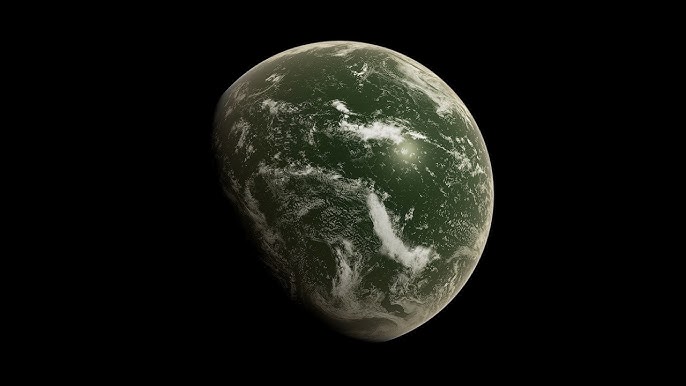
Dreksler Astral
Dreksler Astral’s representation of the early Earth.