
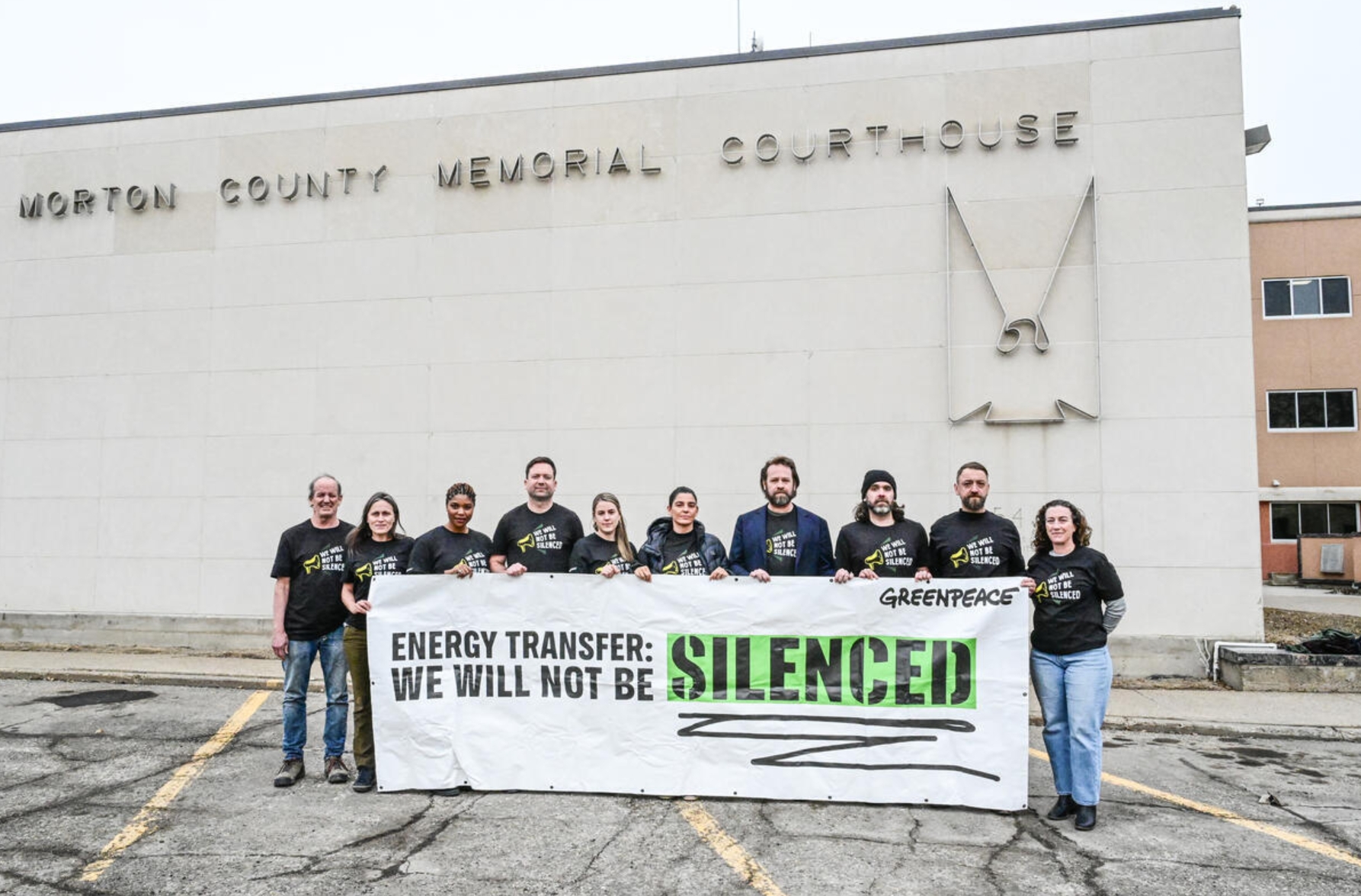
A North Dakota jury has reached the verdict that the environmental group Greenpeace has to pay $345 million to Energy Transfer Partners (ETP) over actions taken to prevent the construction of the Dakota Access Pipeline in 2016. The advocacy group intends to seek a new trial, and if denied, they will appeal the judgment with the North Dakota Supreme Court.
According to CBS News, Trey Cox, an attorney for ETP, “… accused Greenpeace of paying professional protesters, organizing protester training, sharing intelligence of the pipeline route and even sending lockboxes so that demonstrators could attach themselves to equipment.”
While the verdict has been made, Greenpeace groups in the U.S. such as Greenpeace INC, Greenpeace Fund, and Greenpeace International, claim there is insubstantial evidence to support these claims.

Greenpeace
Greenpeace U.S. Interim Executive Director Sushma Raman said in a statement, “It’s part of a renewed push by corporations to weaponise our courts to silence dissent. We should all be concerned about the future of the First Amendment, and lawsuits like this aimed at destroying our rights to peaceful protest and free speech.”
Greenpeace holds the argument that ETP’s lawsuit is an example of SLAAP (Strategies Lawsuit Against Public Participation). SLAAP is an acronym for a type of lawsuit intended to silence advocacy groups through legal fees. Prior to the verdict, Greenpeace warned that the payout could potentially lead to bankruptcy for the group.
Their legal trouble regarding the pipeline dates back to 2016, with the protests that arose due to the pipeline construction running under the Standing Rock Sioux Tribe’s reservation. More specifically, the tribe’s main drinking reservoir. The Dakota Access Pipeline (DAPL) that now carries crude oil across four states faced extensive criticism from the Sioux Tribal members, in addition to many other advocacy groups aside from Greenpeace.
These groups advocated for native sovereignty, environmental laws and regulations, and the environmental impact the pipeline would have. Despite the backlash, the DAPL was still constructed. It eventually ruptured into the residential drinking reservoir a year after its construction in April 2017.
According to Greenpeace, ETP’s first lawsuit was initially filed under the RICO Act (Racketeer Influenced and Corrupt Organizations Act). RICO is a U.S. federal law designed to prosecute mob activity. This initial lawsuit was later dismissed under a judge ruling of insufficient evidence under the RICO Act. Since the federal court did not decide on the state law, ETP filed a new lawsuit in North Dakota state court with the same claim.
Throughout this timeline, Greenpeace believes that ETP’s lawsuit is an intimidation attempt to silence free speech through criminalizing the peaceful protests that occurred during the DAPL construction.