
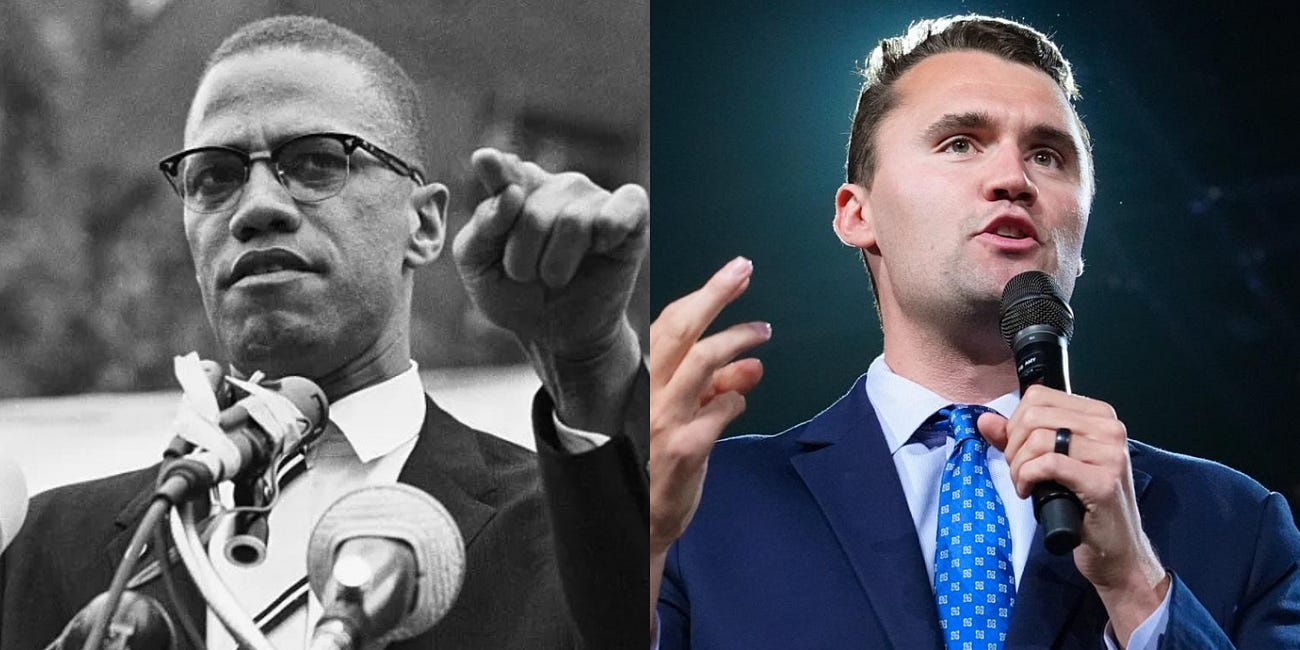
Two men, worlds apart in background and ideology, cut down mid-speech: Malcolm X in Harlem, 1965, and Charlie Kirk in Utah, 2025. One was a Black revolutionary seeking liberation from centuries of oppression. The other, a white conservative activist warning against cultural decay.
On the surface, nothing connects them. But look deeper and the parallels reveal something profound: both deaths testify to what happens when societies lose their cultural anchor. In the absence of shared identity and moral grounding, dissenters become targets and violence becomes a substitute for dialogue.
The Historical Mirror
Malcolm X was assassinated after breaking from the Nation of Islam and charting a broader vision of Black liberation. His new voice threatened entrenched structures; both religious and political, and the bullets that silenced him became a turning point in America’s racial history.
Charlie Kirk, by contrast, was assassinated while addressing a campus audience, a polarizing figure in the culture wars who challenged progressive dominance. For his critics, he symbolized everything wrong with modern conservatism; for his supporters, he gave voice to a silenced majority. Like Malcolm X, he died not only for his words, but for what he represented in a moment of civilizational crisis.
The Crisis of Cultural Identity
For Black Americans, the original wound was chattel slavery; a violent severing of language, heritage, and cultural memory. Through anti-literacy laws, enslaved Africans were deliberately stripped of the right to read or write. By criminalizing literacy, the system sought to silence memory itself; to cut off the transmission of ancestral knowledge, stories, and self-recognition. To forbid literacy was to forbid identity. Out of that fracture emerged both resilience and trauma.
Today, Western societies are experiencing their own crisis of identity. Religious faith has waned, family structures have fractured, and consumerism has replaced deeper meaning. What Black Americans endured under the lash – forced alienation from cultural roots; the West is now inflicting on itself through neglect. The result is the same: a population adrift, desperate for belonging, fearful of the future.
Parallels in Assassination
Both Malcolm X and Charlie Kirk were killed in public while speaking; visible symbols of dissent, made vulnerable because of their platforms. Both deaths carry symbolic weight far beyond the individuals: the silencing of voices, the polarization of communities, and the chilling effect on free expression.
Both men embodied polarizing identities. Each drew intense loyalty from followers and equally fierce hatred from detractors. In both cases, systemic forces played a role: Malcolm X was under constant FBI surveillance; Kirk operated in a climate where political demonization made him a lightning rod for violence. The pattern is clear: when societies fracture, charismatic voices are not debated, they are destroyed.
Differences That Matter
The parallels are striking, but the differences are essential. Charlie Kirk was battling for cultural influence inside a system that already included him, whereas Malcolm X, (as part of a despised minority), was battling for existence and equality within a system that structurally excluded him. Malcolm’s influence has endured across generations; Kirk’s legacy is yet to be written.
But even with these differences, the symbolic resonance of their deaths cannot be ignored.
A Warning for the West
Malcolm X’s assassination warned America of its racial sins. Kirk’s assassination warns the West of something broader: civilizational decay. When a people lose their sense of who they are, violence becomes a way of policing identity. When a nation silences dissenters – whether by bullets, censorship, or character assassination, it is not securing its future. It is announcing its fall.
A nation that silences its dissenters is not strong, it is defeated. And as the assassinations from Malcolm X to Charlie Kirk reveal, such violence signals a deeper crisis of identity.
Cultural identity functions as a society’s moral compass; when it falters, direction is lost, and dissenting voices become the first casualties of confusion. The targeting of thinkers and truth-tellers, whether through bullets or public defamation, signals not strength but moral instability. The West now confronts, in abstract form, what Black Americans once endured in the concrete – the pain of cultural disinheritance, the severing of memory from meaning.
The lesson is clear: when history and identity are neglected, violence rushes in to fill the void. It falls upon citizens, thinkers, and educators alike to guard the inheritance of cultural literacy, for in times of division, remembrance is resistance; and restoration begins with the courage to remember who we are.