
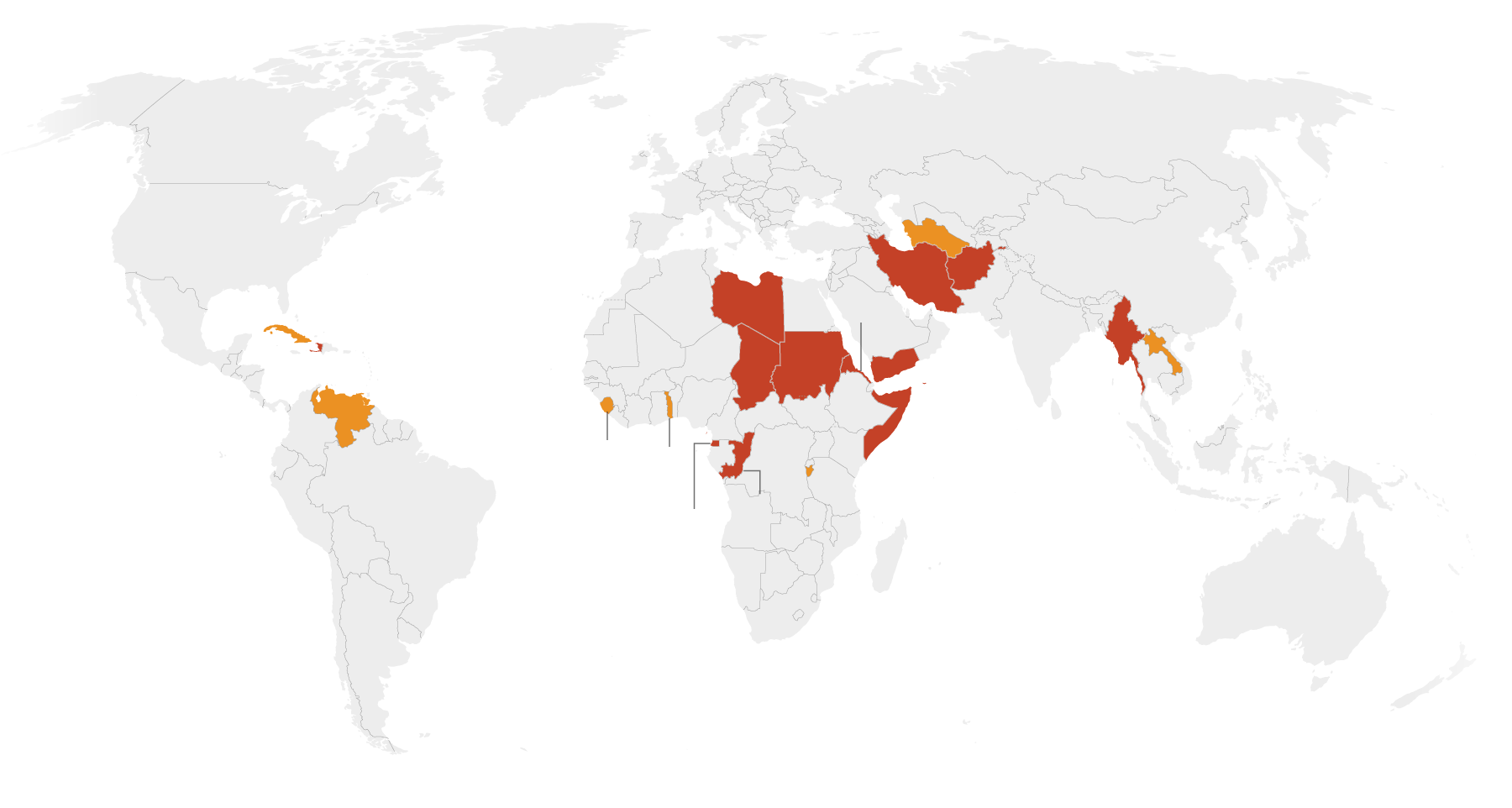
In a move that has reignited fierce debate around the country, President Donald Trump’s administration has reinstated a sweeping travel ban on nationals from 12 countries, primarily targeting Africa and the Middle East. The executive order took effect on Monday, June 9 at 12:01am EST, and now they are exploring additional restrictions on up to 36 nations.

New York Times
President Trump has defended the ban stating that it is crucial to preserve national security and prevent terrorism. When addressing reporters he declared, “Frankly, we want to keep bad people out of our country,” citing the firebomb attack in Colorado as justification.
The attack targeted a group gathering attention for the hostages in Gaza, and as NPR reports, “The man charged in the Colorado attack is from Egypt, which is not on the [original] restricted list.” Egypt was added onto the list of potential bans after Trump’s initial comments.
But critics argue the move unfairly targets vulnerable communities, revives anti-Muslim and anti-Black sentiment, and threatens to separate families for years to come.
Nadiah Alyafai, a Yemeni American organizer at the Arab American Action Network in Chicago, described the deep fear and anxiety gripping her community. “This is undeniably rooted in anti-Muslim, anti-Black, and anti-Arab racism,” she said. “Our families will be further torn apart as we will be unable to reunite with loved ones and elders simply because of our nationality.”
The human toll of the ban is immediate and undeniable. Venezuelan American immigration attorney Raquel Fernandez expressed heartbreak over the possibility of never seeing her elderly grandparents again. Her grandfather’s tourist visa expired just before the ban took effect, and now the family fears they will never secure a renewal. “They’re older in age, and if this ban continues and their visas are all expired, I won’t be able to see them ever again,” Fernandez said.
The impact is also being felt by students and universities. According to NBC News, more than 18,000 international students from the 12 banned countries were studying in the U.S. during the 2023-24 academic year. Dan Berger, an immigration attorney in Massachusetts, noted that while students currently in the U.S. are generally safe for now, those who planned to come this fall are likely to be blocked.
“We’re expecting just continued uncertainty,” Berger said. “Will students be able to come to the U.S.? And once they’re here, will they be able to travel and see their families or do field work or study abroad?”
The ban’s reach extends even further. Leaders of an aid organization that arranges life-saving heart surgeries for Haitian children say Trump’s ban will likely stall or cancel procedures for dozens of children and young adults. “Some of them might be able to wait a few months, and others, if they don’t go now, they’re going to pass away very quickly,” said Owen Robinson, Executive Director of the International Cardiac Alliance.
In cities across the country, the response has been swift. Protests have erupted in New York’s Foley Square and in Chicago’s downtown, where community leaders, students, and families gathered to condemn what they view as a discriminatory and dangerous policy.
Many immigrants who have lived in the U.S. for years are now stuck in limbo. A Haitian green-card holder in Miami said she’s terrified about whether her family can visit again, while in Cuba, people waiting outside the U.S. embassy learned of the ban just before their visa interviews.
The global reaction has been equally intense. Chad, one of the banned countries, announced reciprocal restrictions on U.S. citizens, calling Trump’s policy an affront to their national pride. In Venezuela, government officials decried the policy as “fascist” and an act of persecution.
As Trump’s ban goes into effect, families and communities face an uncertain future. For now, their lives remain caught in a web of fear, confusion, and heartbreak, a stark reminder that policy decisions made in Washington can ripple outward, affecting millions of people around the world.