
“DUNE” is the seminal science-fiction novel written by Frank Herbert and released in August 1965. Herbert’s opus won both the Hugo and Nebula Award for best novel, two of the most prestigious science fiction prizes. The novel has inspired countless books, films, and TV series like Star Trek, Futurama, 2001: A Space Odyssey, and more.

In 2021, the first half of the novel was adapted into film by French director, Denis Villeneuve. With the second half set to release in 2023. Villeneuve is the director behind the science-fiction films “Arrival” and “Blade Runner 2049.”
“DUNE” (both book and film) is set in a distant future where warring noble houses are commanded by an evil emperor. These noble houses navigate a feudalistic world with subjugated peoples.
The story follows the Atreides family as they are about to move to the planet Arrakis, as per the request of the emperor.
The inhospitable and hostile planet of Arrakis is home to spice melange, a valuable substance that is needed for intergalactic space travel. It can also enhance people’s senses, lengthen people’s lives, and provides medicinal benefits when added to food.

On Arrakis, the colossal worm-like species called Sandworms, live under the sand and protect the spice melange. They are about 400 meters tall and four-football fields long.
The film focuses specifically on Paul Atreides (played by Timothée Chalamet), heir to House Atreides, and son of Duke Leto (Oscar Isaac), as well as a Bene Gesserit agent named Lady Jessica (Rebecca Ferguson).
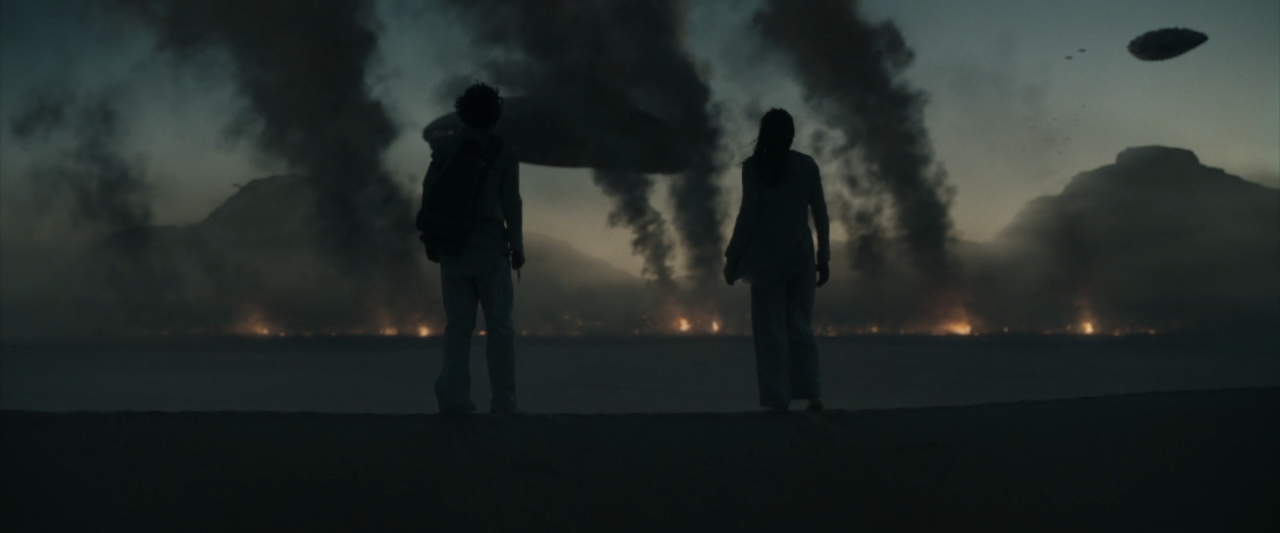
One of many strengths of the film relies on the craftful hand of Greig Fraser, the film’s cinematographer. Fraser allows the audience to get a better look at the fictional world of “DUNE,” and he is responsible for the most memorable scenes of the film.
The establishing shots and visual components of the film are as integral as the plot. These scenes rely heavily on encompassing large areas of the “DUNE” world and keeping the characters at the center but making them appear minuscule and hidden in the shadows. A camera trick meant to accurately portray how the characters, despite their royal titles, are nothing in comparison to their harsh world.
Although DUNE is a heavy epic (the book nearing 900 pages, alone), Villeneuve’s pacing is phenomenal. Every aspect of the plot is important and it carries weight, down to every conversation the characters have with one another. In the 2 hour and 35 minute run time, Villeneuve is able to successfully explain the conflicts, characters, and intricate political turmoil surrounding the fictional world.
Additionally, Hans Zimmer partners with Villeneuve to compliment the myriad of stunning shots with a rhythmic and unique soundtrack. It features the sounds of scraping metal, jarring drums, war horns, Indian bamboo flutes, and rumbles of distorted guitars – and those are only some of the disparate elements that create the award-winning original score.
Another thing the film carries over from the novel is having a large amount of unique and varied factions. A good example is the previously mentioned Bene Gesserit, a secretive organization of women who play a key role in the social and religious politics of the universe. They have a unique ability called The Voice, which allows them to control others by modulating their vocal tones.
In addition, the distinguishable and varying color palette that paints the scenes throughout the film are another exemplary element in the film. For example, Arrakis is a panorama of shades and hues of yellow, beige, orange, and red – a jarring contrast to the initial scenes of the blue-and-green landscape of Caladan, the former fiefdom of House Atreides
Villeneuve has created a large-scale world of convoluted themes and visually stunning sequences. “DUNE” is tantalizing, extraordinary, and a story inexplicably human.