
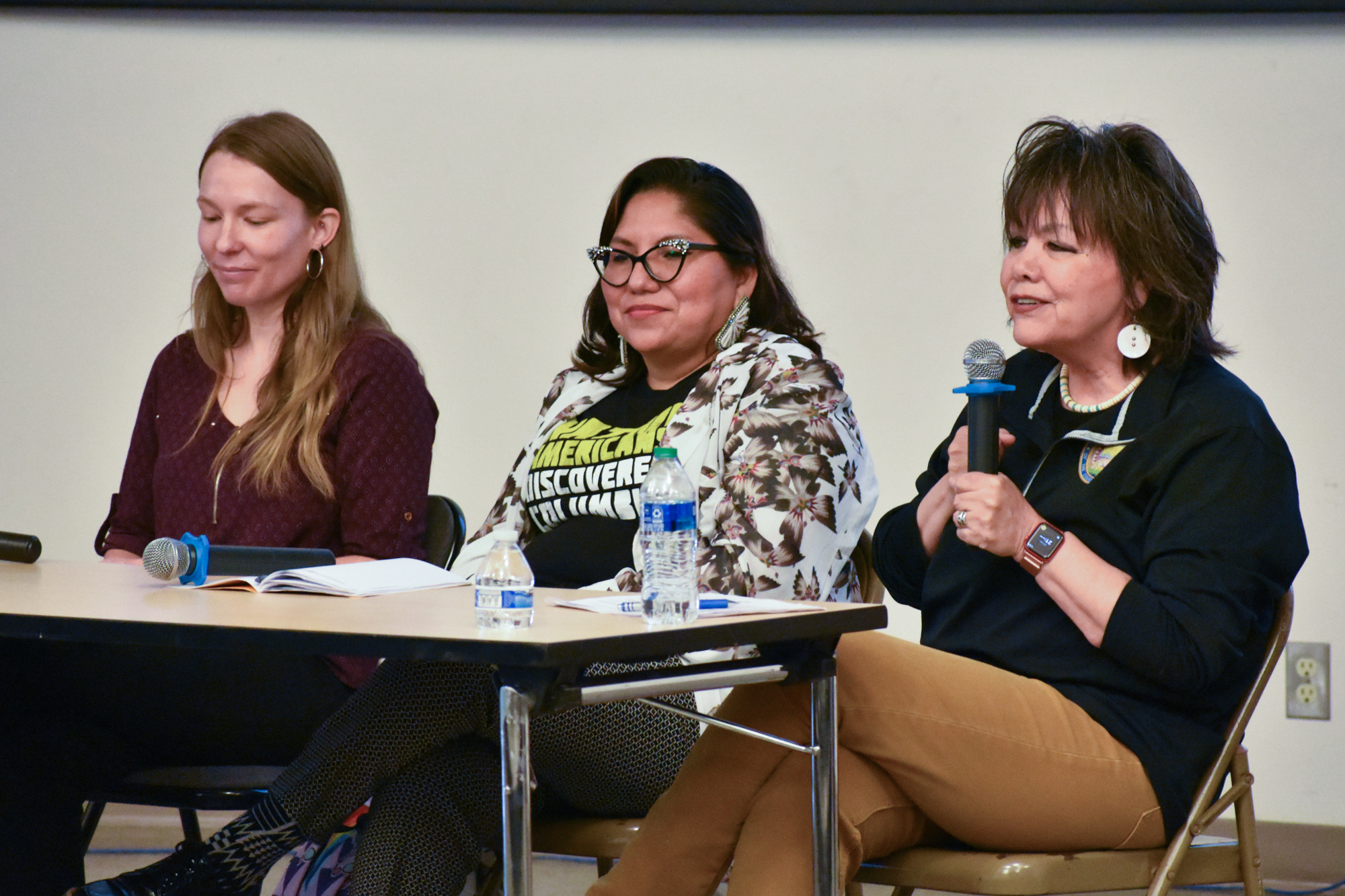
Highline highlights Native-American language and culture to share in cultural appreciation with the community on Indigenous Peoples’ Day.
Highline celebrated Indigenous Peoples’ Day on Monday, October 10, an event that was put together by Highline’s planning committee.

This event was organized by Dr. Emily Lardner, Academic Affairs; Dr. Jamilyn Penn, Student Services; and Josh Gerstman, Institutional Advancement.
The event held Muckleshoot tribe speakers Denise Bill, Wayne Buchanan, and Madrienne White, Native-American artist Preston Singletary, and Panel Members Robin Zape-tah-hol-ah Minthorn, Lynn Palmanteer-Holder, and Kestrel Smith.
The event started off, as many Highline events do, with the land acknowledgement: “We would like to acknowledge the land of Des Moines, located on the original site of the Muckleshoot tribe as well as the Duwamish tribe and many others.’’
Dr. Tanya Powers, Associate Dean for BAS and Workforce Pathways, kicked off the event. Followed by Denise Bill, a Muckleshoot Tribal member. Bill comes from the Dr. Willard Bill, Sr. and Iola Bill-Lobehan family.
“It is important as a Native to state our full name, where we come from, and who we come from,” said Bill.
Bill shared with the community the importance of reclaiming Native languages and education. Bill has had the privilege of working at the Muckleshoot Tribal College for the past 13 years.
“I have four degrees and I didn’t have one Native professor or college book by Natives,’’ said Bill.
Bill has inspired so many people, and Madrain White is one of them, also from the Muckleshoot tribe.
“I never thought I would go past a bachelors. Thank you to mentors like Dr. Denise Bill for encouraging and bringing the Native culture into education,’’ said White.
Wayne Buchanan is a Muckleshoot Tribal member from the Muckleshoot village of Sqwalats, and the Frank Ross and Katherine Daniels Ross Family at Muckleshoot.
Buchanan shared with Highline the land acknowledgements, showing who the land originally belonged to.
The land acknowledgements he listed were Stuck Village, which is just two miles from Highline, then just under that is Forks, which is one of the biggest Muckleshoot villages.
Then there’s Blanket Rock, Marmot Robe which is very significant in Indigenous culture, Tree Point, which is also known as Indian Playground, and Flea House.
Each and every one of the villages hold major significance to the Indigenous Peoples of Washington and Highline recognizes that.
Special guest Oliva Courville who is also a part of the Muckleshoot tribe and descendant of Nooksack and Yakama, did a presentation on their Indigenous language. Showing Highline students and staff the alphabet and dialect of her native language.
“We share this language and dialect with most tribes here in Washington,’’ said Courville.
“I have taught this language (Whulshootseed) to kids and adults for the last 4 years. Our alphabet has 42 characters,” she said.
After that, Preston Singletary, a Tlingit glass artist who is internationally recognized, shared some of his Native artwork. Focusing in on a specific piece called “Journey with Raven” which is a three-piece gallery.
“Usually, white animals in Native culture are seen as special, they hold significance. That is why the raven in my piece is white,” Singletary said.
He also described a few other Native pieces he made over the last decades, like “Belly of the Whale.”
“My accomplishments are not my own but of many peoples,” he said.
E.T. Elwin then introduced the panel team. “Having in-depth conversation with your campus community is important,” Elwin said.
“What we can do as a campus or what we can do differently?” he asked
Kestrel A. Smith, the Department Chair of the American Indian Indigenous Studies program at Wenatchee Valley College-Omak shared her journey.
“I am very excited to be a part of this conversation with the hopes of taking this forward in a cultural way. I am a non-Native person, I cannot speak on behalf of Native peoples, but I can share facts and tools,” Smith said.
Much of her work has focused on how to place Indigenous education within historical and cultural contexts in order to better understand the contemporary Indigenous experience.
“I worked really hard to find my place here in a respectful and meaningful way. The hope is through years of teaching we can work together to create positive changes,” she said.
Lynn Palmanteer-Holder, a Plateau woman and member of 7 of 12 Tribes of the Confederated Tribes of the Colville Reservation, spoke about a few of many obstacles she had to go through to get where she is today.
“We have been forced to learn one way, many of my people were pushed out of educational institutions,” Palmanteer-Holder said.
“We need to find space for diversity, I am happy to see we are opening those pathways and being held accountable,” she said.
“I was raised on the reservation, and it was important to me to keep that voice in the back of my mind, my people at home,” she said.
Robin Zape-tah-hol-ah Minthorn, part of the Kiowa, Umatilla, Nez Perce, Apache, and Assiniboine tribes, was kind enough to tell the community what helped her sustain the work she does for the Indigenous peoples.
“It is the people and the community, the faculty. These relationships help us work on,” Minthorn said.
“We do have our elders that have also been creating this space for us. But I am not doing this work for myself, I do it for the community and my daughter and nephews and nieces,” she said.