
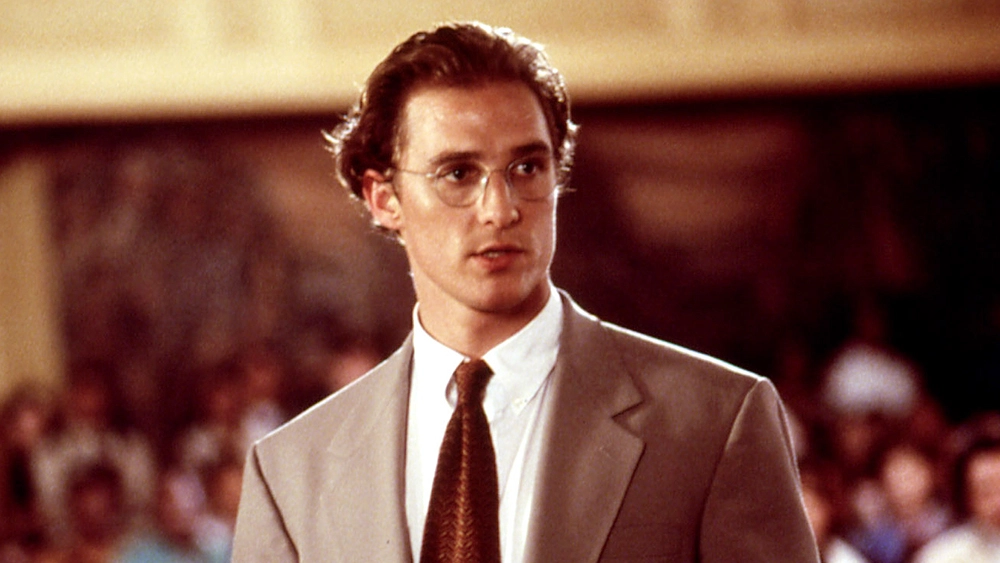
John Grisham’s stories can be just as entertaining as movies as when they’re books.
As you may know, John Grisham is an American novelist who mostly writes about legal dramas. Here are three that might be worth a watch.
A Time to Kill (1996), directed by Joel Schumacher (known for directing, The Lost Boys, Falling Down, and Batman & Robin) is a courtroom drama that deals with race issues in America.
The film is about a black man named Carl Lee Hailey (Samuel L. Jackson), who is on trial for killing two white men for assaulting his 10-year-old daughter. He hires a family friend and relatively unknown lawyer, Jake Brigance (Matther McConaughey), to defend him in a trial that ends up ballooning out of control and having far-reaching consequences.
The film frequently underscores the disenfranchisement of Black Americans compared to White Americans.
Something interesting about the film is how out of hand everything gets. What should be a simple murder case turns into a court case for the heart of the country.

The film also poses the question when, if ever, is it appropriate for citizens to take the law into their own hands? While the film doesn’t necessarily give an answer, it definitely leans toward one answer over another.
The film’s cast is a who’s who of famous actors, with the aforementioned Matthew McConaughey and Samuel L Jackson as the two main leads. Other names include Sandra Bullock, Charles Dutton, Donald Sutherland, Kiefer Sutherland, Chris Cooper, and Kevin Spacey, all of whom slide right into their characters.
What helps is that most of the characters aren’t as two dimensional as they might appear on the surface. For example, even if Jack Brigance is more liberal than most in the town, he still vehemently believes in the death penalty.
Jackson is great in the role with many powerful scenes, as when he goes on a monologue about how he saw the regret, sadness, and fear in one of the men he killed as he was dying. But feels nothing but contempt for the man, and who’s face while dying is one the things that keeps him going, because this memory gives him joy.
Aside from Kevin Spacey being in a prominent role, the film has aged very well. With a story that’s very relevant today and characters that feel real and down to earth, and also morally gray.
A Time to Kill is remembered as a classic for a reason, with great actors, great story, and memorable moments. The film is still worth a watch today.
Runaway Jury (2003) directed by Gary Fleder, is less legal drama and more like a game of chess.
After a terrible shooting, a woman sues the largest gun manufacturers in the country.
To assure their victory the firearm companies hire Rankin Fitch (played by Gene Hackman), who on paper is a jury consultant who helps finding the best jurors for whoever hires him. But in reality he not only helps pick jurors but tries to find every dirty secret for every juror that has the possibility to vote against his client and blackmail them to be on his side.
This simple job is made more complicated when a juror by the name of Nicholas Easter (John Cusack) starts manipulating the jury to do whatever he wants. He along with partner Marlee (Rachel Weisz) secretly tell both the defense and plaintive that they’re willing to swing the jury to whichever side pays them $5 million first.
What’s funny is that despite the film’s plot revolving around a court case, it feels less like a courtroom drama and more like a spy thriller, with two parties secretly going at and trying to outthink each other with the judge and the rest of the jury being none the wiser.
And just like a good spy thriller, the film has a bunch of fun twists and turns throughout that keep the audience on their toes and guessing what will happen next.
Gene Hackman, as the main antagonist, is such an entertaining watch, being so morally compromised and repugnant that he becomes a villain that you love to hate, like when he says, “Trials are too important to be left up to juries.”
John Cusack, while not as over the top as Gene Hackman, is still a great at showing how clever and manipulative he is, like when manipulates events for the jury to not get their lunch during court recess, and sets things up for the jury to get a much better meal at the same fancy restaurant where the judge is eating.
The film is also pretty funny at times, as when Cusack interacts with some of the weird personalities in the jury or how he manipulates them to say the pledge of allegiance after being told to sit in court, with the rest of the courtroom looking confused and going along.
Despite the comedic moments, the film still deals with a morally nuanced discussion about gun control along with heavy scenes and powerful moments that they play seriously.
The plot, while alright for the most part, does stumble sometimes. For instance at one point Cusack has his apartment broken into, and knows that the person who broke in works for Hackman, and that the data he got was incomplete with the complete data still hidden in his apartment. But instead of doing what anyone would do in this situation and move the data to a separate location, he leaves it there. And unsurprisingly Hackman’s guys break in again to get the complete data and eventually find it.
But aside from plot hiccups like that, Runaway Jury is a fun watch that keeps the audience on its toes on who’s playing who.
The Rainmaker (1997) directed by Francis Ford Coppola (famous for directing The Godfather movies and Apocalypse Now) is a hero’s journey in legal drama form.
A new attorney by the name of Rudy Baylor (Matt Damon) ends up taking the case of one Dot Black (Mary Kay Place), a woman who’s suing one of the biggest medical insurance companies who refused to pay for her son’s bone marrow transplant, which could potentially save his life from leukemia.
Unsurprisingly the insurance agency has an army of lawyers at its beck and call, led by Leo F. Drummond (Jon Voight). While Rudy only has support in the form of his partner Deck Shifflet (Danny DeVito), a man who’s technically not a lawyer as he’s failed the bar exam six times, but who knows every trick of the trade.
Similar to how Runaway Jury felt more like a spy thriller than a courtroom drama, The Rainmaker feels like a noire with a gray color palette, lots of rain, narration from the main character, and horns and brass in the soundtrack. Despite that, it works, and the genres mix very well.
Just like the previously mentioned films, this film’s actors all have stand-out performances from the cast, with special mention going to DeVito and Voight.
DeVito’s character is such a charming individual, always ambulance chasing and trying to get clients. He’s morally iffy, while at the same time, he knows how to make the best out of a bad situation.
Voight is such a great pompous lawyer who takes up all the air in the room and who tries to dominate the opposing counsel, and uses almost every dirty trick in the book.
Something that’s fun to notice throughout the film is that Rudy starts becoming a better lawyer as the film goes on, learning little tricks of the trade to his advantage.
A small flaw in the film’s plot is a romance subplot that deals with a lot of heavy concepts. It feels like it could be written out and nothing in the story would change. Because it doesn’t really move the overall plot forward or really change any of the main characters.
The Rainmaker is the noir cross legal drama that works way better than you might think it would.