
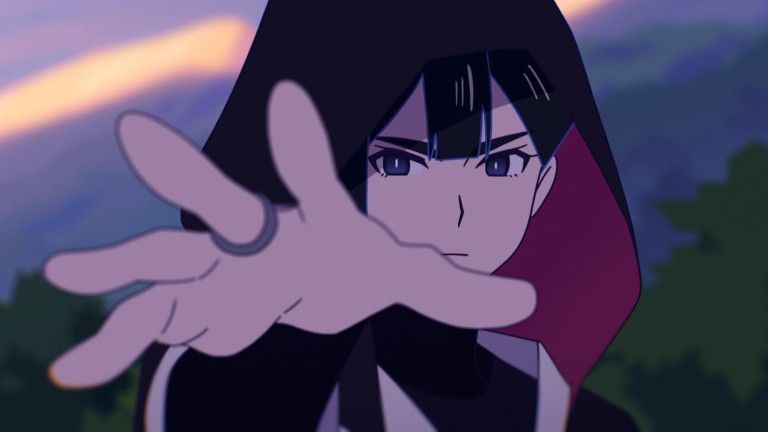
Star Wars: Visions has done the seemingly impossible, and takes Star Wars in a unique and new direction, with mixed results.
After the polarising reception of their sequel trilogy, Disney went to seven different Japanese animation studios and gave them an offer they couldn’t refuse.
Disney loaned them the Star Wars license, and allowed them to make whatever story they want, as long as it took place within the Star Wars universe. Each short was to be non-canonical to the rest of the Star Wars universe.
Nine episodes were produced, all of which are distinctly separate from each other in both tone and story.
The first short simply titled Duel was made by Kamikaze Douga. They’re best known for the openings for the first three parts of Jojo’s Bizarre Adventure.

The plot is that a small farming village is being attacked by bandits who are being led by an unnamed sith (voiced by Lucy Liu).
They are defended by a mysterious Ronin (Brian Tee), who was simply resting in the village when they were being attacked.
The story and animation style is very similar to old samurai films, particularly those made by Akira Kurosawa.
Which is funny, seeing how the original Star Wars was heavily influenced by Kurosawa’s films in particular, making everything come back full circle.
Another call back to old samurai films is that although everything is fully animated, it’s all in black in white and looks grainy, similar to the cameras they used back then.
When the bandits invade, seven mercenaries come out of the shadows and help defend the town, as it turns out the townspeople had hired them to help protect the town.
This plotpoint is similar to the plot of the film Seven Samurai, Kurosawa’s most famous film.
The animation is very well done, everything is fluid and well choreographed. Even if it’s not done by Disney proper, they still have that Disney seal of quality when it comes to animation.
The fight scenes, while a little more over the top than the original and some of the sequel films, aren’t so over the top to be ridiculous.
If anything they’re similar to the prequel films, with a lot more flips and using the environment to their advantage.
Overall the first episode is a strong start to this series.
While the first episode is mostly action, the second episode titled Tatooine Rhapsody is more focused on the character drama.
This episode was made by Studio Colorido, who are best known for Batman: Ninja and Whisker Away.
The story is about Jay (Joseph Gordon-Levitt), an ex-jedi padawan who’s in hiding and decides to start a band with a hutt named Geezer (Bobby Moynihan).
Things aren’t going well for the band, seeing how during every concert they are threatened and attacked by the legendary bounty hunter Boba Fett (played by a returning Temuera Morrison.)
This episode is not very good. The animation is still well done, even if it unintentionally makes Boba Fett (the best bounty hunter in the Star Wars universe) look adorable.
No, the problem is pacing. And this is a problem for a lot of the episodes.
The episode goes by so fast that the story doesn’t have the time to make the viewer care about characters.
Some scenes are not badly acted or animated, but because we barely spend any time with the characters, it’s hard to care when they are in danger.
The idea itself of a jedi going into hiding, and thinking that becoming the lead of a rock band, isn’t a terrible idea if the writing wasn’t too serious. But the story takes itself seriously.
This all culminates in an ending so cheesy, that people with lactose intolerance shouldn’t watch it for their own safety.
The story isn’t offensively bad, but it’s so ridiculous that it becomes impossible for someone to get sucked into the serious drama.
Episode three, The Twins, is similarly ridiculous as the previous episode, but in a good way.
This episode was made by Trigger, best known for the series Kill La Kill
The plot is that a pair of twins are made by the empire using the dark side of the force. A boy named Karre (Neil Patrick Harris) and a girl named Am (Alison Brie). They’re about to test their new super weapon, when suddenly Karre betrays the empire by running off with the weapon’s power source.
This short is full of action, so over the top, that the viewer is forced to raise their hands in the air and just say “screw it” and go along for the ride. The story, while simple, does what it needs to do, to give itself an excuse to have cool action.
Episode three, while not brimming with narrative depth, is still a very fun time to those who just love to watch cool action.
Episode 4, The Village Bride, has elements of the previous three episodes.
This short is animated by Kinema Citrus, who are most well known for making Penguin Highway.
The plot of the episode is that a jedi in hiding named F (Karen Fukuhara) is called in by Valco (an old friend of her master, Cary-Hiroyuki Tagawa) to view an alien people’s strange marriage customs, and their connection with nature.
The plot synopsis might make it seem the episode very boring, and kind of slow.
Thankfully this is circumvented by the plot cleverly getting the audience invested in the relationship between the bride (Haru, played by Nichole Sakura) and the groom (Asu, played by Christopher Sean).
The viewer sees their struggles as they complete the ritual, and the extenuating circumstances around their betrothal. The episode does a good job of getting the audience involved with the story, while informing them about F’s character by seeing her reaction to the ritual and to their culture as a whole.
Another great thing about the episode is an admittedly well-done action scene near the end.
Episode 4 combines the two best parts of the Star Wars franchise, interesting characters and worlds, along with strong action.
The next episode, The Ninth Jedi, is animated and created by Production IG, best known for their work on Attack on Titan.
The plot of the episode is much simpler than the previous ones.
Lah Zhima (Simu Liu) is commissioned by Margrave Juro (Andrew Kishino) to make seven lightsabers for the surviving jedi that Juro contacted. After he’s done making them however, he is attacked by sith troopers. He sends his daughter, Lah Kara (Kimiko Glenn) to deliver them to the margrave. A lot of the episode involves the sith chasing Kara on a speeder.
That’s not to say there are no interesting concepts brought up. There’s an intriguing idea set up, about how the lightsaber’s beam is affected by the wielder.
The episode thankfully ends in a lightsaber duel, because if it didn’t it would have seen weird to have the entire plot revolve around lightsabers, but then not use them. There’s a good twist at the end.
Unfortunately, episode 6, T0-B1, is another low point in the series.This episode is done by Science SARU, best known for Adventure Time and Devilman: Crybaby.
The plot follows T0-B1 (Jaden Waldmen) and his creator Mitaka (Kyle Chandler) trying to restore a dead planet. The episode isn’t bad, it’s just forgettable.
There are moments where it feels like the creatures were making their own completely different story, but halfway through they were told it was a Star Wars story. So they rewrote Star Wars elements into the script.
It feels a lot more like an Astro Boy story, which doesn’t help when both of the main characters are robots that look like young boys, with similar designs.
The story is clearly meant for a younger audience than the previous few episodes, which is fine, but it becomes tonally jaring when all the episodes are watched back to back.
Episode 7, The Elder, is lighter on the plot than some previous episodes, but makes up for that with intensity. This episode was animated by Trigger, who also animated the third episode.
Jedi master Tajin Crosser (David Harbour) and his padawan Dan G’vash (Jordan Fisher) look into rumours of an ancient sith hiding out on a backwater planet.
The episode is very good at building up tension, as the planet is creepy, it’s pouring rain, and the inhabitants are similarly off putting.
When the sith master (James Hong) does show up he’s also very off putting, with how seemingly cheerful he is.
The main problem is that the episode is a bit too short for its own good. The story is very to the point, they show up, investigate for a sith presence, fight him, and the episode ends.
Although the ending does raise a very interesting idea. Without spoiling the ending, it raises points and the idea of the power of the sith and of the Sith master himself.
Episode 8, Lop & Ocho, is another episode that is half story and action.
The episode was animated by Geno Studio, most famous for making Golden Kamuy.
The plot of this episode follows a family being torn apart about what to do about the future of their clan, more specifically should they ally with the empire or should they fight them.
The father, Yasaburo (Paul Nakauchi), thinks they should fight the empire. His daughter, Ocho (Hiromi Dames), thinks they should ally with the empire for the good of the clan.
And Yasaburo’s adopted daughter, Lop (Anna Cathart), is caught in the middle, just trying to keep the family together.
The story does a very good job at showing that while the family can’t stand to be in the same room, they still love each other deep down.
The fight scenes between the family are well choreographed and animated, while still portraying the characters’ emotions. The fights between Yasaburo and Ocho are appropriately filled with anger. Whenever Lop fights, it’s filled with sadness, and regret.
The story is sort of a Shakespearean tragedy. The audience knows it’s not going to end.
Unfortunately, the series doesn’t end on the highest note.
Episode nine, Akakiri, was animated by Science SARU, who previously directed episode 6, T0-B1.
The plot is about a jedi named Tsubaki (Henry Golding) arriving on a planet to help save his secret lover and princess of the planet Misa (Jamie Chung.)
The episode has a pretty interesting premise. The problem is the story, most of which involves the leads just riding their horses and Misa telling Tsubaki that he shouldn’t have come.
Because of this, even though the episode isn’t the longest of the shorts, it feels like it is.
Nor does the episode doesn’t feel like it has an ending. It just stops, like they ran out of animation budget.
The episode isn’t all bad however. Once again, whenever there’s action, it’s well animated and choreographed.
There are some admittedly funny moments with the two guides, Kamahachi (Keone Young) and Sensuu (George Takei). The two of them are cowardly and superstitious, which can lead to some funny interactions with the very stoic and serious Tsubaki.
Even though not every episode lives up to the Star Wars bar of quality, Star Wars: Visions is an interesting watch. Most of the episodes at least have some very interesting concepts and well-animated action.