
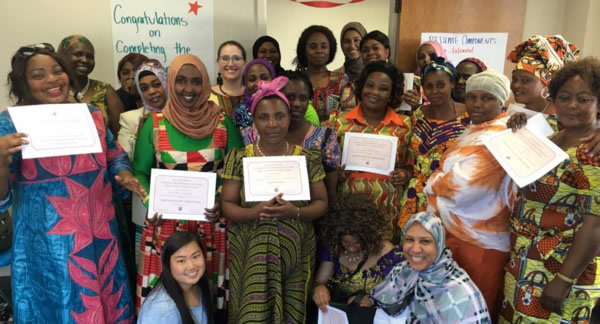
Despite the pandemic, the Mother Africa organization is still open and ready to help African immigrants and refugees.
Mother Africa is a non-profit organization based in Kent. It was founded by Executive Director Risho Sapano in 2004 to help others coming to the country who need access to resources.
Kent is one of the most diverse cities in the country, with an immigrant population of over 30 percent, according to the U.S Census Bureau.
“I founded this organization to meet the community needs and provide opportunities, especially for women to voice their concerns,” said Sapano. “I wanted to create a platform where their voices can be heard and be empowered to be an advocate for themselves and their families.”
Those who are being helped by this organization tend to not have access to the proper resources.
“Historically our communities are underserved by pretty much all sectors, we connect them to existing resources because they aren’t usually aware of what is available for them,” said Sapano.
Our goal is to bring the information to these communities and help them be familiar with providers from the educational field, the health field, you name it, said Sapano, and we have multiple programs to meet different needs of our community.
They also hold sessions to educate others on college readiness, specifically those who are first generation college students in the U.S.
“We recently had an educational session about college readiness for parents and their kids who were ready to go to college but had no idea where to start, how to access scholarships, or how to apply for financial aid,” said Sapano.
They have also needed to adapt to the restrictions that were put in place due to COVID.
“Our offices have been closed since March, so we aren’t able to meet with clients and groups that we used to, everything has been shifted to online,” said Sapano. “At the beginning it was a struggle because some of our clients aren’t familiar with virtual communications.”
To overcome this issue the Mother Africa organization created a digital learning center.
“We created a digital learning center, and anyone who didn’t know how to operate zoom or anything like that were referred to the virtual center,” said Sapano. “One of us who spoke the language of the client will help them understand how to work the virtual platform. This will help us to bridge the digital literacy gap.”
More information about their organization can be found at: https://www.motherafrica.org