
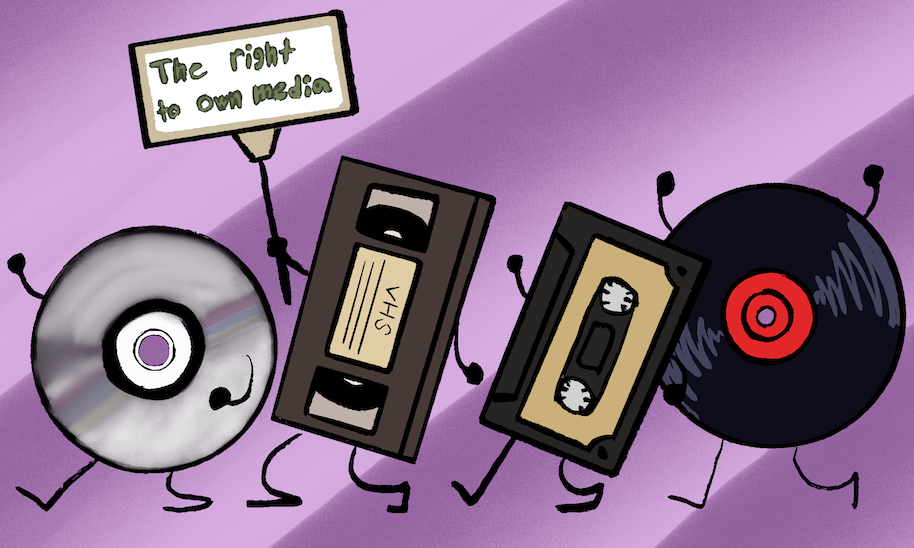
In the current days of the streaming era, many people don’t keep physical media like music and movies, since those are seconds away on their phone instead. Slightly older people have developed a superiority complex because some younger folk don’t know what a cassette tape is.
Yet beneath the jokes and generational teasing lies a more serious conversation about what is lost when entertainment exists only as a digital file or a temporary subscription. Physical media is more than nostalgia. It represents ownership, preservation, and a more personal connection to art that streaming services often fail to replicate.
For many people growing up today, entertainment is built around convenience. What feels like nearly every song ever recorded is available with a search bar, while movies and television shows rotate endlessly across streaming platforms. The system is fast, cheap, and accessible, but it also comes with limitations that are easy to ignore.
Consumers rarely own the content they pay for. Instead, they are renting access through monthly subscriptions. For example, 83% of U.S. adults are subscribed to a streaming service. Albums disappear because of licensing disputes, films are removed without warning, and entire shows can vanish overnight depending on corporate decisions. Physical media avoids that uncertainty. A vinyl record, CD, VHS tape, DVD, or Blu-ray belongs entirely to the owner and cannot suddenly disappear because a contract expired.
Physical media also plays a major role in preserving art and culture. In the streaming age, media companies can quietly alter or erase content without much public attention. Certain songs may be edited, movie scenes changed, or older works removed entirely because they are no longer considered profitable.
Physical copies preserve entertainment in its original form. Film historians, collectors, and archivists often rely on physical releases to maintain access to versions of media that may no longer exist digitally. Without physical preservation, pieces of cultural history risk becoming inaccessible to future generations.

Isaac Stewart/THUNDERWORD
Beyond preservation, physical media creates a more intentional experience with entertainment. Streaming encourages constant skipping and passive consumption. People jump between songs after a few seconds or scroll endlessly through movie catalogs without choosing anything at all.
Physical formats require more commitment. Playing a record or inserting a DVD becomes an activity rather than background noise. Many music fans argue that listening to a full album on vinyl or CD allows them to appreciate the artist’s vision more completely instead of consuming songs individually through playlists and algorithms. Alinea Kirshenbaum, an avid user of physical media, said, “I love listening to vinyls and CDs because artists often curate their tracklists in a way that sets a mood or tells a story. By using physical media, I get to be immersed in that storytelling in the way that the artist intended, and even hold that artwork in my very hands.”
There is also an emotional value tied to collecting physical media that digital libraries cannot fully replace. Shelves lined with records, books, or films often reflect someone’s personality and interests in a visible way. Album covers, lyric booklets, posters, and special packaging become part of the artistic experience itself. Digital media prioritizes efficiency, but physical media offers tangibility.
Holding a favorite album or movie in your hands can create memories associated with when it was bought, who recommended it, or the period of life connected to it.
At the same time, physical media is not perfect. Records can be expensive, DVDs take up space, and not everyone has the money or storage to maintain large collections. Streaming has undeniably made entertainment more accessible for millions of people.
The issue is not that digital media exists, but that physical media is slowly being treated as unnecessary or obsolete. In reality, the two can coexist. Streaming provides convenience while physical media provides permanence.
As technology continues to evolve, the debate around physical media reflects a larger question about ownership in the digital age. Whether it is music, movies, books, or even video games, more entertainment now exists behind subscriptions and cloud servers controlled by corporations.
Physical media offers an alternative — one where consumers still have direct access to the art they love regardless of internet outages, licensing agreements, or platform changes. In a world where nearly everything has become temporary and disposable, there is something increasingly valuable about being able to hold onto the things that matter.