
How a Persian Literary Circle Keeps Language and Culture Alive
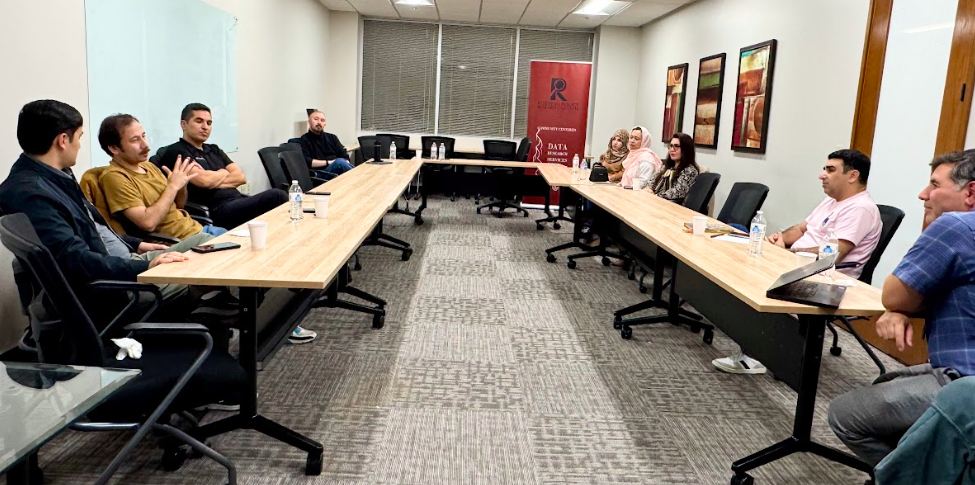
On the second Friday evening of every month, a room in south King County fills with the sounds of poetry, music, and animated conversation in Persian. Tea is poured. Books are passed from hand to hand. Someone begins to read a poem aloud, and the room grows quiet.

Sher Mehryar/THUNDERWORD
This is the Mother Tongue Literary Circle, a grassroots initiative formed last November by Persian-speaking immigrants from Afghanistan. What began as a simple idea — to gather and read together — has quickly grown into a vibrant space where language, culture, and identity are nurtured far from home.
The circle’s mission is straightforward yet deeply meaningful: to preserve and celebrate Persian language and literature in exile. For many members, the gatherings are more than social events. They are a way to reconnect with their roots, share stories shaped by migration, and ensure that younger generations inherit not only a language, but a cultural legacy.
“Each session is dedicated to a well-known Persian poet or novelist. Meetings typically open with a presentation by a member who has volunteered to introduce that writer’s life and work,” Reza Sakhi, the co-founder of the circle said. “The presenter offers context — historical background, major themes, stylistic features — before reading selected poems or excerpts aloud. Discussion follows, often lively and reflective, as participants respond to the text and draw connections to their own experiences.”
Organizers hope to expand the circle’s reach in the future by inviting living authors to join virtually or send recorded messages. Between meetings, members stay connected through a public Facebook group, where they share photos, videos, and reflections from each gathering.

Sher Mehryar/THUNDERWORD
“These sessions are informal literary gatherings where everyone is invited to participate — by reciting poetry, reading short stories, engaging in discussion, and sharing their reflections and critiques,” Reza said.
But the circle is not only about literary appreciation. At a session on Feb. 12, members discussed the life and poetry of Nadia Anjoman, a young poet from Herat who was killed by her husband in 2005. Her work, written under Taliban rule, explored themes of confinement and longing for freedom. The discussion soon turned to the ongoing struggles of women in Afghanistan and the ways patriarchal norms can persist even within immigrant communities abroad, including here in Washington state.
“The first session of the circle was held in November, and attendance has steadily grown. Members range from students and professionals to parents and scholars. For immigrants, language often shifts quickly in diaspora,” Amu Urozgani, another co-founder of the circle, explained. “English becomes dominant in schools and workplaces. Over time, the mother tongue risks being reduced to fragmented phrases or lost entirely in the next generations. The literary circle seeks to counter that erosion by making Persian a living, shared experience.”

Ehsan Shayegan
As someone who immigrated at age 26 and worked as a journalist and Farsi copyeditor, I have felt firsthand how language becomes something deeper in exile. It is memory. It is belonging. It is a bridge to childhood, to family stories, to histories that cannot always be translated.
In the context of Afghanistan, this responsibility feels even stronger. Persian — often officially labeled “Dari” for political reasons — has experienced periods of marginalization and cultural suppression. Preserving the language thus becomes, in its own quiet way, an act of resilience. The term “Dari” can be understood as a state-driven designation applied to Persian, shaped by historical and governmental efforts to redefine linguistic identity.
Persian is one of the world’s richest literary languages, with a poetic tradition spanning more than a thousand years. It is spoken primarily in Iran, Afghanistan, and Tajikistan, yet for many in the diaspora, it now survives in private spaces — around dinner tables, at weddings, in community gatherings, and in circles like this one.