
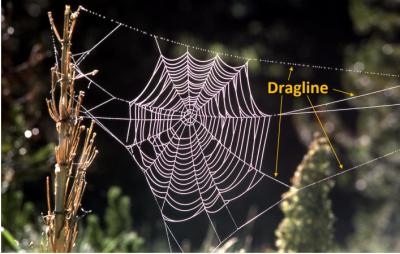
Spider silk has always been known to be one of the strongest organic materials. Fortunately, scientists have found out why. Tiny, yet complicated chemical attractions allow spider silk to remain flexible while still being extremely strong.
The strongest spider silk is spider dragline silk. It forms the frame of the spiderweb, and needs to be able to hold the weight of the spider. It is stronger than steel (by weight), and tougher than Kevlar (a material used in the making of bulletproof vests).
“The potential applications are vast – lightweight protective clothing, airplane components, biodegradable medical implants, and even soft robotics could benefit from fibers engineered using these natural principles,” said Chris Lorenz, the Professor of Computational Materials Science at King’s College London, and a researcher in spider silk study.
They found that spider silk is made up of proteins, built from long chains of amino acids. The proteins are kept in a dense liquid form in the spider’s silk gland, known as the “silk dope.”
When a spider spins its web, the amino acids arginine and tyrosine interact to trigger the initial clustering of the proteins. They act like reversible stickers, allowing connections to be broken and remade, helping the proteins condense and organize correctly. Moreover, these amino acids continue to interact during solidification, allowing the proteins to form a structure that both allows for strength and flexibility with little to no error.

JMOL
“The way silk proteins undergo phase separation and then form β-sheet–rich structures mirrors mechanisms we see in neurodegenerative diseases such as Alzheimer’s,” said Gregory Holland, a San Diego State University professor of physical and analytical chemistry. “Studying silk gives us a clean, evolutionarily-optimized system to understand how phase separation and β-sheet formation can be controlled.”
β-sheet–rich structures are secondary structures of proteins, consisting of beta strands linked together laterally by hydrogen bonds. They form a zig-zag and twisted pleated sheet configurations.
These unique structures form dense crystalline and hydrophobic (water repellent) links within the fiber. These precise molecular steps to understand the final steps of the phase change have been unknown until now.
Stronger than steel and tougher than Kevlar, spider silk continues to be studied for its unique properties and only the future will tell what endless possible applications it can be used for.