
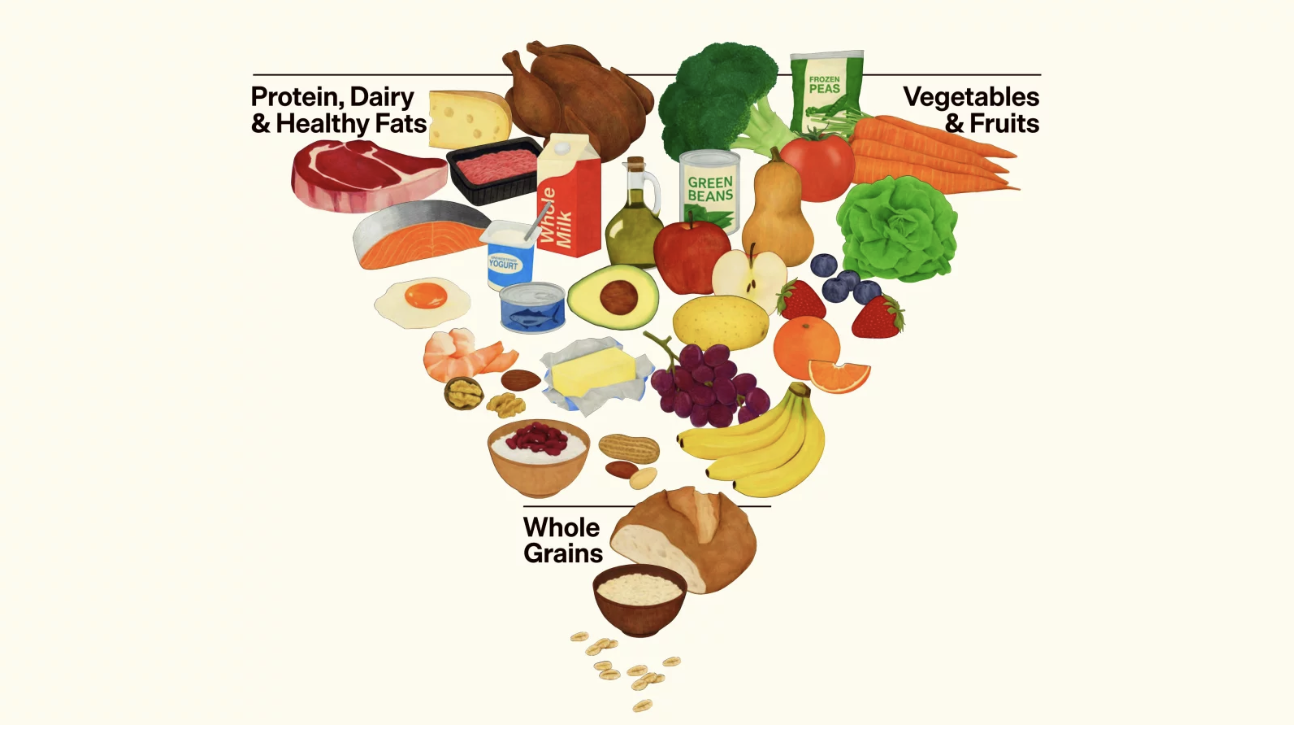
One of Robert F. Kennedy Jr.’s (RFK) most recent controversial public statements regarding public health is the new emphasis on meat and dairy on the food pyramid. While many experts agree with the decision to encourage people to consume fewer processed foods and added sugars, the emphasis on sources of saturated fats is raising alarm.
While RFK intended for this new pyramid to showcase the importance of avoiding “highly processed foods,” many nutrition experts are concerned that foods that are known to be significant sources of saturated fat are featured on the very top.
Christopher Gardner, a nutrition expert at Stanford, said that this new pyramid “does go against decades and decades of evidence and research” regarding the emphasis on saturated fat sources.
It is important to note that dairy and meat aren’t necessarily bad, and they can even be components of a healthy diet, but the concern experts have with this pyramid is just how featured meat and dairy products are, being the largest images on the pyramid at the top, even ahead of plant-based sources of fat and protein such as nuts.
Dr. Patti Anderson, who is a policy director at the Johns Hopkins Center for a Livable Future, released a statement, saying, “Plant-based proteins like beans, peas, and lentils have fiber, which we know is associated with satiety and health benefits. … In addition, beef, pork, and dairy production use vastly more water, land, and energy than plant foods. A plant-forward diet is better for both health and the environment, and it’s a shame they chose to de-emphasize that.”

myplate.gov
Historically, the food pyramid was used to illustrate what foods people should eat sparingly at the top, such as oils and fats, and what foods should be consumed more as the base of the pyramid, such as grains. The pyramid system was retired in 2011 in favor of the MyPlate visual that was introduced by Michelle Obama. On Jan. 7, the pyramid made a comeback, but now it’s upside down and meat and dairy products are featured as highly recommended, and grains are on the bottom.
There is also some concern with the new alcohol consumption recommendations. This new set of guidelines removes the previous guideline of no more than one drink a day for women and two drinks a day for men, and now recommends that individuals should “consume less alcohol for better health.”
Dr. Johannes Thrul, an associated pressor at the Johns Hopkins Bloomberg School of Public Health, mentioned in a news release that, “Guidelines should help people understand that gradient, not obscure it,” when referring to the fact that the risks of alcohol consumption increase with the amount consumed.
Overall, while some components of RFK’s new guidelines are approved by experts, others are raising concerns, leaving the general public conflicted on if this new set of guidelines is beneficial or not.