
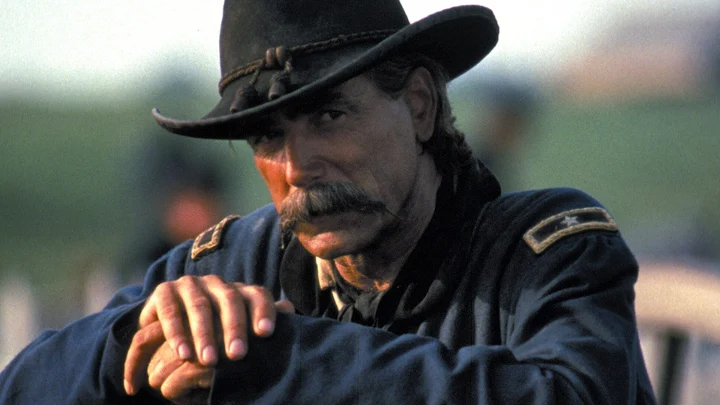
The 4-hour and 30-minute behemoth known as Gettysburg is a historical epic that’ll never be made again. Despite that it’s still a bit too bloated for its own good.
Gettysburg (released 1993 and directed by Ron Maxwell) chronicles the three-day fighting outside of the town of Gettysburg, Penn. during the American Civil War in 1863.
The film focuses on both Union and Confederate points of view without taking a side. Both sides have mostly equal screen time, with Confederates getting a bit more than the Union.
What helps with this bipartisan angle is that the film has a main cast of characters on both sides of the war.

For the Confederate side there is General Robert E. Lee (Martin Sheen), Lt. General James Longstreet (Tom Berenger), Brigadier General Lewis A. Armistead (Richard Jordan), and Major General George Pickett (Stephan Lang).
For the Union side there is Col. Joshua Lawrence Chamberlain (Jeff Daniels), Lt. Thomas Chamberlain (C. Thomas Howell), Sargeant “Buster” Kilrain (Kevin Conway), and Brigadier General John Buford (Sam Elliot).
The film is broken up by the three days of fighting.
The first day covers Buford and his cavalry getting into a skirmish with two of the Confederates brigades, with the skirmish roping in the large armies from both sides, with Buford having the height advantage but the Confederates having the numbers.
The first day isn’t too heavy on action, mostly focusing on the build-up to the battle. The problem comes from the fact that there was a lot more fighting than what’s shown in film.
The first day does a great job of introducing the characters and their personalities along with most of their relationship with each other.
After the first day Buford simply vanishes from the rest of the movie. I understand that in real life he didn’t do much past the first day so not showing him much afterward makes sense. It’s just the beginning of the film focuses so much on him that when he vanishes off the face of the earth it comes off as jarring and makes a person wonder, why even focus so hard on him anyway?
The second day is the best part of the film by far. The film focuses mainly on the Chamberlain brothers and “Buster” Kilrain and the rest of the regiment, holding off four Confederate regiments on Little Round Top.
This part is the best part because it simply focuses on one regiment, with characters you’ve come to know and care about, with action that is tense and exciting. It shows that the battle of Little Roundtop could have gone either way.
Day Three focuses on Pickett’s charge, with Confederate troops charging head on into the reinforced Union line, with the charge being led by General Armistead.
The part of the film is fine if a little slow, as it feels like every other scene of a person soliloquizing about their cause.
This part focuses more on how much the Civil War sucked so much for everyone involved as it was figuratively and sometimes literally brother vs. brother.
This point is primarily driven home with the characters of Lewis Armistead and Major General Winfield Hancock (played by Brian Mallon).
The night before Picketts’s charge, Armistead confides in Longstreet that he doesn’t want to lead the charge on the Union line, as he knows that Hancock is in charge of the particular area where he’s charging. But before the war started, the two of them were actually the best of friends, and Armistead doesn’t think he has it in him to hurt his best friend.
As stated earlier the film is four and a half hours long. With that in mind, one might think that things are evenly spaced out and that every character is well fleshed out.
Wrong. The script is full of so many characters that it’s forced to fly by most of them and focus on a few. That’s a fine idea until the characters who we haven’t been focusing too much on start dying, and the movie tries to tell the audience “feel bad now.”
When this happens, the audience is more confused why they should feel bad as they probably don’t remember who that character was.
The film also feels disjointed all over the place. When things are in the heat of battle, it is intense. There are great character moments, and with acting that helps ground the character from near mythical status.
But in between those moments are large sections of people just sitting down and talking about how much this war sucks or another speech about how righteous their cause is. These scenes tend to stop the film to a screeching halt and you’re just waiting for the film to start up again.
Fun fact, this film was originally going to be a mini-series, however no network would sign off on it, so director Ron Maxwell and financer Ted Turner (yes, that Ted Turner) just decided to make it a movie.
However, I get the impression that they didn’t change the script too much as this script would probably work much better as a six-hour miniseries, giving much more character and time to explain to the audience what’s going on.
But a script that works well into a miniseries doesn’t mean it would work well for a film. They probably should have narrowed down the scope of the film.
In fact it would probably have been better to focus on a single regiment.
That way the script would be much tighter, so the film wouldn’t be bouncing all over the place like a ping pong ball. You can also focus on a shorter cast of characters all of whom could be fleshed out for the story.
But despite all of the film’s flaws, and it has its fair share of them, one can’t help but respect it.
It’s clear from researching behind the scene information that the film wasn’t made to make money, but because the people who made it were truly passionate about what they were making. You don’t see those very often nowadays.
To give an example, most of the extras for both the Union and Confederate army were actual civil war reenactors, and not only did they barely pay them (if at all), they brought their own uniforms, their own muskets and rifles, heck one of them brought their own cannon, why? Because they cared that deeply about historical accuracy being put on the big screen.
Though this can lead to the unintentional fact that a person can tell that they aren’t professional stunt actors or extras as they are more awkward while on screen. And some extras are a bit pudgy and noticeably older than Robert E. Lee, the general in charge of the entire Confederate Army.
This is especially true when you compare it to some of the heavy hitter actors.
Speaking of actors, both sides have great performances by great actors with great chemistry with each other.
On the Union Side, Daniels and Howell do a great job acting believably as the Chamberlain brothers, as sometimes they get on each other’s nerves but still deeply care for each other. A great example is that throughout the film Thomas Chamberlain, the younger brother and lower in rank, keeps calling his older brother “Lawrence,” with Joshua Chamberlain, the older brother and higher in rank always responding with “don’t call me Lawrence” as he doesn’t want his men to think he’s showing favoritism.
Daniels specifically does a fantastic job as Joshua Lawrence Chamberlain, effortlessly getting across his kindness, ingenuity, and inexperience.
On the Confederate side special mention must go to Martin Sheen as Robert E Lee and Tom Berenger as James Longstreet. You understand instantly the respect both men have for each other and why their own men respect them so much.
Special mention goes to Sheen. He does a great job portraying the quiet subdued shrewdness of Lee along with moments where his patience is tested as he loses his cool for a few moments, showing off Sheen’s amazing acting chops.
Gettysburg, despite having its fair share of flaws, is looked back upon as a classic for a good reason. And most importantly it’s the type film that may never be made again.